
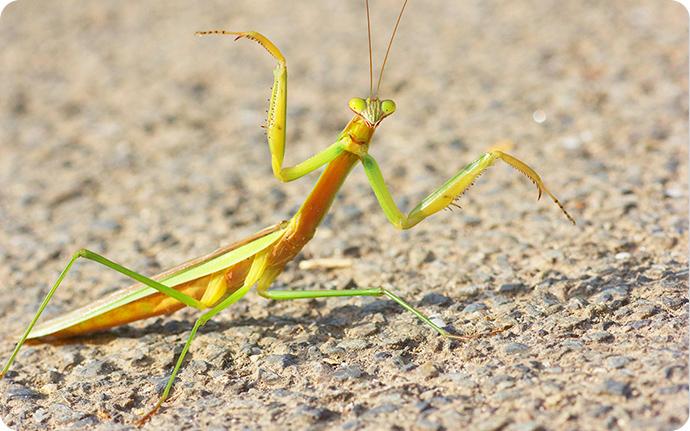
If you find a mantis in a Missouri garden, old field, or on a porch light, it is most likely one of three species. The Missouri Department of Conservation lists three mantid species as the most common in the state: the native Carolina mantis (Stagmomantis carolina), the nonnative Chinese mantis (Tenodera sinensis), and the nonnative European mantis (Mantis religiosa). All three can be found statewide. Missouri Department of ConservationMissouri Department of Conservation
The Chinese mantis is the one most people encounter. It is also the largest, which is why so many Missouri sightings involve a big tan insect four inches long clinging to a window screen in September.
Telling the three apart takes more than color. Every one of them can be green, tan, or something in between, so color on its own will lead you in circles. The reliable clues are size, the pattern on the face, how far the wings reach on a female, a black spot under the forelegs, and — often easiest of all — the shape of the egg case.
Quick comparison
| Carolina mantis | Chinese mantis | European mantis | |
|---|---|---|---|
| Status in Missouri | Native | Nonnative, very common | Nonnative, least often seen |
| Adult length | About 2–2¼ in. | 2¼–4 in. or more | About 2–3 in. |
| Face | Long, narrow shield, no stripes | Squarish shield with vertical stripes | — |
| Best single clue | Female’s short wings | Large size + striped face | Black dot under the foreleg base |
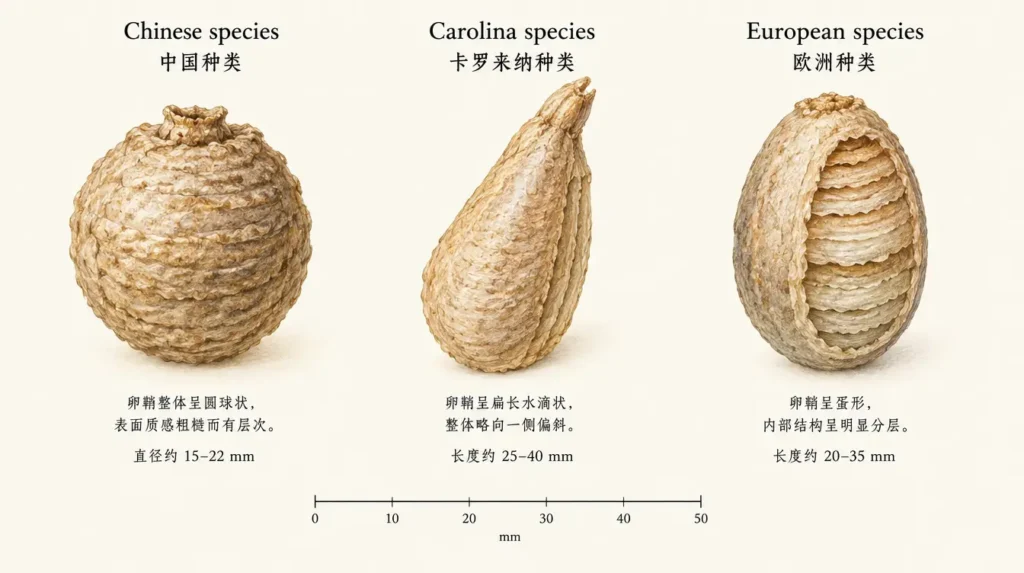
| Egg case | Flattened, elongated teardrop | Round, like a toasted marshmallow | Egg-shaped, distinctly layered |
Carolina mantis (Stagmomantis carolina) — Missouri’s native species
This is the smaller of the three and the one native to North America. Adults reach about 2 to 2¼ inches, and the color ranges from pale green to tan or mottled gray.
Two structural clues are more useful than color:
- Wing length on females. Female Carolina mantises are essentially flightless. Their folded wings usually reach only about three-quarters of the way down the body rather than to the tip of the abdomen. Males have longer wings that may extend past the abdomen tip, and they sometimes fly to lights at night. A stout adult female with obviously short wings, in Missouri, is a strong Carolina mantis candidate.
- The facial shield. This is the flat plate between and just below the eyes, in front of the antennae. In Stagmomantis, it is long and narrow and lacks stripes.
There is also a dark patch on the outer pair of wings, and the combined length of the head and thorax is roughly equal to the length of the abdomen.
Chinese mantis (Tenodera sinensis) — the big one
This is the species Missourians encounter most often. Adults run 2¼ to 4 inches or more, which makes size alone a useful first filter: a mantis clearly longer than about 2½ inches in Missouri is very unlikely to be a Carolina mantis.Color is usually tan or pale green, and tan individuals often show a thin green stripe along the side — that stripe is the border of the front wing. The facial shield is fairly square and carries vertical stripes, which separates it cleanly from the plain, narrow face of the Carolina mantis. Chinese mantises fly well and are often drawn to lights after dark.The species is native to east Asia and was introduced to North America accidentally in 1896, then later imported deliberately in the hope that it would control insect pests Mantids (Mantises) | Missouri Department of Conservation +2
.
European mantis (Mantis religiosa) — the one to check the forelegs on
This species is nonnative and probably the least encountered of the three in Missouri. Adults are about 2 to 3 inches long and may be yellowish green, cream, or tan.The diagnostic feature is a round black dot on the underside of the basal joint (the coxa) of each foreleg, sometimes with a pale center. The spot can be hard to see when the mantis holds its forelegs folded together, so you may need a photo from below or a patient view from the side.
Extension guides often describe it as a bull’s-eye marking on the inside of the foreleg.
It is native to Europe and was introduced to North America accidentally in 1899, with later intentional releases for pest control. People still occasionally introduce them in Missouri.
Egg cases are often the easiest identification
A mantis egg case is called an ootheca (plural: oothecae). The three main Missouri species can be told apart by ootheca shape — useful, because the egg cases stay on twigs all winter while the adults are long gone.
- Chinese mantis: round, about as long as wide, roughly Ping-Pong-ball size, tan, with the look of a toasted marshmallow. Usually attached to twigs of shrubs and small trees.
- Carolina mantis: somewhat flattened and elongated, teardrop-shaped.
- European mantis: more egg-shaped, with a distinctly layered structure.
Females lay their eggs in late summer onto twigs, bark, or other structure. The eggs are extruded in a frothy material that hardens into a tough case with the texture of dry, crusty foam, and the eggs overwinter inside it.
If you find an ootheca on a shrub you are about to prune, it is worth deciding what to do with it before you cut. Our guide on moving a praying mantis egg case covers the considerations.
Nymphs are much harder to identify
Immature mantises look like small adults without fully developed wings, and very young ones often hold the tip of the abdomen curled upward. Because wing length is one of the better adult clues, and nymphs simply do not have full wings yet, species identification from a nymph photo is often uncertain. Missouri Department of Conservation
If you are looking at something small, start with our guide to small and immature mantis identification rather than trying to force a species name onto it. In many cases the honest answer is “a mantis nymph, species undetermined.”
Missouri insects that get mistaken for mantises
Several other Missouri insects bring people to a mantis identification page:
- Mantidflies. These are small, delicate insects with veined wings, but the front half looks like a mantid, complete with raptorial forelegs. The brown wasp mantidfly is banded with yellow, brown, rust, or black and mimics a wasp. Adults are often attracted to lights at night. They are not mantises, and they are much smaller.
- Walkingsticks. Long, thin, and slow-moving, but without the enlarged grasping forelegs.
- Grasshoppers and katydids. Sometimes reported as “green mantises,” but the hind legs are built for jumping and the front legs are ordinary walking legs.
The forelegs are the quickest check. A mantis has large, powerful, spined raptorial forelegs, usually held folded and raised.
When and where to look in Missouri
Most mantises live about a year. They hatch in spring, spend the growing season feeding and molting, mate and lay eggs in late summer, and die when freezing weather arrives. The egg cases carry the population through winter.
That gives Missouri a fairly predictable pattern. Tiny nymphs appear in spring, are easy to overlook through early summer, and the large, obvious adults turn up from late summer into fall — which is exactly when most sighting questions arrive. After the first hard freezes, the oothecae are what is left to find.
For habitat, look in open, heavily vegetated places: gardens, old fields and pastures, thickets, woodland borders — anywhere a mix of plants attracts a wide variety of insects. For more on habitat generally, see where praying mantises live.
Native versus nonnative: what is known, and what isn’t
This is the part of the Missouri mantis story that deserves care rather than a slogan.
The Chinese mantis eats a wide range of insects, including smaller native mantids, and it may be playing a role in the decline of Carolina mantis populations in some regions. Because it has been widespread in the United States for so long, its overall ecological effect on native ecosystems is difficult to determine. That is a genuinely open question, not a settled one, and it is worth resisting both the “harmless garden helper” framing and the “ecological disaster” framing.
Mantises are also generalist ambush predators, not targeted pest-control agents. They eat pest insects, but they also eat other insect predators, pollinators, and butterflies. Nonnative mantis egg cases are widely sold for pest control, and their usefulness for that purpose is questionable given how indiscriminate the diet is. University extension guidance on buying and releasing mantises reaches a similar conclusion, noting they are as likely to take a butterfly or bumblebee as a pest caterpillar. If garden ecology is your main question, see are praying mantises good for gardens.
You may also read that large mantises catch hummingbirds. This does happen, but it is exceptional rather than routine. A 2017 global review documented 147 recorded incidents of mantises capturing small birds across 13 countries, with more than 70 percent of reports coming from the United States, frequently at hummingbird feeders or hummingbird-pollinated plants in gardens. MDC notes that large female Chinese mantises have occasionally been recorded eating small vertebrates, but treats these as relatively rare events that do not appear to affect those populations meaningfully. Ordinary mantis prey is arthropods.
If you still aren’t sure
Photograph these four things before the mantis moves on:
- The whole insect from the side, with something for scale
- The face, straight on, showing the shield between the eyes
- The forelegs, ideally from underneath
- Any egg case, in place on its twig
Then take it to people who look at Missouri insects for a living. The Missouri Department of Conservation’s field guide entry for mantids is the appropriate starting reference for this state, and MDC regional offices and University of Missouri Extension staff handle identification questions from the public. For questions about collecting, keeping, or moving any wild insect, ask MDC directly rather than relying on a general-interest article.
Our broader field guide to identifying a praying mantis covers the same method in more detail, and the Chinese mantis species profile goes deeper on the species you are statistically most likely to have found.
Frequently asked questions
How many praying mantis species live in Missouri?
MDC treats three species as the most common in the state: Carolina, Chinese, and European. Other mantis species are established elsewhere in the United States, and observation databases occasionally turn up unexpected records anywhere, so an unusual specimen is worth reporting rather than forcing into one of the three.
Which Missouri mantis is native?
The Carolina mantis. The Chinese and European mantises are both nonnative, introduced to North America in 1896 and 1899 respectively.
Why is the mantis at my porch light so large?
It is most likely an adult Chinese mantis. They fly well and are frequently attracted to lights at night, and they are the largest of the three. Male Carolina mantises also come to lights, but they are smaller and more slender.
Do Missouri mantises bite people?
A mantis handled roughly may grab or pinch with its spined forelegs, and a large one can deliver a nip. They are not venomous and there is no reason for alarm. Watching one in place is better for both parties than picking it up.
Should I buy mantis egg cases for my Missouri garden?
MDC points out that the value of purchased nonnative egg cases for pest control is questionable because mantises eat beneficial insects along with pests, and suggests that using the nonnative Chinese mantis seems ill-advised given its possible role in native mantid declines. Supporting a varied insect community and avoiding broad-spectrum insecticides is the more dependable approach.
How do I tell a mantis nymph’s species?
Often you can’t, at least not confidently. Nymphs resemble adults but lack fully developed wings, and wing proportions are one of the clearer adult clues. The facial shield can help on larger nymphs; a clear photo submitted to MDC is the better route.
References
- Missouri Department of Conservation — Mantids (Mantises), Field Guide. https://mdc.mo.gov/discover-nature/field-guide/mantids-mantises
- Missouri Department of Conservation — Chinese Mantis, Field Guide. https://mdc.mo.gov/discover-nature/field-guide/chinese-mantis
- Missouri Department of Conservation — Mantidflies (Mantis Flies), Field Guide. https://mdc.mo.gov/discover-nature/field-guide/mantidflies-mantis-flies
- University of Maryland Extension — Praying Mantid (Mantis). https://extension.umd.edu/resource/praying-mantid-mantis
- University of New Hampshire Extension — Should I Release Praying Mantis into My Garden? https://extension.unh.edu/blog/2021/10/should-i-release-praying-mantis-my-garden
- Nyffeler, M., Maxwell, M. R., & Remsen, J. V. (2017). Bird predation by praying mantises: a global perspective. The Wilson Journal of Ornithology, 129(2), 331–344. https://doi.org/10.1676/16-100.1