
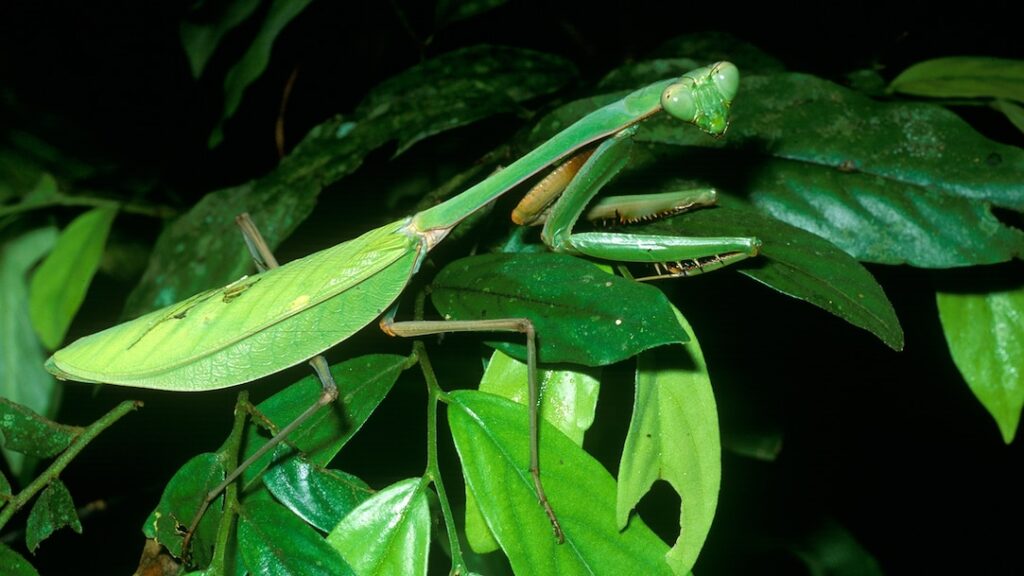
Praying mantises live in places where they can hide, hunt, and find enough live prey. In many parts of the world, they are found among grasses, shrubs, garden plants, flower beds, forest edges, meadows, and warm areas with plenty of insects. Some species live in trees or dense foliage, while others may be found closer to the ground in grasslands, dry habitats, or garden borders.
The exact answer depends on the species, climate, season, and life stage. A young mantis nymph needs tiny prey and safe cover. An adult mantis may perch higher on stems, shrubs, flowers, or branches where flying insects pass by. A female looking for a place to lay eggs may choose a stem, twig, fence, wall, or other firm surface for her egg case.
In simple terms, praying mantises usually live where vegetation and prey overlap.
Quick Answer: Praying Mantis Habitat at a Glance
Praying mantises are most often found in:
- Gardens and flower beds
- Tall grasses and meadows
- Shrubs, hedges, and vines
- Vegetable gardens
- Woodland edges
- Fields and weedy borders
- Warm, sunny areas with insect activity
- Tree branches, stems, fences, or walls where egg cases can be attached
They are not social insects and do not live in colonies like ants or bees. A mantis usually lives alone and depends on camouflage, patience, and quick front legs to catch prey.
Praying Mantises Usually Live Among Vegetation
Most people find praying mantises on plants because plants give them three important things: cover, hunting perches, and access to prey.
A green mantis may be difficult to see among leaves. A brown mantis may blend into dry stems, bark, or late-season vegetation. This camouflage helps protect the mantis from birds and other predators. It also helps the mantis remain unnoticed while waiting for insects to come close.
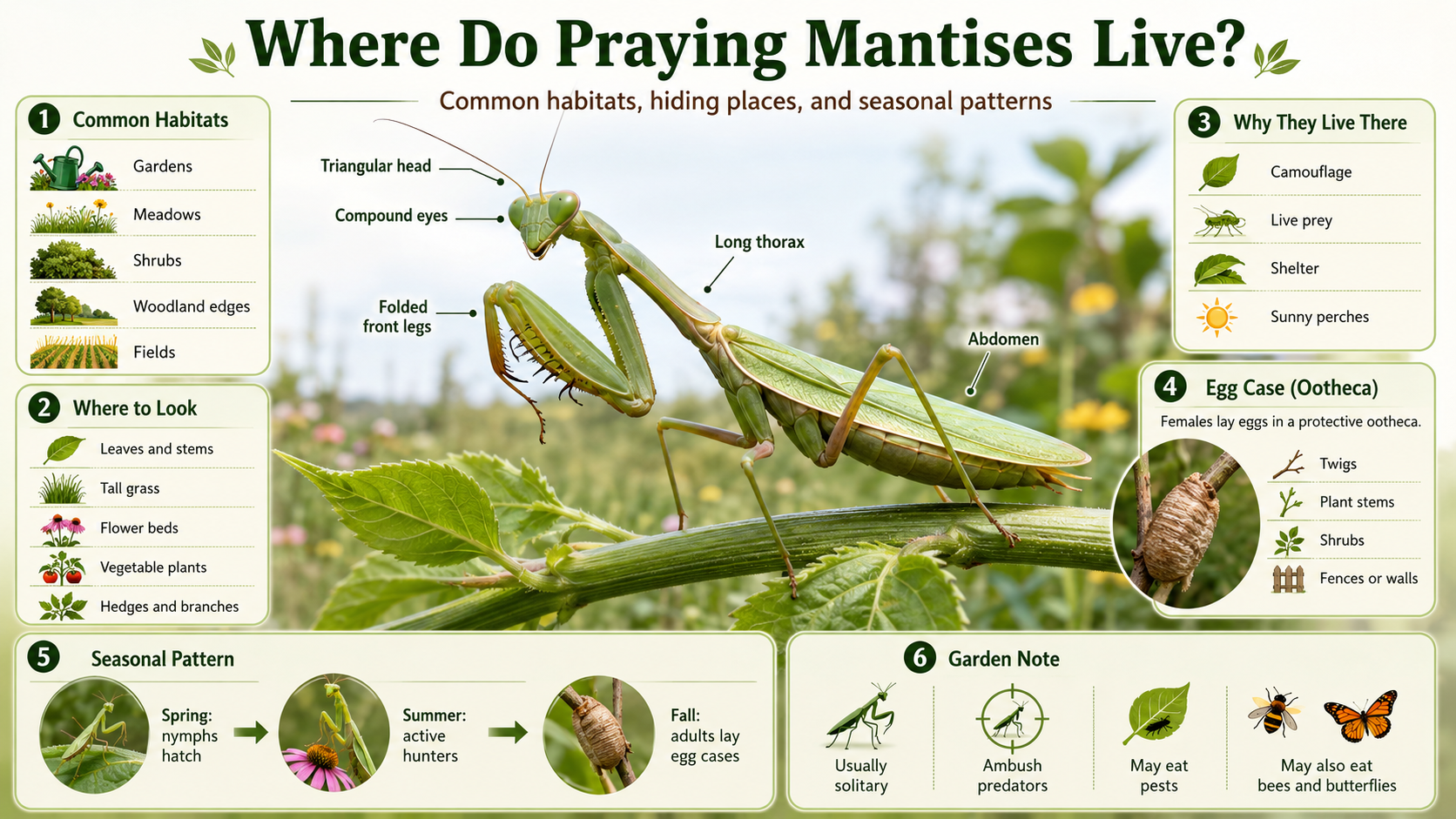
Praying mantises are ambush predators. Rather than chasing prey over long distances, many species wait quietly with their front legs folded. When a fly, moth, grasshopper, cricket, bee, butterfly, or another small animal comes within reach, the mantis may strike quickly with its spiny forelegs.
This is why mantises are often seen in places with many insects, such as flower beds, meadow edges, tall grasses, and vegetable gardens.
Where Do Praying Mantises Live in Gardens?
In gardens, praying mantises may live almost anywhere with cover and prey. They often sit on plants rather than on open soil.
Flower Beds
Flower beds can attract insects, which in turn may attract mantises. A mantis may wait on stems, leaves, or flowers for flies, moths, bees, butterflies, or other insects.
This does not mean mantises are “flower insects” in the same way bees or butterflies are. They are not visiting flowers for nectar. They are usually there because other insects are nearby.
Vegetable Gardens
Vegetable gardens can provide good mantis habitat when there are leafy plants, stakes, trellises, and insect prey. A mantis may perch on tomato vines, bean supports, squash leaves, corn stalks, or nearby weeds.
Gardeners often enjoy seeing mantises because they may eat insects that damage plants. However, mantises do not choose only pest insects. They may also eat pollinators and other beneficial insects.
Shrubs and Hedges
Shrubs, hedges, and dense border plants provide shelter and hunting positions. Mantises can hide among leaves and wait for insects moving through the vegetation.
Hedges may also offer places for females to attach egg cases in late summer or fall, depending on the region and species.
Tall Grass and Meadow Edges
Tall grasses and unmowed areas can support many small insects. These places may be especially useful for mantis nymphs because tiny prey is more available.
In a very tidy yard with short turf, few stems, and little plant diversity, mantises may have fewer places to hide and hunt.
Where Do Praying Mantises Lay Their Eggs?
Female praying mantises lay eggs inside a protective egg case called an ootheca. The ootheca is usually made from a foamy material that hardens after it is laid. It may look like dried foam, tan insulation, a small lump of hardened froth, or a ridged case attached to a surface.
Depending on the species, oothecae may be found on:
- Plant stems
- Twigs and branches
- Shrubs
- Tall grasses
- Fence posts
- Walls
- Siding
- Eaves
- Garden stakes
- Outdoor furniture or other firm surfaces
In colder climates, mantises often overwinter as eggs inside the ootheca. Adults usually die after the breeding season, while the egg case remains through winter and may hatch in spring when conditions become warmer.
The shape of an ootheca can vary by species. Some are long and narrow, while others are larger, rounded, or cube-like. Because egg cases differ, an ootheca can sometimes help identify the type of mantis in an area.
Where Do Baby Praying Mantises Live?
Baby praying mantises are called nymphs. They hatch from the ootheca and look like tiny, wingless versions of adults. As they grow, nymphs molt several times, shedding their outer skin and gradually becoming larger.
Newly hatched nymphs need small prey. They may feed on tiny flies, aphids, small insects, and sometimes other small mantises. Because they are delicate and vulnerable, they often need dense cover.
Good nymph habitat may include:
- Fine grasses
- Small herbaceous plants
- Weedy edges
- Low shrubs
- Flower beds with small insects
- Undisturbed plant stems near the ootheca
Not all nymphs survive. Many are eaten by birds, spiders, larger insects, reptiles, amphibians, or even other mantises. This is one reason females may produce many eggs in a single ootheca.
Do Praying Mantises Live in Trees?
Some praying mantises may live or hunt in trees, shrubs, and taller vegetation, especially if the species is adapted to climbing or perching above ground. A mantis may use tree branches, bark, leaves, or vines as hunting sites.
However, not every mantis you see belongs high in a tree. Some species are more often found in grasslands, garden plants, or low shrubs. Others may use tree trunks or branches only occasionally.
If you see a mantis on a tree, it may be hunting, resting, escaping disturbance, or searching for a place to lay eggs.
Do Praying Mantises Live in Grass?
Yes, many mantises can be found in grass, especially tall grass, meadow edges, field margins, and weedy areas. Short lawns are usually less useful because they offer less cover and fewer perching places.
Tall grass provides:
- Camouflage
- Protection from wind and predators
- Access to small insects
- Vertical stems for resting and hunting
- Possible egg-laying surfaces
Grassland and meadow habitats can be especially important for smaller mantis species or young nymphs.
Do Praying Mantises Live in Flowers?
Praying mantises may sit on or near flowers, but they are not feeding on nectar. They are predators waiting for insects.
Flowers attract many potential prey animals, including flies, bees, butterflies, moths, and small beetles. A mantis on a flower may be using the flower as a hunting platform.
This is one reason gardeners should be realistic about mantises. They may eat pests, but they may also capture pollinators. A mantis does not know which insects humans consider helpful.
Do Praying Mantises Live Indoors?
Praying mantises are outdoor insects. If one appears indoors, it usually wandered in by accident, was brought in on a plant, or hatched from an ootheca that was kept inside too warmly.
A mantis found inside a house is not usually trying to infest the home. It needs live prey, suitable temperature, and proper conditions to survive. Indoor spaces usually do not provide a natural habitat.
If you find one indoors, the safest choice is usually to move it gently outside when weather allows. Place it on vegetation rather than on a bare driveway or exposed wall.
If an ootheca is brought indoors during winter, it may hatch too early. This can create a sudden group of tiny nymphs when there is no natural outdoor food available. For this reason, egg cases should not be kept in a heated room unless someone is intentionally raising mantises and understands their care needs.
Where Do Praying Mantises Live During Winter?
In many temperate regions, adult praying mantises do not survive winter. Instead, the next generation survives as eggs inside the ootheca.
The ootheca may remain attached to a stem, branch, fence, wall, or other surface through winter. In spring, depending on temperature and species, nymphs emerge and begin hunting small prey.
In warmer climates, mantis activity and timing may differ. Some species may have longer active seasons, and tropical species may not follow the same winter pattern as mantises in cold climates.
Where Do Praying Mantises Live Around the World?
Praying mantises are found in many warm and temperate regions of the world. They are especially diverse in tropical areas, but some species live in temperate climates as well.
Different mantises may live in very different habitats, including:
- Tropical forests
- Shrublands
- Grasslands
- Meadows
- Gardens
- Agricultural edges
- Dry habitats
- Woodland margins
- Urban green spaces
Some species are excellent plant mimics. They may resemble leaves, twigs, bark, flowers, or dry vegetation. Their body shape and color often match the places where they live.
This is why a mantis from a tropical forest may look very different from a mantis found in a North American garden.
Habitat Depends on Species
There is no single “praying mantis habitat” that fits every species. The mantis family includes many forms, sizes, colors, and behaviors.
For example, some commonly noticed mantises in North American gardens are large green or brown species that perch on shrubs, flowers, or tall plants. Other mantises may be smaller, more ground-oriented, or better camouflaged among dry stems.
Species can differ in:
- Preferred height above ground
- Color and camouflage
- Adult size
- Egg case shape
- Cold tolerance
- Seasonal timing
- Prey size
- Use of shrubs, grasses, trees, or dry habitats
This is why identification matters. A mantis in one region may not behave exactly like a mantis in another region.
Do Praying Mantises Need Water?
Wild praying mantises usually get moisture from their prey and from the environment. They may also drink droplets from leaves or surfaces when available.
A garden does not need a special “mantis water station.” In fact, deep dishes or open containers may be risky for small insects. A healthier approach is to maintain diverse vegetation, avoid overuse of pesticides, and support a balanced insect community.
For pet mantis care, humidity and drinking needs depend on the species. Pet care should be researched separately and carefully, especially for tropical species.
How to Make a Garden More Mantis-Friendly
A mantis-friendly garden is not just a garden designed for mantises. It is a garden that supports habitat complexity, insects, shelter, and seasonal plant structure.
Grow a Variety of Plants
A mix of native plants, flowers, grasses, shrubs, and herbs can support more insect life. More insect diversity means more possible prey for mantises and more overall habitat value.
Keep Some Plant Stems Through Winter
Because oothecae may be attached to stems or shrubs, leaving some dead stems standing through winter may help protect egg cases and other overwintering insects.
You do not need to leave the whole garden messy. Even a small undisturbed corner can help.
Reduce Broad-Spectrum Pesticide Use
Pesticides can reduce both prey insects and beneficial insects. They may also directly harm mantises or the insects that support a balanced garden.
If there is a serious pest problem, consider contacting a local extension service or qualified pest professional for advice suited to your region and crop.
Provide Layered Vegetation
Mantises use structure. A garden with only short lawn and a few isolated plants gives them fewer places to hide. Shrubs, tall perennials, grasses, trellises, and mixed borders create more hunting and resting places.
Do Not Rely on Purchased Egg Cases
Some garden centers and online sellers offer mantis egg cases for pest control. This is not always a good idea. Many mantises sold for release may be non-native species, and mantises are not precise pest-control tools.
They eat what they can catch, not just the insects that damage plants. In many gardens, encouraging a broad community of native beneficial insects is a more responsible approach than releasing mantises.
Are Praying Mantises Good for Gardens?
Praying mantises can be part of a healthy garden ecosystem, but they should not be treated as perfect pest-control insects.
They may eat pests such as flies, moths, grasshoppers, crickets, and caterpillars. But they may also eat bees, butterflies, lacewings, other beneficial insects, and even other mantises. Large mantises may sometimes capture small vertebrates, although this is not the main part of their diet.
A mantis in the garden is interesting and often welcome, but it is not a complete pest-management plan. The best garden strategy is usually plant diversity, healthy soil, reduced pesticide use, and tolerance for a reasonable amount of insect activity.
Common Misconceptions About Where Praying Mantises Live
Misconception 1: Praying Mantises Only Live in Gardens
Gardens are common places to see them, but mantises also live in meadows, fields, shrubs, forest edges, grasslands, and natural habitats. Gardens simply make them more visible to people.
Misconception 2: A Mantis on a Flower Is Helping Pollinators
A mantis on a flower may be hunting pollinators. It is not there to pollinate the flower. Mantises are predators, and their prey can include bees and butterflies.
Misconception 3: Buying an Egg Case Will Solve Pest Problems
Mantises are generalist predators. They may eat some pests, but they do not target only problem insects. Releasing egg cases is not a reliable solution for serious garden pest control.
Misconception 4: All Praying Mantises Live the Same Way
Habitat varies by species, age, region, and season. A tropical leaf-mimicking mantis, a garden mantis, and a grassland mantis may use very different microhabitats.
Misconception 5: Praying Mantises Live in Groups
Praying mantises are usually solitary. Newly hatched nymphs may emerge together from the same ootheca, but they disperse and live independently. If crowded, they may even eat one another.
What Should You Do If You Find a Praying Mantis Egg Case?
If you find an ootheca outdoors, the best choice is often to leave it where it is, especially if it is attached to a plant stem, twig, or sheltered surface.
Avoid bringing it into a warm house during winter. Warm indoor temperatures may cause early hatching before outdoor prey is available.
If the egg case is on a plant stem that must be pruned, you can carefully move the stem section to a protected outdoor area, keeping it exposed to natural winter temperatures. Place it near shrubs, grasses, or other vegetation so emerging nymphs have cover and prey nearby.
Local climate matters, so gardeners with specific concerns should check guidance from a local extension service or wildlife authority.
About This Guide
This guide is written for general nature education and garden observation. It is not a pest-control prescription, pet mantis care manual, or wildlife release guide.
Praying mantis habitat, diet, survival, and seasonal behavior vary by species and region. If you are dealing with a serious pest issue, considering release of purchased mantises, or unsure about local wildlife regulations, consult a local extension service, pest-control professional, or appropriate wildlife authority.
Conclusion
Praying mantises live where they can hide, hunt, and reproduce. In many regions, that means gardens, shrubs, tall grasses, meadows, woodland edges, and other plant-rich habitats with plenty of live prey.
They are often seen on flowers, vegetable plants, stems, fences, and shrubs, but they are not limited to gardens. Their habitat depends on species, life stage, climate, and season. Nymphs need small prey and shelter. Adults often perch where insects pass by. Females lay eggs in protective oothecae attached to stems, branches, walls, or other firm surfaces.
A praying mantis in the garden is a sign of an active insect community, but it should be understood realistically. Mantises are fascinating predators, not selective pest-control workers. The best way to support them is to maintain a diverse, low-pesticide garden with layered vegetation and room for natural life.
FAQ Section
Where do praying mantises live most often?
Praying mantises most often live among vegetation, including grasses, shrubs, garden plants, flowers, and tree branches. They choose places where they can hide and wait for live prey.
Do praying mantises live in houses?
Praying mantises are outdoor insects. If one is found indoors, it usually entered by accident or came in with a plant or egg case. A house is not a normal long-term habitat for a wild mantis.
Where do praying mantises lay eggs?
Female mantises lay eggs in a protective case called an ootheca. Oothecae may be attached to stems, twigs, branches, fences, walls, siding, or other firm outdoor surfaces.
Do praying mantises live in gardens?
Yes, many praying mantises live or hunt in gardens. They may be found on flowers, vegetable plants, shrubs, vines, or tall grasses where insects are active.
Do praying mantises live in trees?
Some mantises may live or hunt in trees and shrubs, especially species that use higher vegetation. Others are more common in grasses, low plants, or garden borders.
Do praying mantises stay in one place?
A mantis may stay in a good hunting spot for a while, but it can move when prey becomes scarce, when disturbed, when searching for a mate, or when looking for a place to lay eggs.
Are praying mantises good for pest control?
Praying mantises may eat some garden pests, but they also eat beneficial insects such as bees and butterflies. They are interesting garden predators, but they should not be relied on as a complete pest-control method.
What kind of habitat attracts praying mantises?
A habitat with varied plants, tall stems, shrubs, flowers, grasses, and reduced pesticide use is more likely to support mantises. These features provide cover, hunting sites, and access to prey.
1 thought on “Where Do Praying Mantises Live? Habitat, Gardens, Eggs, and Seasonal Behavior”