
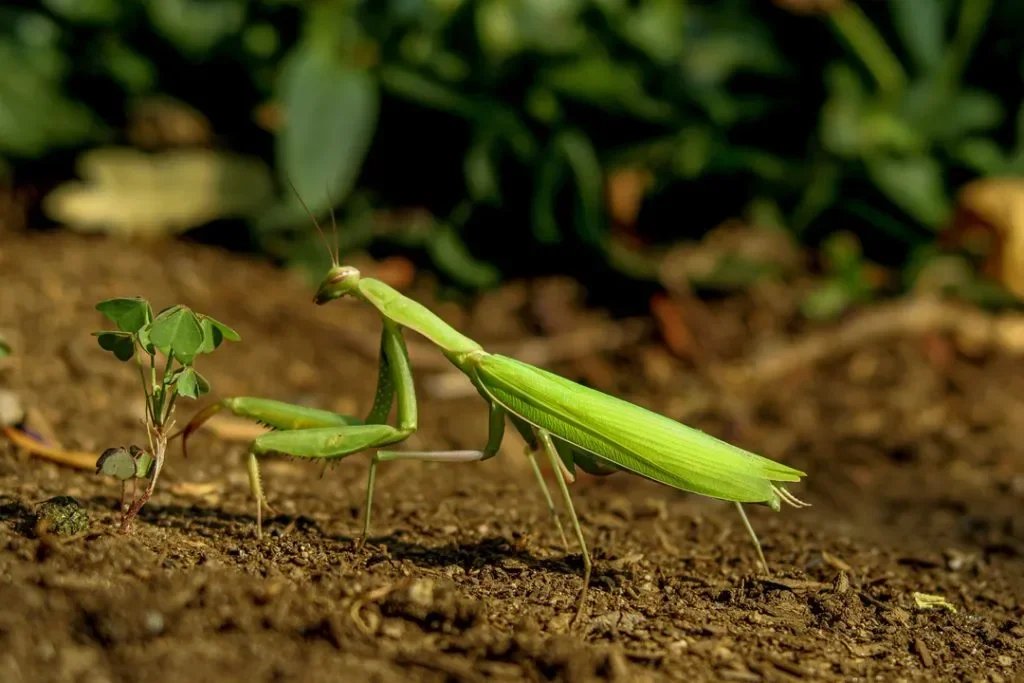
Praying mantises are not simply “good” or “bad.” They are fascinating predatory insects that can eat many garden pests, but they may also eat butterflies, bees, and other beneficial insects. In most gardens, a praying mantis is best understood as part of the natural food web rather than as a perfect pest-control solution.
If you find one on a tomato plant, flower stem, fence post, or shrub, there is usually no need to panic. A mantis is not there to damage your plants. It is there because the habitat offers cover and live prey.
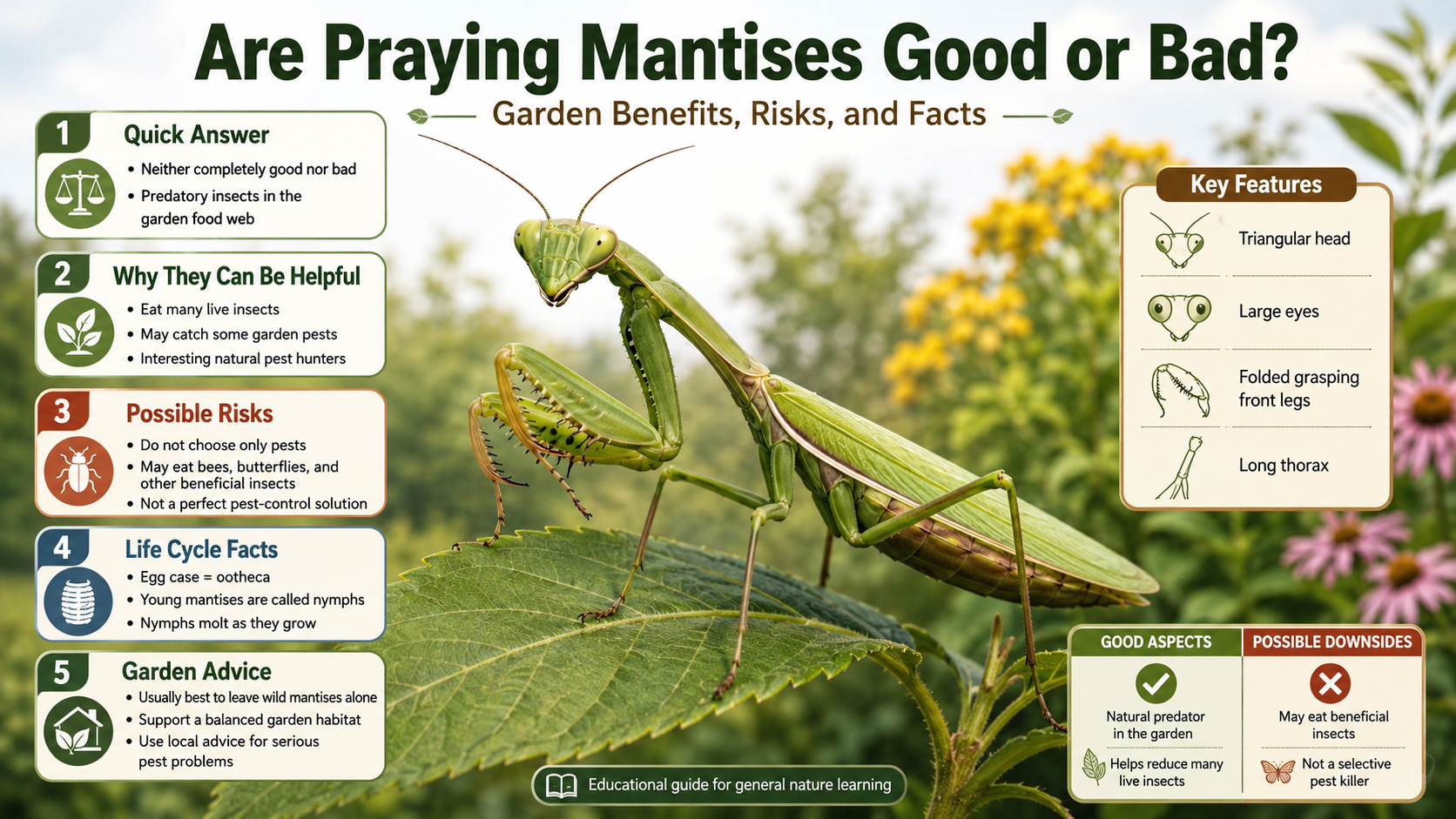
For gardeners, the more useful question is not “Is this insect good or bad?” but “What role is it playing in my garden?” The answer depends on the mantis species, its size, the season, the available prey, and the overall balance of insects in your yard.
Quick Answer: Praying Mantises Are Neither Completely Good nor Bad
Praying mantises are predators. They usually hunt live prey such as flies, moths, grasshoppers, crickets, beetles, caterpillars, aphids, and other small animals. Larger mantises may even catch surprisingly large prey compared with their own body size.
That makes them helpful in some situations. A mantis may eat insects that chew leaves, damage vegetables, or bother people around outdoor lights.
But mantises are not selective garden helpers. They do not know which insects you want removed and which insects you want protected. A mantis may eat a pest caterpillar one day and a butterfly, bee, lacewing, or another mantis the next.
So the balanced answer is this:
Praying mantises are often interesting and sometimes helpful garden predators, but they are not reliable targeted pest-control insects. They should usually be respected and observed, not treated as either garden heroes or garden villains.
Why People Think Praying Mantises Are Good
Many people are happy to see a praying mantis in the garden. That reaction makes sense. Mantises are large, easy to recognize, and dramatic hunters. Their folded front legs, triangular head, and slow stalking behavior make them look almost thoughtful.
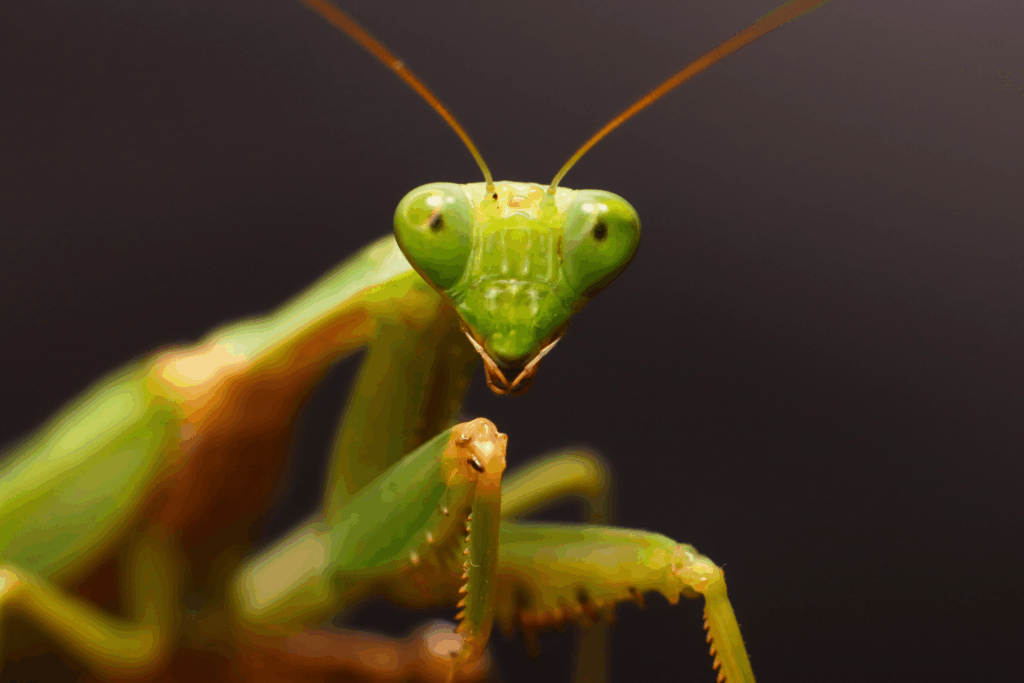
Gardeners also like them because they eat other insects.
They Eat Many Common Garden Insects
Praying mantises may capture flies, leafhoppers, moths, beetles, grasshoppers, crickets, caterpillars, and other small invertebrates. Young mantises, called nymphs, often start with very small prey such as tiny flies or aphids. As they grow, they can handle larger insects.
This is one reason mantises have a reputation as beneficial insects. They are not plant feeders. They do not chew leaves, bore into stems, or suck plant juices. If a mantis is sitting on your basil, tomato, rose, or zinnia, it is using the plant as a hunting platform.
They Are Part of a Healthy Outdoor Food Web
A garden with mantises usually has enough insects and vegetation to support predators. That can be a sign of a more complex habitat than a bare, heavily sprayed yard.
Mantises also become food for other animals. Birds, spiders, bats, reptiles, and other predators may eat them. Their egg cases, called oothecae, may also be part of the seasonal food web.
In that sense, a mantis is not just a pest-control tool. It is one participant in a living garden.
Why Praying Mantises Are Not Perfect Pest Control
The biggest misconception is that praying mantises are “good bugs” that only eat “bad bugs.” Nature does not work that neatly.
They Do Not Choose Only Garden Pests
A praying mantis is an ambush predator. It waits for movement, judges whether the prey is a manageable size, and strikes with its spined front legs. It does not sort prey into helpful and harmful categories.
A cabbageworm, moth, bee, hoverfly, butterfly, small grasshopper, or another mantis may all look like food if they come close enough.
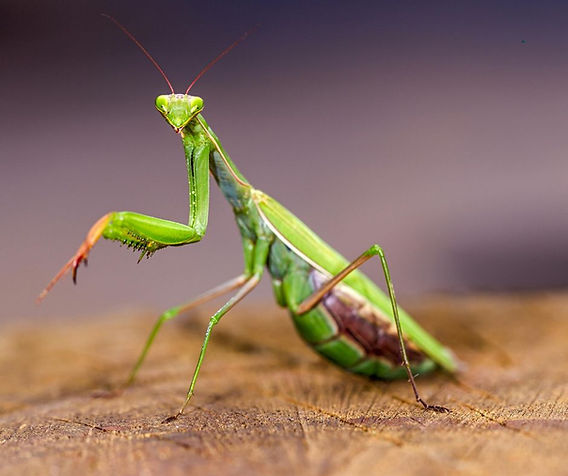
This is why mantises are often described as generalist predators. They eat a wide variety of prey rather than specializing in one pest.
They May Eat Bees, Butterflies, and Other Helpful Insects
Mantises can catch pollinators and other beneficial insects, especially when they hunt on flowering plants. A mantis waiting on a coneflower, zinnia, milkweed, or herb flower may be positioned where bees and butterflies regularly visit.
This does not mean every mantis is destroying your pollinator garden. It does mean mantises should not be advertised as harmless pest-control machines.
In a balanced garden, some predation is normal. But if your goal is to support butterflies, bees, and native beneficial insects, releasing extra mantises may not help that goal.
They May Not Stay Where You Release Them
Another common misconception is that buying praying mantis egg cases will place a ready-made pest-control army exactly where you need it.
In reality, newly hatched mantis nymphs disperse. Some may be eaten by siblings. Some may leave the area. Some may not survive. Adults can also move through the landscape. Even if they remain nearby, they will not focus only on the pest that concerns you.
If you have a serious aphid, caterpillar, roach, whitefly, or grasshopper problem, mantises alone are unlikely to solve it. Proper pest identification and integrated pest management are usually more reliable.
Are Praying Mantises Good for Gardens?
Praying mantises can be good for gardens in a limited, natural sense.
They may help reduce some insects. They add biodiversity. They give children and adults a memorable way to observe insect behavior. They can also be a sign that your garden has enough structure, prey, and cover to support predators.
A single mantis on a vegetable plant is usually not a problem. In many cases, the best response is simply to leave it alone and enjoy the observation.
Mantises may be especially welcome in gardens where the goal is general wildlife interest rather than maximum pest removal. They are excellent subjects for nature study because their hunting posture, camouflage, molting, and life cycle are easy to observe.
Are Praying Mantises Bad for Gardens?
Praying mantises are usually not bad for plants. They do not feed on leaves, flowers, roots, or fruit.
However, they can be a concern in three situations.
First, they may eat beneficial insects. This is especially relevant in pollinator gardens, butterfly gardens, and native plant landscapes where bees, butterflies, and other beneficial insects are intentionally encouraged.
Second, some commonly seen mantises in North America are introduced species. Depending on your region, Chinese mantises and European mantises may be more common than native mantises. Non-native mantises can compete with or prey on native insects, including native mantis species.
Third, buying and releasing mantis egg cases may not be appropriate in every region. Local regulations, ecological concerns, and species identification all matter. A mantis sold online may not be native to your area, and releasing insects without understanding the species can create unintended problems.
Should You Buy Praying Mantis Egg Cases?
For most home gardeners, buying praying mantis egg cases is not the best pest-control strategy.
A mantis egg case is called an ootheca. Depending on the species, an ootheca may contain dozens or even hundreds of eggs. When the nymphs hatch, they are tiny, hungry, and mobile. They may scatter quickly, eat each other, or feed on whatever small prey they can catch.
This can be interesting for observation, but it does not guarantee pest control.
Before buying mantis egg cases, ask a few questions:
Is the species native or appropriate for your region?
Will the mantises be released outdoors?
Are you trying to control a specific pest?
Could local beneficial insects or pollinators be affected?
Would habitat improvement and pest identification be a better first step?
For school or classroom observation, mantis egg cases can be educational when handled responsibly. For garden pest control, they are often oversold.
What Should You Do If You Find a Praying Mantis?
In most cases, leave it alone.
If the mantis is outdoors on a plant, fence, wall, or patio, it is usually safe to observe. Give it space and avoid grabbing it. A mantis may raise its front legs, spread its wings, or move away if threatened.
If a mantis is in a risky place, such as inside a house, on a busy walkway, or near a door where it may be crushed, you can gently move it outdoors. Use a container, a piece of cardboard, or a soft plant stem rather than handling it roughly.
Place it in vegetation, shrubs, tall grass, or a sheltered garden area. Do not place it directly onto a bird feeder, spider web, pesticide-treated plant, or indoor houseplant where it cannot find normal prey.
What Should You Do If You Find a Praying Mantis Egg Case?
If you find a tan, foamy-looking mass attached to a twig, fence, plant stem, or outdoor object, it may be a mantis ootheca.
In many situations, the best option is to leave it outside where you found it. The egg case is designed to protect developing mantises through seasonal conditions. Bringing it indoors can cause nymphs to hatch early, often when there is no suitable food available.
If the ootheca is attached to a movable object that must be brought indoors, such as patio furniture or a garden stake, consider relocating the stem or object to a sheltered outdoor spot with similar exposure. Avoid placing it in direct indoor warmth.
If you are concerned that the ootheca belongs to a non-native mantis, check with your local extension office, natural history group, or wildlife authority. Ootheca identification can be difficult, and recommendations may vary by region.
Are Praying Mantises Dangerous to People or Pets?
Praying mantises are not dangerous to people in the way stinging insects or venomous spiders may be.
They do not have venom. They do not seek out people. They do not damage houses or infest food. A large mantis may pinch or scratch with its spined front legs if handled, and it may bite defensively, but this is usually minor and avoidable.
For children, the safest rule is: look, do not squeeze. Mantises are delicate animals, especially when molting or newly hatched.
For pets, mantises are usually not a major hazard. A curious cat or dog is more likely to injure the mantis than the other way around. Still, it is better to prevent pets from chewing wild insects, especially if pesticides may have been used nearby.
How to Support a Balanced Garden Without Relying Only on Mantises
A healthier garden does not depend on one predator. It supports many kinds of beneficial insects, spiders, birds, and other wildlife.
Here are better long-term steps:
Plant a variety of flowers that bloom at different times. This supports pollinators, small predators, and parasitoid insects.
Grow native plants when possible. Native plants often support local insects better than highly modified ornamental varieties.
Leave some garden structure. A perfectly bare garden gives predators fewer places to hide, rest, lay eggs, or overwinter.
Avoid unnecessary broad-spectrum insecticides. These can kill beneficial insects along with pests.
Identify the pest before treating the problem. Many insects are harmless, temporary, or even helpful.
Accept a little plant damage. A few chewed leaves do not always mean a garden is in trouble.
Use local advice for serious pest problems. Climate, pest species, plant type, and local regulations all affect the best solution.
A praying mantis may be one predator in this system, but it should not be the whole plan.
Editor’s Note
This guide is for general educational purposes. It is not a substitute for local pest-control advice, professional diagnosis, or regional wildlife guidance.
Praying mantis behavior and ecological impact can vary by species, season, life stage, climate, and habitat. If you are dealing with a serious garden pest problem, considering insect releases, or trying to identify native versus non-native mantises, contact your local extension service, pest control professional, or wildlife authority.
Conclusion
Praying mantises are best described as neutral to helpful garden predators, not as purely good or bad insects. They may eat pest insects, but they may also eat pollinators and other beneficial species. They are exciting to observe, valuable for nature education, and usually harmless to people and plants.
For most gardeners, the best approach is simple: appreciate mantises when they appear naturally, avoid unnecessary pesticides, support diverse habitat, and do not rely on purchased mantis egg cases as a guaranteed pest-control method.
A praying mantis in the garden is not a miracle cure or a menace. It is a predator doing what predators do.
10. FAQ Section
Are praying mantises good or bad?
Praying mantises are neither completely good nor completely bad. They are predatory insects that may eat garden pests, but they may also eat bees, butterflies, and other beneficial insects. In most gardens, they are best viewed as part of the natural food web.
Are praying mantises good for vegetable gardens?
They can be somewhat helpful because they may eat insects that damage vegetables. However, they are not targeted pest-control insects. They may also eat beneficial predators and pollinators, so they should not be treated as a perfect solution.
Do praying mantises eat plants?
No, praying mantises do not normally eat plants. They are predators and usually feed on live prey. If you see one on a plant, it is probably hunting or resting, not feeding on the plant.
Do praying mantises eat bees and butterflies?
Yes, they can. Mantises are generalist predators and may catch bees, butterflies, moths, flies, grasshoppers, and many other insects if the prey is the right size and comes close enough.
Should I buy praying mantis eggs for my garden?
Usually, buying mantis egg cases is not the most reliable pest-control choice. The nymphs may disperse, eat each other, or feed on beneficial insects as well as pests. It is usually better to improve habitat for a variety of native beneficial insects.
What is a praying mantis egg case called?
A praying mantis egg case is called an ootheca. It is a protective case that holds the eggs. In many temperate regions, oothecae overwinter outdoors and hatch when conditions become suitable.
What are baby praying mantises called?
Baby praying mantises are called nymphs. They look like tiny versions of adults but do not have fully developed wings. They molt several times as they grow.
Should I remove a praying mantis from my garden?
Usually, no. If the mantis is outdoors and not in danger, it can be left alone. If it is inside your home or in a place where it may be crushed, gently move it to outdoor vegetation.