
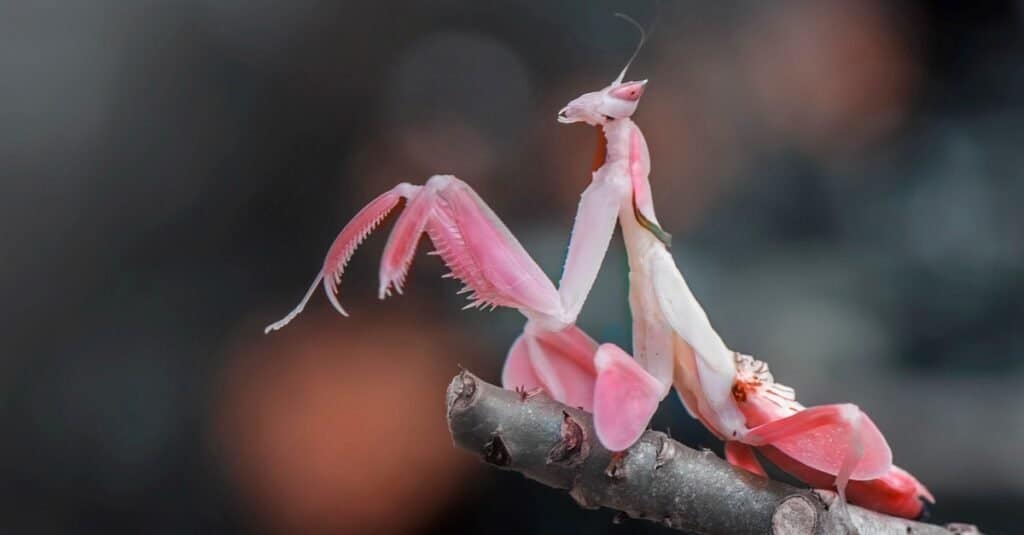
Praying mantises usually hunt by waiting quietly, watching for movement, and striking when live prey comes close enough to catch. Most mantises are ambush predators. They rely on stillness, camouflage, sharp vision, and powerful spiny front legs to grab insects and other small animals.
The hunting style looks simple from the outside: a mantis sits on a leaf, stem, fence, flower, or branch with its front legs folded as if in prayer. But that quiet pose is not laziness. It is a hunting position. The mantis is scanning its surroundings, judging distance, and waiting for the right moment.
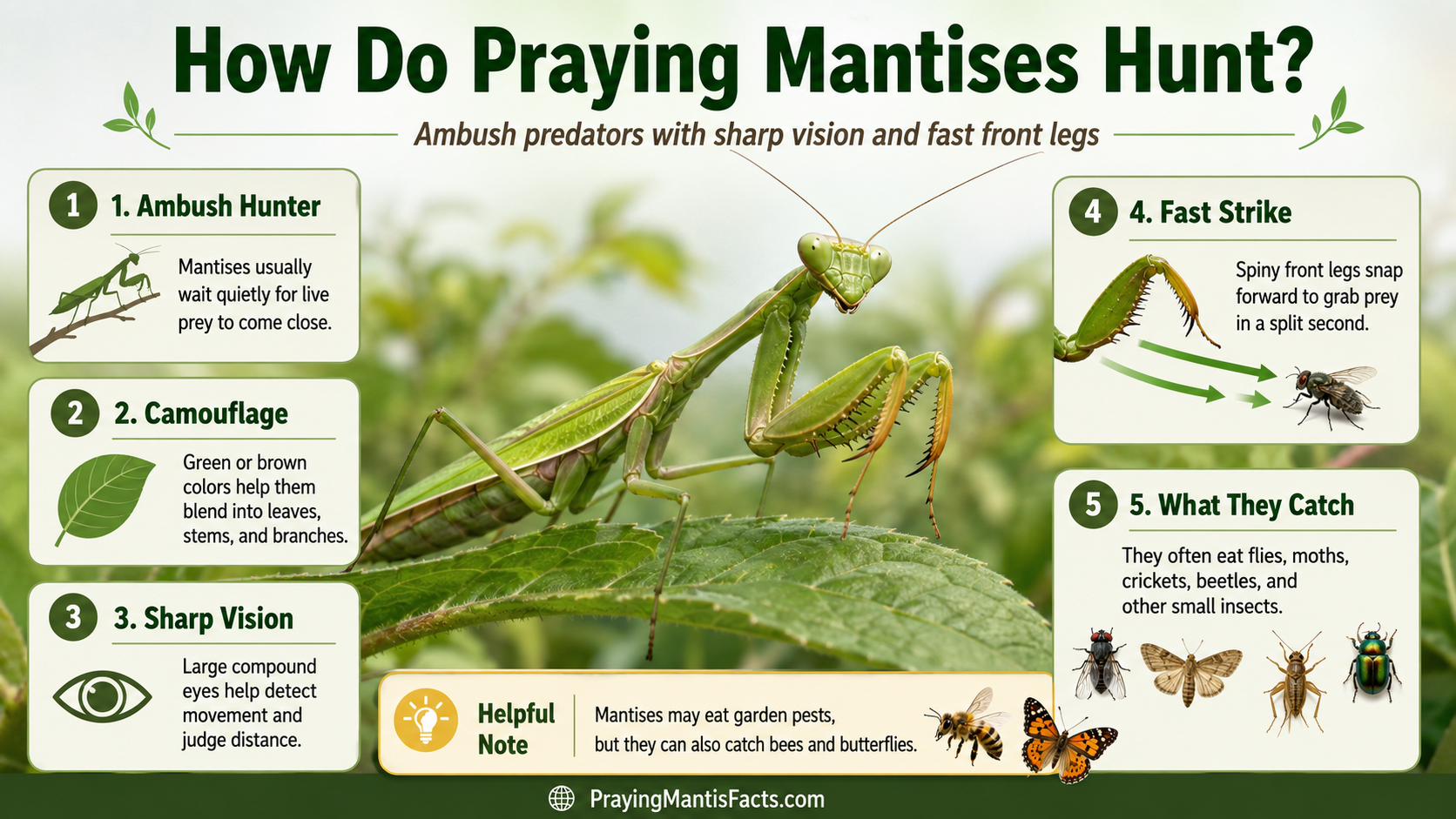
When prey moves into reach, the mantis can extend its front legs quickly, hook the prey with sharp spines, pull it toward the mouthparts, and begin feeding. The details vary by species, size, age, temperature, habitat, and hunger level, but the basic pattern is the same in many familiar praying mantises.
Praying Mantises Are Predatory Insects
Praying mantises are predatory insects. They do not feed on plants in the way caterpillars, aphids, or grasshoppers often do. Instead, they usually eat live prey, especially other insects and small arthropods.
Common prey may include flies, moths, crickets, grasshoppers, small butterflies, bees, wasps, beetles, spiders, and other insects. Larger mantises may sometimes capture small vertebrates, but that is not the everyday diet of most garden mantises.
For beginners, the most important point is this: a praying mantis is not “hunting pests” in the human sense. It is hunting animals it can catch. That prey may be a garden pest, but it may also be a pollinator or another beneficial insect.
Why Praying Mantises Are Ambush Predators
Many praying mantises use a sit-and-wait strategy. Instead of running through the garden like a tiger beetle or jumping after prey like a jumping spider, they often choose a good perch and wait.
This strategy works well because many insects move constantly. Flies land and take off. Bees visit flowers. Moths rest on leaves. Grasshoppers climb through stems. A mantis does not need to chase every possible meal. It only needs to be in the right place when prey comes close.
A typical ambush hunting sequence looks like this:
- The mantis chooses a perch.
- It remains still, often with its front legs folded.
- It turns its head or body slightly toward movement.
- It tracks a nearby insect.
- It waits until the prey is within striking range.
- It snaps out its front legs and grabs the prey.
This patient style saves energy. It also helps the mantis avoid being noticed by both prey and predators.
The Role of Camouflage in Mantis Hunting
Camouflage is one of the most important parts of mantis hunting. Many mantises are green, brown, gray, or leaf-like, which helps them blend into grasses, twigs, leaves, bark, or dried vegetation.
A green mantis on a leafy plant may be difficult for insects to notice. A brown mantis on dry stems may almost disappear. Some species have body shapes that resemble leaves, flowers, bark, or dead vegetation. These forms are not just beautiful; they help the mantis survive and hunt.
Camouflage works in two directions. It can hide the mantis from prey, giving it a better chance to strike. It can also help hide the mantis from birds, lizards, spiders, and other animals that may eat mantises.
Not every mantis is perfectly matched to its background. Color can vary by species, molt stage, habitat, and individual. Some mantises are more conspicuous than others. Still, remaining motionless is often just as important as color. A slightly visible mantis may still be overlooked if it does not move.
How Mantis Eyes Help Them Hunt
Praying mantises are highly visual hunters. Their large compound eyes help them detect movement, track prey, and judge when an animal is close enough to catch.
One reason mantises are so fascinating is that they can use depth perception. Their two large eyes face partly forward, giving them overlapping fields of view. This helps them estimate distance when targeting prey.
For a hunting mantis, distance matters. If the prey is too far away, the strike will miss. If the prey is close enough, the mantis can launch its front legs with better timing. This is why a mantis may appear to stare at prey before striking. It is not simply looking; it is judging position, size, and movement.
Mantises are also sensitive to motion. A still insect may be ignored for a while, while a moving fly or cricket may quickly trigger attention. In many cases, movement is what makes prey “stand out” from the background.
Raptorial Forelegs: The Mantis Hunting Tool
The folded front legs of a praying mantis are called raptorial forelegs. “Raptorial” means adapted for seizing prey. These legs are not ordinary walking legs. They are specialized grasping tools.
A mantis foreleg has spines along key sections. When the leg folds shut around prey, the spines help hold the struggling animal in place. This is why the mantis strike is so effective. It is not just a slap or grab. It is more like a springing trap with hooks.
The front legs also give the mantis its famous “praying” posture. To humans, the pose may look calm or peaceful. In reality, it is often a ready position. The mantis is prepared to shoot the legs forward when prey comes within reach.
After capture, the mantis usually brings the prey toward its mouthparts and begins feeding while holding the animal firmly.
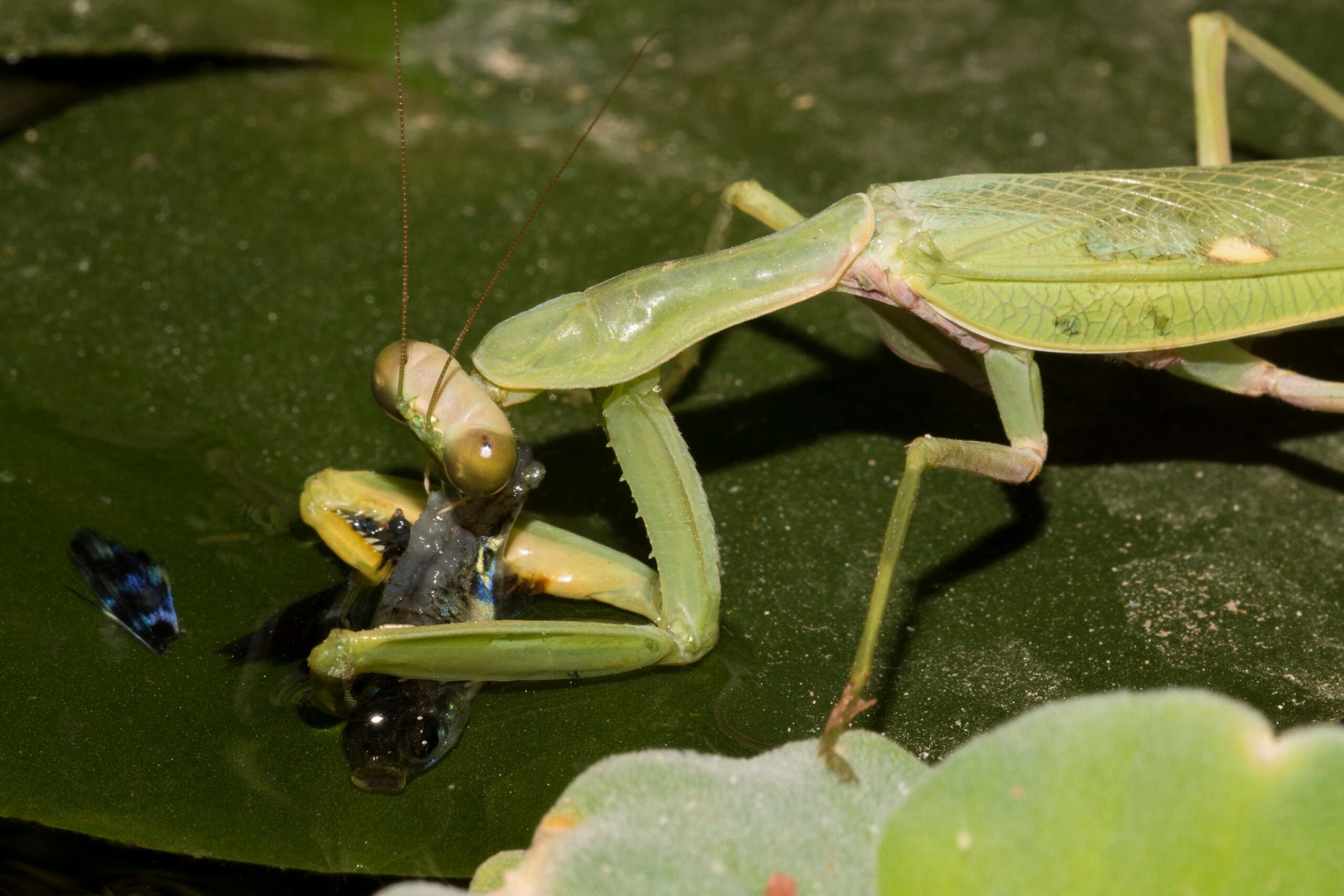
What Happens During a Mantis Strike?
A mantis strike can happen quickly. The mantis may look frozen for several seconds or minutes, then suddenly move.
A simplified strike sequence looks like this:
- Detection: The mantis notices movement.
- Orientation: It turns its head or body toward the prey.
- Distance judgment: It waits until the prey is close enough.
- Strike: The front legs extend and close around the prey.
- Grip: Spines hold the prey in place.
- Feeding: The mantis pulls the prey toward its mouthparts.
The strike is usually aimed at live prey. Mantises generally respond best to moving animals. This is one reason captive mantises are often fed live insects rather than dead food, although pet care details depend on the species and should be researched carefully.
In the wild, the strike does not always succeed. Prey may escape, jump away, fly off, or detect the mantis in time. Mantises are skilled predators, but they are not perfect hunters.
Do Praying Mantises Chase Their Prey?
Many praying mantises do not actively chase prey over long distances. They usually wait and ambush. However, behavior can vary.
Some mantises may slowly stalk prey if it is nearby. A hungry mantis may move closer to an insect before striking. Males of some species may fly or move more actively than females, especially when searching for mates. Some ground-dwelling mantises may be more active hunters than the familiar garden mantises people usually notice on plants.
So the best answer is: praying mantises usually hunt by ambush, but some may stalk or move toward prey depending on the species, the situation, and the mantis’s hunger.
What Do Praying Mantises Hunt?
Praying mantises mostly hunt live animals small enough for them to capture and hold. Their diet varies widely by size and life stage.
Small nymphs may eat tiny insects such as gnats, fruit flies, aphids, and other small soft-bodied prey. As they grow, they can handle larger prey.
Adult mantises may eat:
- Flies
- Moths
- Crickets
- Grasshoppers
- Beetles
- Bees
- Wasps
- Butterflies
- Spiders
- Other mantises
- Small caterpillars
- Other small arthropods
Large mantises may occasionally catch small vertebrates, but this should not be treated as their normal diet in most backyard observations.
Mantises are opportunistic predators. They do not sort prey into “good insects” and “bad insects.” If an insect is the right size, moves close enough, and can be captured, the mantis may try to eat it.
How Young Mantises Hunt
Young praying mantises are called nymphs. They hatch from egg cases called oothecae. An ootheca is a protective egg case that may contain many eggs, depending on the species.
When nymphs emerge, they often look like tiny versions of adult mantises, but without fully developed wings. They begin hunting small prey soon after hatching, although newly emerged nymphs are delicate and vulnerable.
As nymphs grow, they molt. Molting means shedding the outer exoskeleton so the insect can increase in size. After a molt, the mantis may look pale and soft for a short time until the new exoskeleton hardens.
Nymphs use the same basic hunting method as adults: watch, wait, strike, and feed. The difference is prey size. A small nymph cannot catch the same prey as a large adult. It needs tiny insects. As it molts and grows, it can capture larger prey.
How Adult Mantises Hunt
Adult mantises are usually stronger and can take larger prey than nymphs. Many adults have wings, though wing length and flying ability vary by species and sex.
Adult females are often larger and heavier than males in many familiar species. They may spend more time waiting on plants and ambushing prey. Adult males may be slimmer and more mobile in some species, especially during the mating season.
Adults may choose hunting locations where insects are likely to pass by, such as:
- Flowering plants
- Tall grasses
- Garden borders
- Shrubs
- Vegetable plants
- Porch lights
- Fence lines
- Wildflower patches
A mantis near flowers may catch flies, bees, butterflies, or moths. A mantis near vegetable plants may catch grasshoppers, caterpillars, beetles, or other insects. The exact prey depends on what is available in that habitat.
How Praying Mantises Hunt in Gardens
Gardeners often enjoy seeing praying mantises because they are large, interesting, and visibly predatory. A mantis on a tomato plant or flower stem feels like a helpful garden ally.
In some cases, mantises do eat insects that gardeners consider pests. They may catch flies, moths, grasshoppers, beetles, and other insects that feed on plants.
However, mantises should not be described as perfect pest-control insects. They are generalist predators, not pest specialists. A mantis may eat a cabbage moth, but it may also eat a bee, butterfly, hoverfly, lacewing, or another beneficial insect.
This makes their role in gardens more complicated. They are part of the food web, not a targeted pest management tool. If a garden has a serious pest problem, it is better to consult a local extension service or qualified pest control professional rather than relying on mantises alone.
For a wildlife-friendly garden, focus on habitat balance: diverse native plants, reduced pesticide use, healthy soil, and a range of beneficial insects and predators.
Where Praying Mantises Wait for Prey
Mantises often choose hunting spots where prey traffic is high. A good ambush site gives the mantis cover, a stable perch, and access to passing insects.
Common hunting spots include:
- Flower heads
- Leaf stems
- Shrub branches
- Tall grass
- Weed patches
- Garden fences
- Porch plants
- Outdoor lights
- Vegetable foliage
Outdoor lights can attract moths and other flying insects at night, so mantises may sometimes be found nearby. Flowering plants also attract insect visitors, which may make them useful hunting locations for mantises.
A mantis may stay in one area if prey is available. If hunting is poor or the location becomes disturbed, it may move.
How Season and Weather Affect Hunting
Mantis hunting behavior can change with temperature, season, and life stage.
In cooler weather, mantises may move more slowly. In warm weather, they may be more active and responsive. In temperate regions, nymphs are often seen after eggs hatch in spring or early summer, while adults are more noticeable later in the growing season.
Late summer and fall are often when people notice large adult mantises. They are bigger, easier to see, and may be active around gardens, shrubs, and buildings.
Local climate matters. Tropical and subtropical regions may have different seasonal patterns from colder temperate areas. Species also differ, so a mantis in one region may not behave exactly like a mantis in another.
Do Praying Mantises Hunt at Night?
Some mantises may feed or move at night, especially if prey is available, but many familiar observations happen during the day. Mantises rely heavily on vision, so light conditions matter.
At night, artificial lights may attract moths and other insects. A mantis positioned near a porch light, window, or garden lamp may take advantage of that prey traffic.
Still, not all species have the same activity pattern. Some are more often seen in daylight, while others may be noticed at dusk or around lights.
Common Misconceptions About Mantis Hunting
Misconception 1: Praying mantises only eat pests
This is not true. Mantises eat many kinds of prey. They may eat pests, but they may also eat bees, butterflies, and other beneficial insects.
Misconception 2: Praying mantises are harmless to all garden life
Mantises are predators. They are part of a natural food web, but they can reduce beneficial insects as well as pests.
Misconception 3: A mantis always waits and never moves
Many mantises are ambush predators, but they can still walk, climb, turn, stalk short distances, jump, and in some cases fly.
Misconception 4: All mantises hunt the same way
Hunting behavior varies by species, age, sex, habitat, and environmental conditions. A tiny nymph in spring does not hunt exactly like a large adult female in late summer.
Misconception 5: The “praying” pose means the mantis is gentle
The pose is mostly a hunting posture. The folded front legs are specialized tools for catching prey.
Editor’s Note: About This Guide
This guide is written for general educational purposes. Praying mantis behavior can vary by species, region, season, climate, and life stage. If you are dealing with a serious garden pest problem, invasive species concern, pet mantis care question, or wildlife release issue, consult your local extension service, wildlife authority, or qualified pest control professional.
Avoid releasing store-bought mantis egg cases without checking local guidance. Some commercially sold mantises may be non-native in your region, and releasing them may not be recommended.
Conclusion
Praying mantises hunt by combining patience, camouflage, vision, and specialized front legs. Most familiar species are ambush predators. They wait quietly, track movement, judge distance, and strike when live prey comes close enough.
Their hunting behavior is one reason people find them so fascinating. A mantis can look motionless and delicate one moment, then become a precise predator the next. In gardens, they may eat pest insects, but they may also eat pollinators and other beneficial species. The best way to understand them is not as “good” or “bad,” but as skilled predators with an important role in the wider food web.
FAQ Section
How do praying mantises catch their prey?
Praying mantises usually catch prey with their raptorial forelegs. They wait until live prey comes close, then quickly extend and close their spiny front legs around the animal.
Do praying mantises hunt by sight?
Yes, praying mantises are highly visual hunters. They use their large compound eyes to detect movement, judge distance, and time their strike.
Do praying mantises chase insects?
Many praying mantises are ambush predators and do not chase prey over long distances. Some may slowly stalk nearby prey or move to a better position before striking.
What do praying mantises eat in the garden?
They may eat flies, moths, grasshoppers, beetles, crickets, bees, butterflies, spiders, and other small animals. Their diet depends on size, species, habitat, and available prey.
Are praying mantises good for pest control?
They can eat some garden pests, but they are not selective pest-control insects. They may also eat beneficial insects such as bees, butterflies, and other predators.
Do baby praying mantises hunt?
Yes. Baby praying mantises, called nymphs, hunt small prey soon after hatching. They eat tiny insects and molt several times as they grow.
What is a praying mantis egg case called?
A praying mantis egg case is called an ootheca. Depending on the species, an ootheca may contain many eggs and often protects them through part of the season.
Why do praying mantises stay so still?
Staying still helps mantises avoid detection. It also allows them to ambush prey that moves close enough to catch.