
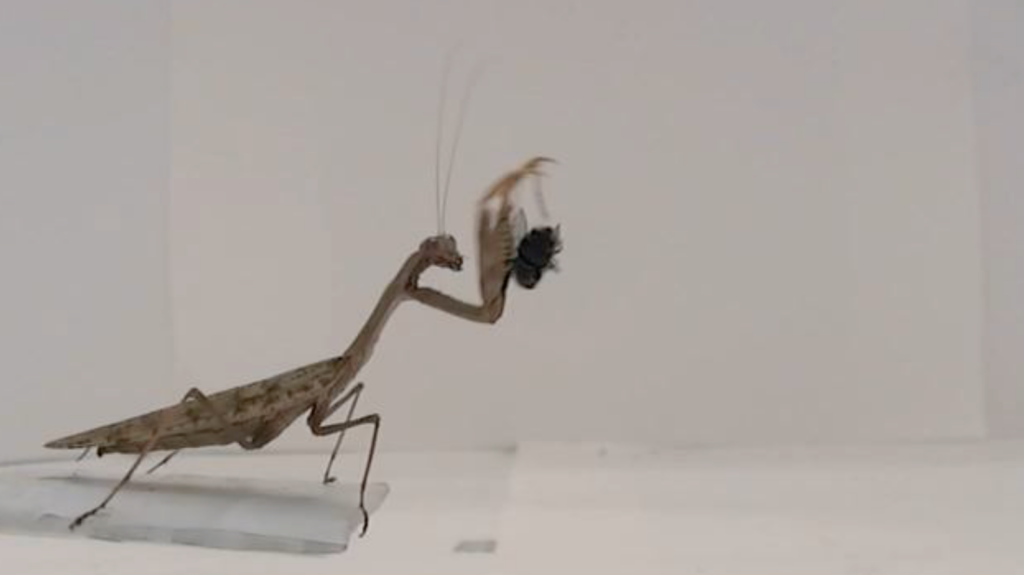
Praying mantises are predatory insects known for their still, folded posture and sudden strike. Their hunting behavior relies on patience, camouflage, sharp vision, and fast front-leg movement — not long-distance chasing.
Most mantises are ambush predators. They wait on leaves, stems, flowers, bark, or garden plants until suitable prey comes within reach. Then they strike with their enlarged raptorial front legs, secure the prey, and begin feeding.
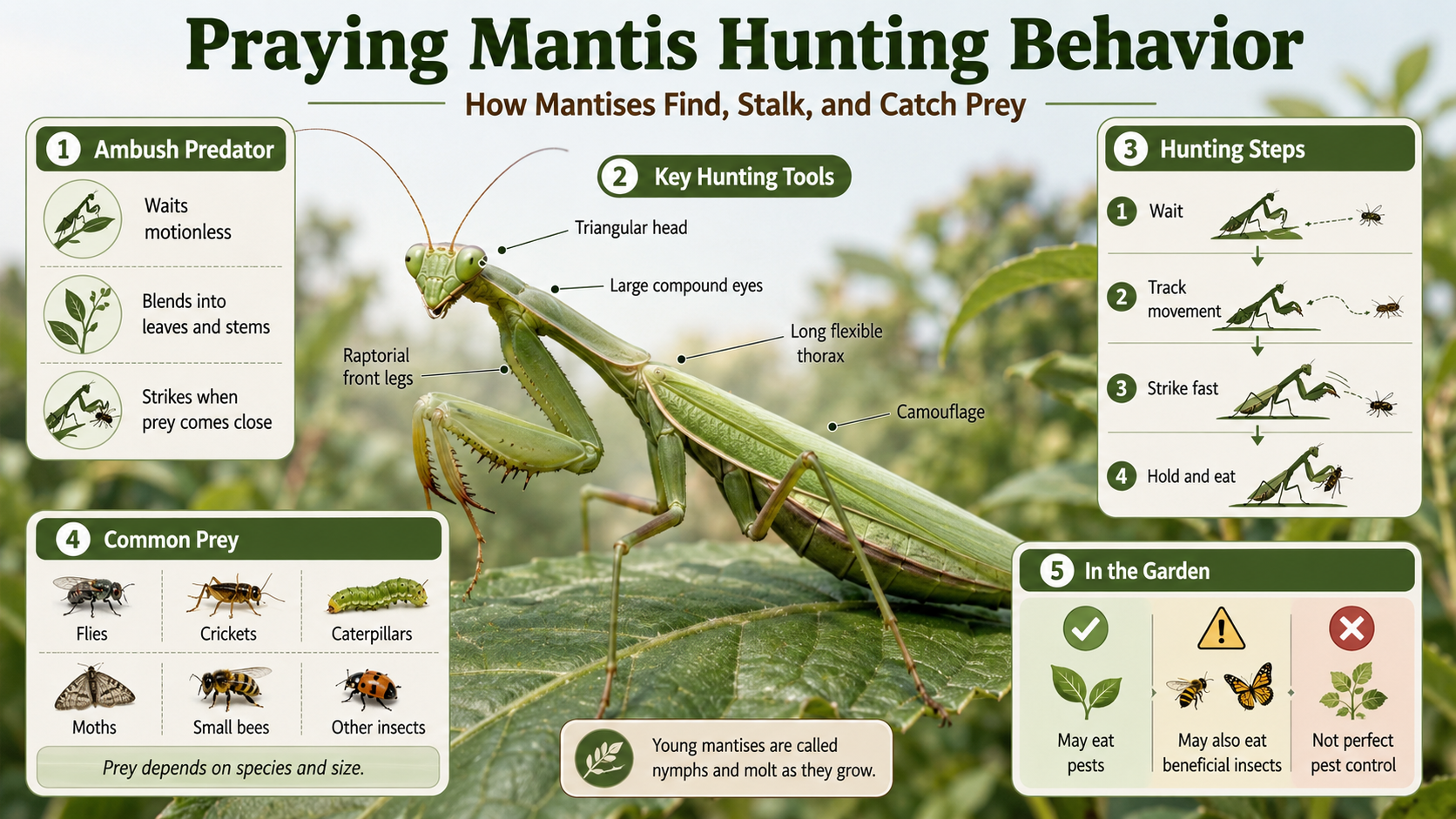
This behavior looks dramatic, but it isn’t mysterious. A mantis is a highly specialized insect predator whose body shape, eyesight, front legs, posture, and camouflage all work together to detect and capture moving prey. Mantises may eat many garden pests, but they also eat pollinators and other beneficial insects — extension sources note that mantids are not selective and may consume butterflies, bumblebees, and nuisance insects alike.
What Is Praying Mantis Hunting Behavior?
Praying mantis hunting behavior refers to the full sequence of how a mantis searches for, detects, approaches, strikes, captures, and eats prey.
In many species, this process includes:
- Waiting motionless in a good hunting position
- Using camouflage to blend with leaves, twigs, bark, flowers, or grass
- Turning the head to follow movement
- Judging whether prey is close enough to strike
- Snapping the spiny front legs forward
- Holding prey while feeding
Mantises hunt live animals. Depending on species and size, prey may include flies, moths, crickets, grasshoppers, caterpillars, bees, butterflies, beetles, spiders, and other small animals. Larger mantises may occasionally catch small vertebrates, but in most garden observations, insects and other arthropods make up the typical diet.
Exact behavior varies by species, age, season, habitat, and prey availability. A tiny nymph hunting fruit flies or aphids behaves quite differently from a large adult waiting near flowers for bees or moths.
Are Praying Mantises Ambush Predators?
Yes. Praying mantises are generally described as ambush predators. They don’t normally roam in search of prey the way a wolf spider or ground beetle might. Instead, they wait quietly where prey is likely to pass.
The familiar “praying” posture is part of this strategy. The front legs are folded and ready — not because the mantis is passive, but because those legs are specialized capture tools.
The American Museum of Natural History explains that mantises use camouflage not only to avoid predators but also to set up ambushes. A mantis may remain motionless against bark, grass, leaves, or flowers, then strike when prey enters range.
This approach conserves energy. Rather than pursuing every insect in view, the mantis waits for a reasonable opportunity — which makes it an efficient predator in gardens, meadows, shrubs, and woodland edges where insects move regularly through vegetation.
How a Praying Mantis Detects Prey
Mantises rely heavily on vision. Their large compound eyes detect movement, shape, and distance. When a mantis notices a potential prey animal, it often turns its head and tracks the target.
Research on mantis predatory behavior notes that mantises use acute vision to follow both prey and potential threats, turning their heads to keep a moving target in an important part of their visual field.
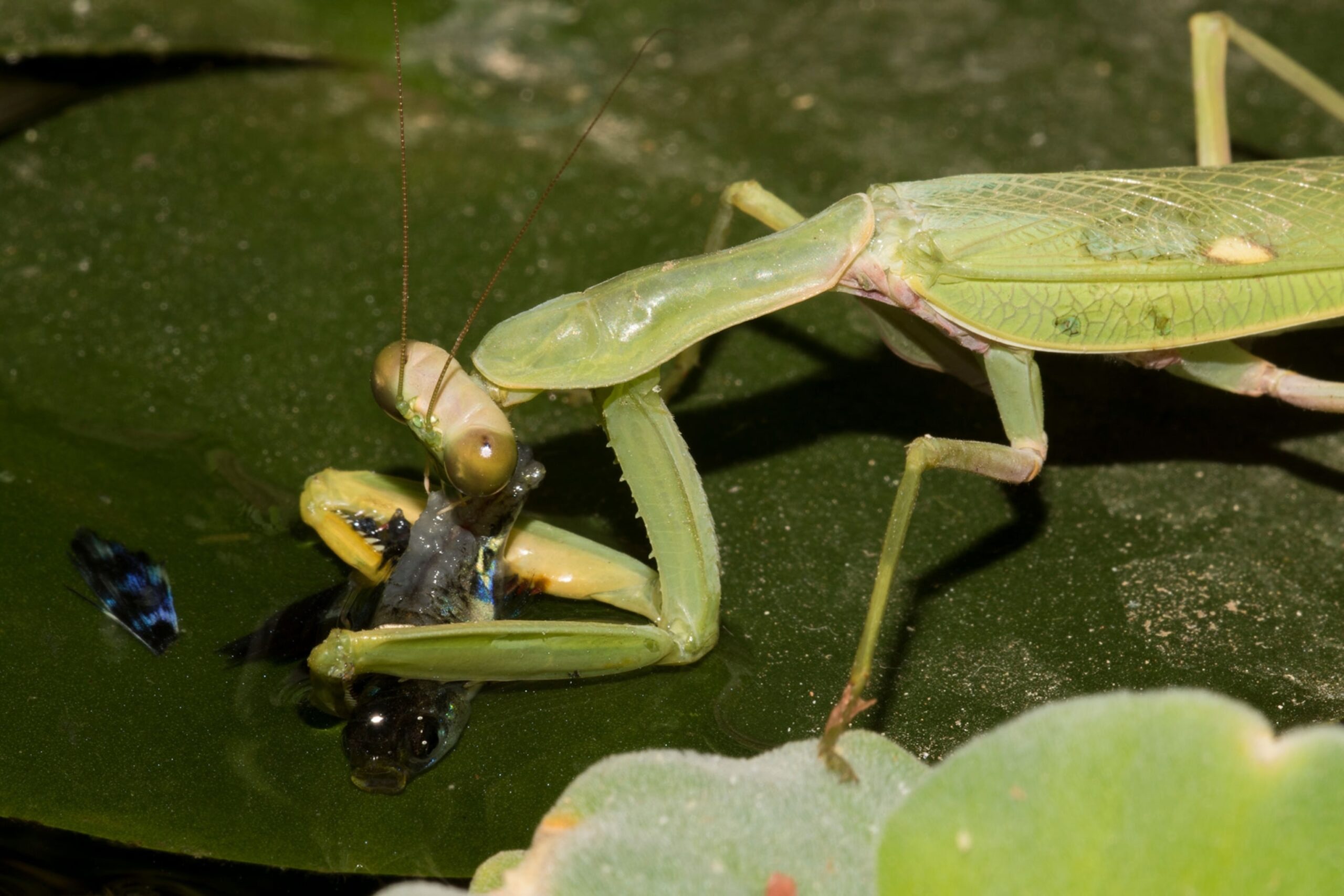
For anyone watching a mantis, this head movement is one of the easiest things to notice. The mantis appears to “look” at a fly, cricket, or passing hand. In reality, it’s tracking movement and deciding whether the object is prey, a threat, or something to ignore.
Mantises respond more readily to moving prey. A still insect may be overlooked, while one that is walking, flying, or twitching is much more likely to draw attention.
The Mantis Hunting Process Step by Step
1. Waiting and Blending In
A mantis typically selects a position where insects are likely to pass — a flower head, shrub, vegetable plant, tall grass stem, vine, or tree branch.
Green mantises blend with leaves and stems. Brown mantises are difficult to spot against dry grass, bark, or dead plant material. Some species have body shapes that closely resemble twigs, leaves, or flowers.
This stillness isn’t laziness. It’s the hunting method. By staying motionless, the mantis reduces its chance of being detected by prey.
2. Tracking Movement
When a prey animal appears, the mantis may slowly turn its head or shift its body. It typically waits until the prey moves into range.
A mantis doesn’t strike at everything. Prey generally needs to be close enough, the right size, and moving in a way that triggers the hunting response.
Size matters here. A small nymph focuses on tiny, soft-bodied insects, while a large adult can handle bigger flies, moths, grasshoppers, crickets, or bees. Prey that is too large, too fast, or potentially dangerous is often ignored.
3. Striking with the Front Legs
The strike is the most recognizable part of mantis hunting behavior.
A mantis has enlarged front legs built for grasping — commonly called raptorial legs. They fold like a spring-loaded trap and are lined with spines that grip struggling prey. When prey comes within range, the mantis rapidly extends these legs, grabs the prey, and pulls it toward its mouthparts.
The strike is fast, but not impulsive. The mantis has already tracked the prey and judged the distance before moving.
4. Holding and Eating Prey
After the strike, the mantis holds prey with its spiny front legs and begins eating. Mantises have chewing mouthparts and consume prey piece by piece.
Mantises are not venomous like spiders, and they don’t sting like wasps. Their primary hunting tools are vision, camouflage, speed, and their gripping front legs.
What Do Praying Mantises Hunt?
Mantis diet varies by species, body size, habitat, and life stage. Common prey may include:
- Flies
- Moths
- Crickets
- Grasshoppers
- Caterpillars
- Bees
- Butterflies
- Beetles
- Leafhoppers
- Aphids (especially for small nymphs)
- Spiders and other small arthropods
Small nymphs target tiny prey because they can’t overpower larger insects. As they molt and grow, they take on larger prey. A Connecticut Agricultural Experiment Station fact sheet notes that mantis nymphs hatch in spring, disperse, and begin hunting while progressing through several molts during the growing season.
Even adult mantises are limited by their body size and the prey available in their habitat.
Do Praying Mantises Chase Their Prey?
Not usually. Mantises are not pursuit hunters. They may slowly reposition, creep closer, or lean forward to improve their angle — but they don’t chase prey across open ground for long distances. This is why mantises are typically spotted waiting on plants rather than patrolling like ants or running beetles.
That said, behavior varies. Some individuals are more active than others, and a hungry mantis may move more frequently between hunting spots. Habitat plays a role too. A mantis in dense vegetation may need only to wait, while one in sparser surroundings may relocate more often.
How Nymphs Hunt Compared with Adult Mantises
Young mantises are called nymphs. They hatch from egg cases called oothecae and resemble miniature adults, though they are wingless and much smaller.
Nymphs begin hunting soon after hatching. Because of their size, they target small prey — aphids, small flies, tiny caterpillars, or other soft-bodied insects. They’re also vulnerable themselves and may be eaten by larger mantises or other nymphs.
As nymphs molt and grow, they’re able to take on larger prey. After several molts, they reach adulthood. Adults can generally capture larger prey, and many species can use wings for short flights or gliding, though sustained flight is uncommon.
How Camouflage Helps Mantises Hunt
Camouflage is central to praying mantis hunting behavior.
A mantis that blends into its surroundings gains two advantages: prey is less likely to notice it, and predators — birds, reptiles, larger insects — have a harder time finding it.
Different species use different approaches. Some resemble green leaves. Others match dry twigs, bark, dead leaves, or flowers. Posture plays a role too — a mantis may align its body with a stem or sway slightly in a way that mimics plant movement in a breeze.
This camouflage isn’t purely defensive. The AMNH notes that mantises use disguise to help ambush prey, not merely to avoid predators. For gardeners and nature observers, this explains why a mantis can be sitting in plain view and still be nearly impossible to spot.
Hunting Behavior in Gardens
Gardens attract insects, which makes them common hunting grounds for mantises. Flower beds, vegetable patches, shrubs, and tall grasses all offer suitable spots.
A garden mantis may catch caterpillars, flies, grasshoppers, or leafhoppers — which is why many gardeners view mantises as beneficial. But the picture is more complicated than that.
Mantises don’t distinguish between pest insects and helpful ones. The University of New Hampshire Extension states that praying mantids are just as likely to catch butterflies or bumblebees as nuisance caterpillars, making them a neutral factor in the garden rather than a reliable pest-control solution. North Carolina State Extension makes a similar point: mantids are indiscriminate ambush predators.
For this reason, releasing purchased mantis egg cases into a garden isn’t always a sound approach. It may not resolve pest problems, and in some regions, non-native mantis species raise ecological concerns. For serious pest issues, it’s worth consulting a local extension service or qualified pest-control professional.
Common Misconceptions About Mantis Hunting
Misconception 1: Praying mantises only eat pest insects. Mantises eat what they can catch. That may include pest insects, but it also includes pollinators and other beneficial species. A mantis on a flower is just as likely to catch a bee or butterfly as a fly.
Misconception 2: Mantises are reliable garden pest control. Mantises can be part of a healthy garden ecosystem, but they aren’t a complete pest-control method. They’re not selective, and extension guidance generally warns against treating them as a simple solution to pest problems.
Misconception 3: Mantises hunt people or attack when approached. Praying mantises don’t hunt humans. A mantis may turn its head toward a hand, camera, or passing movement — but that’s tracking behavior, not aggression. Large mantises may bite or pinch if handled roughly, but they’re not dangerous to most people. The best approach is to observe quietly without unnecessary handling.
Misconception 4: All mantises hunt the same way. The basic ambush strategy is common across species, but individual behavior varies. Species, body size, habitat, temperature, hunger, sex, and age all play a role. A flower-dwelling mantis, a bark-camouflaged mantis, and a garden mantis on tomato plants may all hunt in somewhat different ways.
Misconception 5: One egg case means many adult mantises. An ootheca may contain many eggs, but survival rates are low. Newly hatched nymphs disperse quickly, and many are eaten by other predators. The Connecticut Agricultural Experiment Station notes that nymphs are cannibalistic and disperse after hatching — so mass survival is unusual.
Why Mantises Sometimes Eat Other Mantises
Cannibalism occurs in praying mantises, particularly when individuals are crowded, hungry, or mismatched in size. Nymphs may eat smaller nymphs, and adults may eat other mantises given the opportunity.
This partly explains why mantis populations don’t tend to explode in a garden even after a large hatch. UNH Extension notes that mantids prey on each other, making it unlikely that released mantises will become extremely abundant in a landscape.
Cannibalism isn’t unique to mantises, but it’s one of the behaviors that makes them particularly interesting predators to study.
When Are Praying Mantises Most Active Hunters?
Mantis activity depends on temperature, season, prey availability, and species. In many temperate regions, nymphs appear in spring, grow through summer, and adults become more visible in late summer or fall. The Connecticut Agricultural Experiment Station describes eggs overwintering in oothecae, hatching in spring, and adults appearing in late summer.
Warmer weather typically increases insect activity, which also creates more hunting opportunities for mantises. In cooler conditions, mantises tend to move and hunt less frequently.
In gardens, they’re often noticed when they settle on flowers, vegetable plants, fences, shrubs, or tall weeds where other insects are active.
How to Observe Mantis Hunting Behavior Safely
The best approach is to watch quietly without disturbing the insect. Good observation spots include:
- Flowering plants with regular insect visitors
- Vegetable gardens
- Shrubs and hedges
- Tall grass and meadow edges
- Stems near outdoor lights, where moths or flies gather at night
A camera or binoculars can help you get a closer look without getting in the way. Avoid placing prey in front of a mantis for entertainment, especially if the prey is too large or could fight back. Don’t release non-native mantises or purchased oothecae without checking local guidance first.
For classrooms, home gardens, and family nature study, mantises are excellent subjects for observing predator behavior, camouflage, molting, and insect life cycles.
About This Article
This article is written for general nature education, garden observation, and beginner-friendly insect learning. Praying mantis behavior varies by species, region, age, season, climate, and habitat.
For serious garden pest problems, local invasive species concerns, or questions about releasing insects, consult your local extension service, pest-control professional, or wildlife authority. This article is not a substitute for local ecological or pest-management guidance.
Conclusion
Praying mantis hunting behavior is built around patience, camouflage, vision, and a rapid strike. Most mantises are ambush predators that wait for live prey to come within range before grabbing it with their spiny front legs.
They’re impressive hunters, but not selective ones. A mantis may catch garden pests, but it may also catch bees, butterflies, and other beneficial insects. The most accurate way to understand them is as generalist predators within a larger ecosystem — not targeted pest-control tools.
For anyone new to watching mantises, the key takeaway is straightforward: a praying mantis doesn’t hunt by chasing. It hunts by waiting, watching, blending in, and striking at exactly the right moment.
Frequently Asked Questions
Do praying mantises hunt or wait for prey? Praying mantises usually wait rather than chase. Most are ambush predators that sit still on plants, track nearby movement, and strike when prey comes close enough.
What do praying mantises usually eat? They eat live prey including flies, moths, crickets, grasshoppers, caterpillars, bees, butterflies, beetles, spiders, and other small animals. Their exact diet depends on species, size, habitat, and life stage.
Do praying mantises eat garden pests? Yes, they may eat garden pests such as caterpillars, flies, grasshoppers, and leafhoppers. However, they also eat beneficial insects including bees and butterflies, so they aren’t reliable pest-control insects.
Are praying mantises good for gardens? They can be interesting and occasionally helpful garden predators, but they shouldn’t be treated as a complete pest-control solution. Mantises are generalist predators and don’t select only pest insects.
Do baby praying mantises hunt? Yes. Nymphs begin hunting small prey shortly after hatching. They grow by molting and can capture larger prey as they develop.
What is a praying mantis egg case called? It’s called an ootheca. In many temperate species, the ootheca protects eggs through winter, and nymphs hatch in spring.
Do praying mantises hunt at night? Some mantises may feed or move in low light, but many are observed during the day waiting on plants for active insects. Activity varies by species, temperature, and prey availability.
Do praying mantises bite humans? Praying mantises don’t hunt humans. A large mantis may bite or pinch if handled roughly, but they’re not dangerous to most people. Quiet observation without handling is the best approach.