
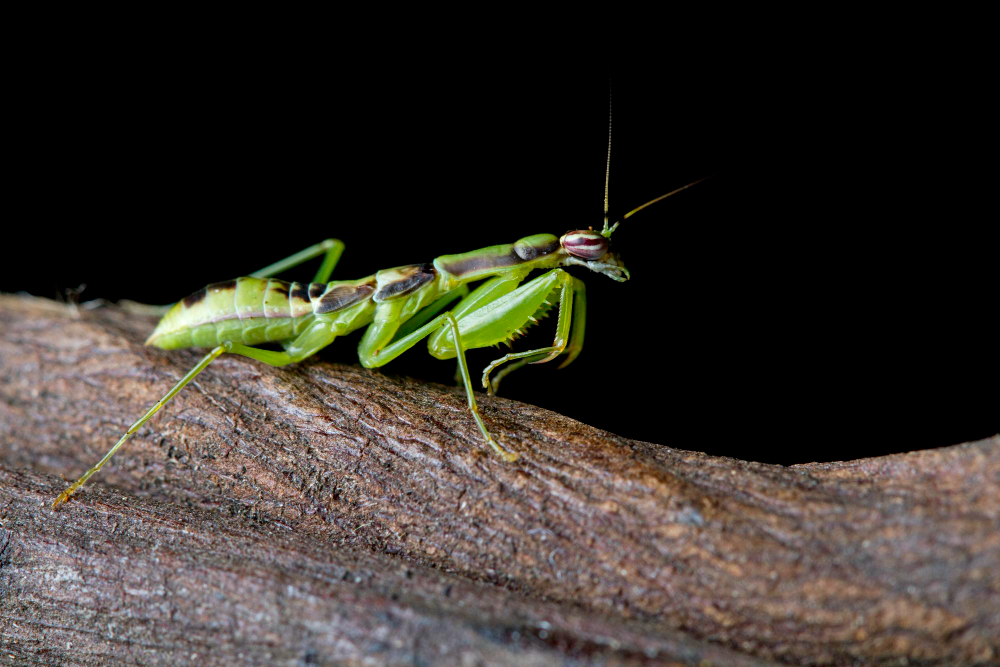
A small praying mantis is most often a young nymph — especially if it looks like a miniature adult but has no fully developed wings. In some cases, it could be a naturally small adult species. Either way, size alone won’t tell you much.
The easiest way to confirm what you’re looking at: check for a triangular head, large forward-facing eyes, and folded spiny front legs held in the familiar “praying” position. Those three features together are a reliable sign you’ve found a mantis, regardless of age or size.
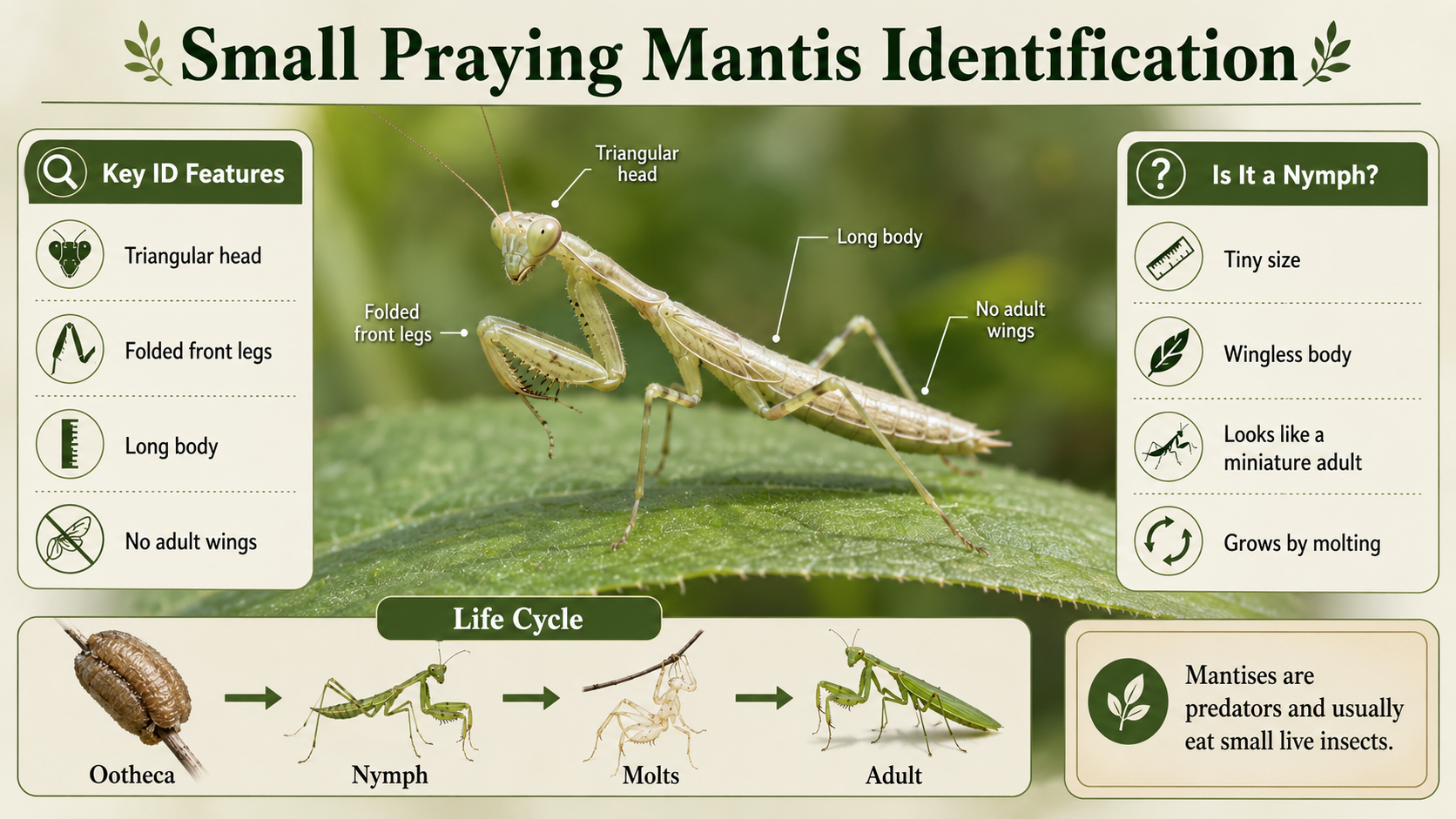
Color varies widely. A small mantis might be green, brown, tan, grayish, or yellowish depending on species, age, and habitat. Whatever color it is, a mantis found in a garden, on a shrub, or on a house wall is harmless to people and is best observed quietly rather than grabbed.
What Is a Small Praying Mantis?
The phrase “small praying mantis” can refer to several different things: a newly hatched mantis, a growing nymph, a juvenile that has molted several times, or an adult of a smaller species. This is why size alone isn’t enough for identification.
Young mantises are called nymphs. They hatch from egg cases called oothecae, then grow by molting. After each molt, the mantis gets larger and closer to its adult form. Immature mantises look like adults but are smaller and lack fully developed wings.
Newly hatched nymphs can look surprisingly delicate — almost transparent in some species. As they grow, the body lengthens, the front legs become more robust, and the typical mantis posture becomes easier to recognize.
Quick Identification Checklist
If you’ve found a small insect and want a fast answer, run through this list.
A small praying mantis usually has:
- A triangular or heart-shaped head
- Large eyes positioned at the upper corners of the head
- A long, narrow body
- Front legs folded upward or forward
- Spines on the grasping front legs
- Slow, deliberate movements — often with a slight swaying motion
- A tendency to sit still on stems, leaves, fences, walls, or garden plants
- No wings, or short undeveloped wing buds (if it’s a nymph)
If the insect has six legs, a narrow body, and front legs that look built for grabbing rather than walking, it’s very likely a mantis. If it’s tiny and wingless, it’s probably a nymph.
Is It a Baby Praying Mantis or a Small Adult?
This is the most important question in small praying mantis identification.
Many people call any tiny mantis a “baby,” but the more accurate term is nymph — an immature mantis that hasn’t yet reached adulthood.
Signs It’s a Mantis Nymph
A small mantis is probably a nymph if it:
- Has no fully developed wings
- Looks like a scaled-down adult
- Has a soft, somewhat delicate body
- Is very small — sometimes only a fraction of an inch long
- Appears in spring or early summer after egg cases hatch
- Is found near a cluster of other tiny mantises
- Has visible wing pads (small stubs) rather than full wings, if it’s older
Nymphs grow through a series of molts, shedding their exoskeleton because insects can’t grow inside a fixed hard shell. Right after a molt, a mantis may look pale or fragile until the new exoskeleton hardens.
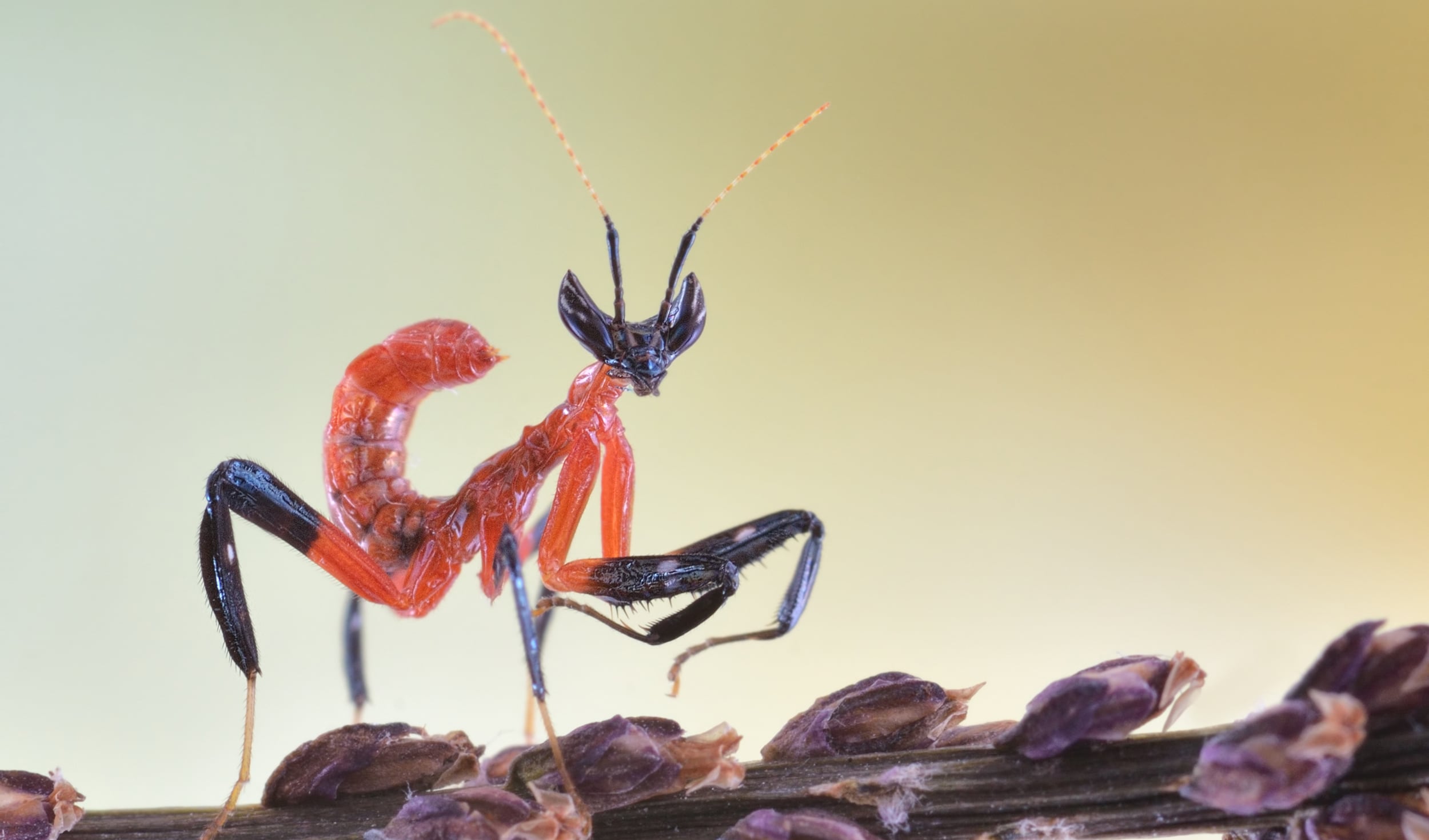
Signs It May Be a Small Adult
A small mantis may be an adult if it:
- Has fully formed wings
- Has a firmer, more complete-looking body
- Is active later in the season
- Has proportions that look mature rather than juvenile
Some mantis species are simply smaller than others. Extension sources describe the Carolina mantis, for example, as smaller than larger introduced species such as the Chinese mantis. This matters: a two-inch mantis might be a full adult of a small species, while the same size in a larger species may still be immature.
Key Features to Look For
When identifying a small praying mantis, focus on body structure rather than color. Color varies too much to be reliable on its own.
Triangular Head
A mantis has a distinct triangular head with large compound eyes. Unlike most insects, a mantis can turn its head noticeably — which gives it an alert, almost watchful appearance that beginners often find striking.
The face may look unusual up close, but the shape of the head and placement of the eyes are exactly what help the mantis detect movement while hunting.
Grasping Front Legs
The most useful identification feature is the pair of enlarged front legs.
These are not ordinary walking legs. They’re raptorial legs — adapted specifically for grabbing and holding prey. They’re usually folded in front of the body, which creates the familiar praying posture. Small spines on the inner surface help the mantis grip prey securely.
Even very small nymphs typically show this feature clearly.
Long Body and Flexible Neck
A mantis body is long and narrow. Color varies by species and surroundings, but the shape is consistent: elongated, with the thorax connecting the head to the abdomen in a way that gives the mantis an unusually upright posture for an insect.
Camouflage plays a big role. A small green mantis can disappear into foliage, while a brown mantis blends into dry stems, bark, or late-season plant debris.
Wingless or Short-Winged Appearance
Wing development is one of the best clues for age.
Young mantises don’t hatch with adult wings. Wing pads develop gradually over several molts. After the final molt, most adult mantises have fully developed wings, though flight ability varies by species and sex.
A small mantis without wings isn’t a different type of insect — it’s almost certainly just immature.
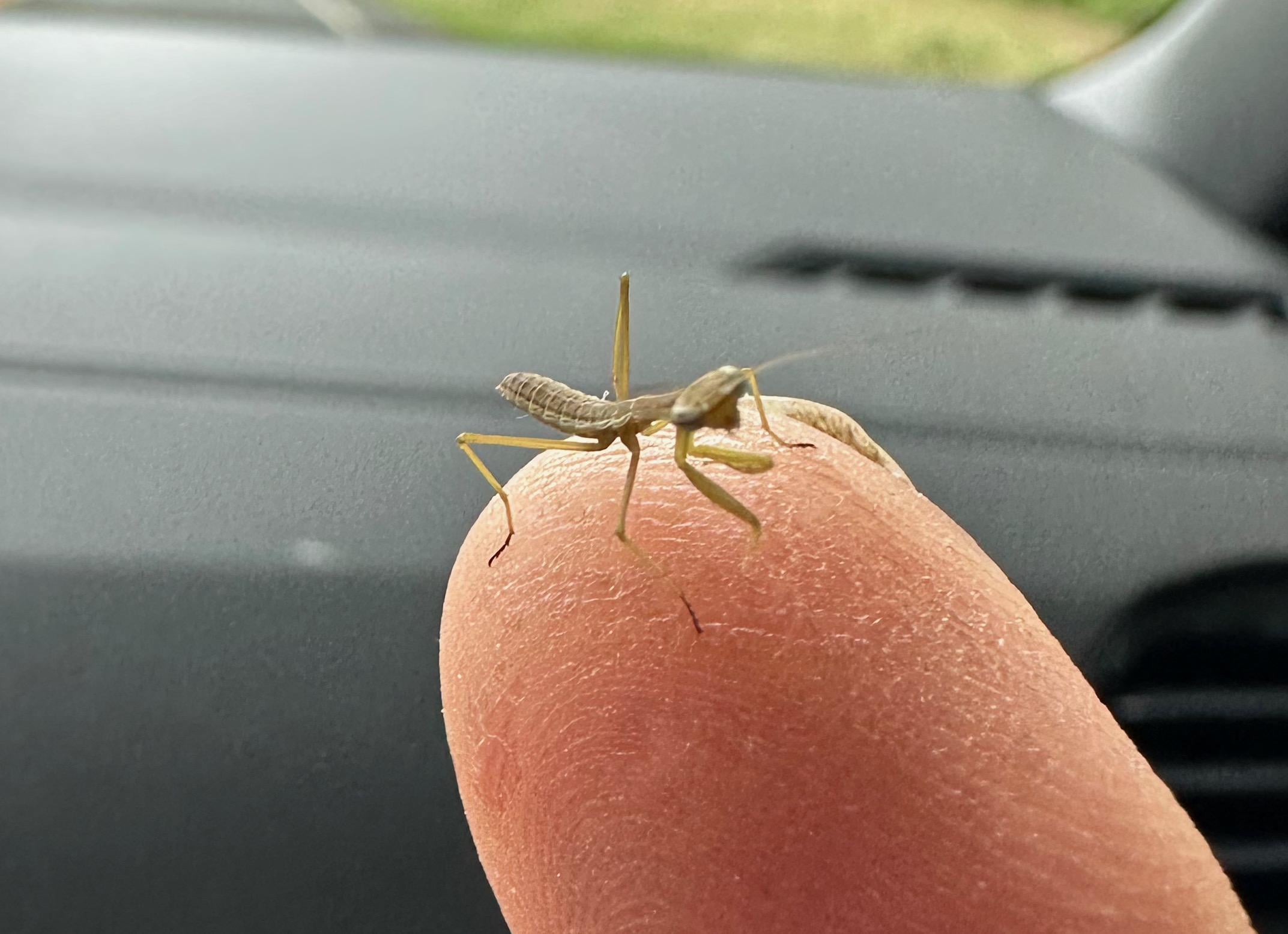
Common Places to Find Small Praying Mantises
Small mantises tend to show up wherever prey insects are available and where they can stay hidden.
You may find them:
- On garden plants, flowers, or vegetable beds
- In shrubs, hedges, or tall grass
- On fences, screens, or porch walls
- Near outdoor lights (which attract prey insects)
- Around windows
- On houseplants that have been kept outdoors
- Near oothecae attached to stems, twigs, or structures
Oothecae are the foam-like egg cases that protect mantis eggs. They’re often attached to stems, twigs, branches, or sheltered surfaces and can be easy to miss until you know what to look for. If you see several tiny mantises in one area, an ootheca may have hatched nearby.
What Do Small Praying Mantises Eat?
Small praying mantises are predators, just like adults. They hunt live prey small enough to catch and hold.
Young mantises typically eat:
- Aphids
- Fruit flies
- Small flies and moths
- Tiny leafhoppers
- Small caterpillars
- Other soft-bodied insects and small arthropods
As they grow, they can take larger prey. Adults of larger species may catch flies, grasshoppers, crickets, moths, bees, butterflies, and other insects.
It’s worth being clear about this: mantises are not plant feeders. They don’t chew leaves. Their body plan is built for hunting, not browsing. If you see leaf damage near a small mantis, another insect is responsible. In educational or captive-care settings, young mantids are commonly fed fruit flies or aphids — which reflects their natural predatory diet.
Are Small Praying Mantises Good for the Garden?
Mantises can be interesting garden predators, but they’re not a targeted pest-control solution.
They may eat pest insects such as flies, aphids, and small caterpillars. But they’re generalist predators — they don’t distinguish between harmful and beneficial insects. A mantis may just as easily catch a bee, butterfly, or lacewing.
Utah State University Extension notes that mantids are not host-specific and may eat pests, pollinators, and other beneficial insects alike. It also cautions that they aren’t among the most effective biological control agents.
That doesn’t make mantises “bad.” It means they should be understood honestly: a mantis in the garden is part of the food web, not a pest-control guarantee.
If you have a serious garden pest problem, integrated pest management practices and advice from a local extension service will be more reliable than hoping for mantises.
Common Misconceptions About Small Praying Mantises
Misconception 1: Every Small Mantis Is a Baby
Many small mantises are nymphs, but not all are freshly hatched. Some may be older juveniles; some may be adults of smaller species. Size needs to be read alongside season, wings, body proportions, and what species are known in your area.
Misconception 2: Green and Brown Mantises Are Always Different Species
Color alone is not reliable for identification. Some mantis species appear in multiple color forms — green, brown, and yellowish phases are known. UC IPM notes that a single species can have different color phases. Color may also shift with age, molt stage, or the surroundings where the mantis lives.
Misconception 3: Small Mantises Eat Plants
Praying mantises are not plant feeders. If there’s leaf damage nearby, something else caused it. The mantis may simply be there because prey insects are present.
Misconception 4: Mantises Only Eat Harmful Bugs
A mantis eats whatever live prey it can catch. It has no preference for pest insects over beneficial ones. Treating mantises as perfect garden protectors overstates what they actually do.
Misconception 5: Finding Tiny Mantises Indoors Means an Infestation
Finding one small mantis indoors is usually not a sign of infestation. A nymph can wander in through an open door, window screen, or on a plant brought inside. If several appear at once, an ootheca may have hatched somewhere nearby — possibly on outdoor plants, firewood, or decorations brought indoors.
Small Praying Mantis Lookalikes
A few other insects can trip up beginners, especially at small sizes or in a quick glance.
Assassin Bug Nymphs
Some assassin bug nymphs are slow-moving predators found on plants. They don’t have the same folded raptorial front legs as mantises, and many have a visible piercing beak.
Lacewing Larvae
Lacewing larvae are garden predators but look nothing like mantises up close — more like tiny, bristled alligators. They don’t have a triangular head or the praying posture.
Katydid Nymphs
Katydid nymphs can be green and delicate enough to be mistaken for small mantises. Look at the antennae (very long in katydids) and the hind legs (built for jumping). Their front legs are ordinary walking legs, not grasping arms.
Stick Insects
Stick insects are long and narrow but lack the folded predatory front legs entirely. They’re plant feeders and tend to hold completely still, resembling twigs.
Grasshopper or Cricket Nymphs
Young grasshoppers and crickets may be small and green or brown, but they have strong jumping hind legs and don’t hold their front legs in any kind of raised hunting posture.
What to Do If You Find a Small Praying Mantis
In most cases, the best response is simply to observe and leave it alone.
If it’s outdoors: leave it where it is unless it’s in immediate danger. A garden, shrub, or plant bed is exactly where a mantis should be.
If it’s indoors: gently move it outside. Use a cup and a piece of paper rather than grabbing it with your fingers. Place it on a shrub or sheltered plant where small insects are likely to be present.
Avoid applying pesticides directly around a mantis if you’re trying to protect garden wildlife. Broad-spectrum insecticides affect many insects, not just the ones you’re targeting.
If you find an ootheca, don’t move it casually. In some regions there are concerns about introduced mantis species, and egg cases are best left undisturbed unless there’s a specific reason to act. If you’re unsure, contact a local extension service, garden educator, or wildlife authority for guidance specific to your area.
How to Photograph a Small Praying Mantis for Identification
A clear photo makes identification much easier — especially if you want help from an online community or expert.
Try to capture:
- A side view of the full body
- A front view of the head and forelegs
- A top-down view showing body shape
- Any wing pads or wings
- The plant or surface where it was found
- An approximate size reference — a leaf, a ruler, or a coin placed nearby without disturbing the mantis
One blurry close-up usually isn’t enough. Small mantises are genuinely difficult to identify to species level without clear photos, size, location, and season.
For most beginners, confirming “this is a mantis nymph” is a realistic and useful outcome. Identifying the exact species often requires a regional field guide or someone with local expertise.
About This Guide
This guide is written for general nature education and beginner identification. Praying mantis size, color, diet, behavior, and habitat vary by species, age, molt stage, season, climate, and region.
For local species identification, invasive species questions, pest-control decisions, or wildlife release concerns, consult your local extension service, natural history organization, pest management professional, or wildlife authority.
Conclusion
A small praying mantis is most likely a nymph — especially if it has a triangular head, folded spiny front legs, a long narrow body, and no fully developed wings. That said, some mantis species are naturally small as adults, so size alone isn’t a reliable final answer.
Look at the wings, body proportions, season, and habitat together. If the mantis is outdoors and not in any danger, it’s usually best left where it is. It may eat some garden pests, but it may also eat beneficial insects — so think of it as a general predator rather than a targeted solution.
For most readers, the practical answer is straightforward: if the tiny insect looks like a miniature praying mantis and holds its front legs in a raised, folded hunting posture, you’ve most likely found a young praying mantis nymph.
Frequently Asked Questions
What is a small praying mantis called? A young praying mantis is called a nymph. Nymphs hatch from egg cases called oothecae and grow through a series of molts before reaching adulthood.
How can I tell if a small praying mantis is a baby? A young mantis usually looks like a tiny adult but lacks fully developed wings. Look for a slim body, triangular head, and folded grasping front legs. If it’s very small and wingless, it’s almost certainly a nymph.
Do small praying mantises bite? Small mantises are not dangerous to people. If handled, they may try to grasp or pinch, but they are not venomous and don’t seek out humans. Small nymphs are also quite delicate, so rough handling is more of a risk to the mantis than to you.
What do tiny praying mantises eat? Tiny mantises eat small live prey — typically aphids, fruit flies, small flies, and other tiny insects. Their prey size increases as they grow.
Are small praying mantises good for gardens? They can eat some pest insects, but they’re generalist predators that may also eat beneficial insects such as bees, butterflies, and other predators. They’re better understood as part of the garden ecosystem than as a pest-control tool.
Why did I suddenly find many tiny praying mantises? A large number of tiny mantises appearing at once usually means an ootheca has hatched nearby. Mantis egg cases can contain many eggs, and the nymphs disperse after hatching.
Can I keep a small praying mantis as a pet? Some people do keep mantises successfully, but care requirements vary by species and involve temperature, humidity, and live food. Check local regulations before keeping one, and don’t release non-native mantises into the wild.
Is a brown small mantis a different species from a green one? Not necessarily. Some mantis species have multiple color forms, and an individual’s color can vary with age, habitat, or molt stage. Body shape, wing development, size, location, and known species range in your area are more reliable than color alone.