
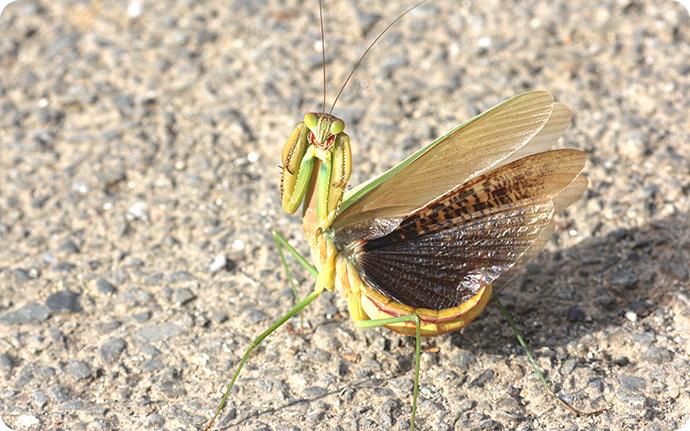
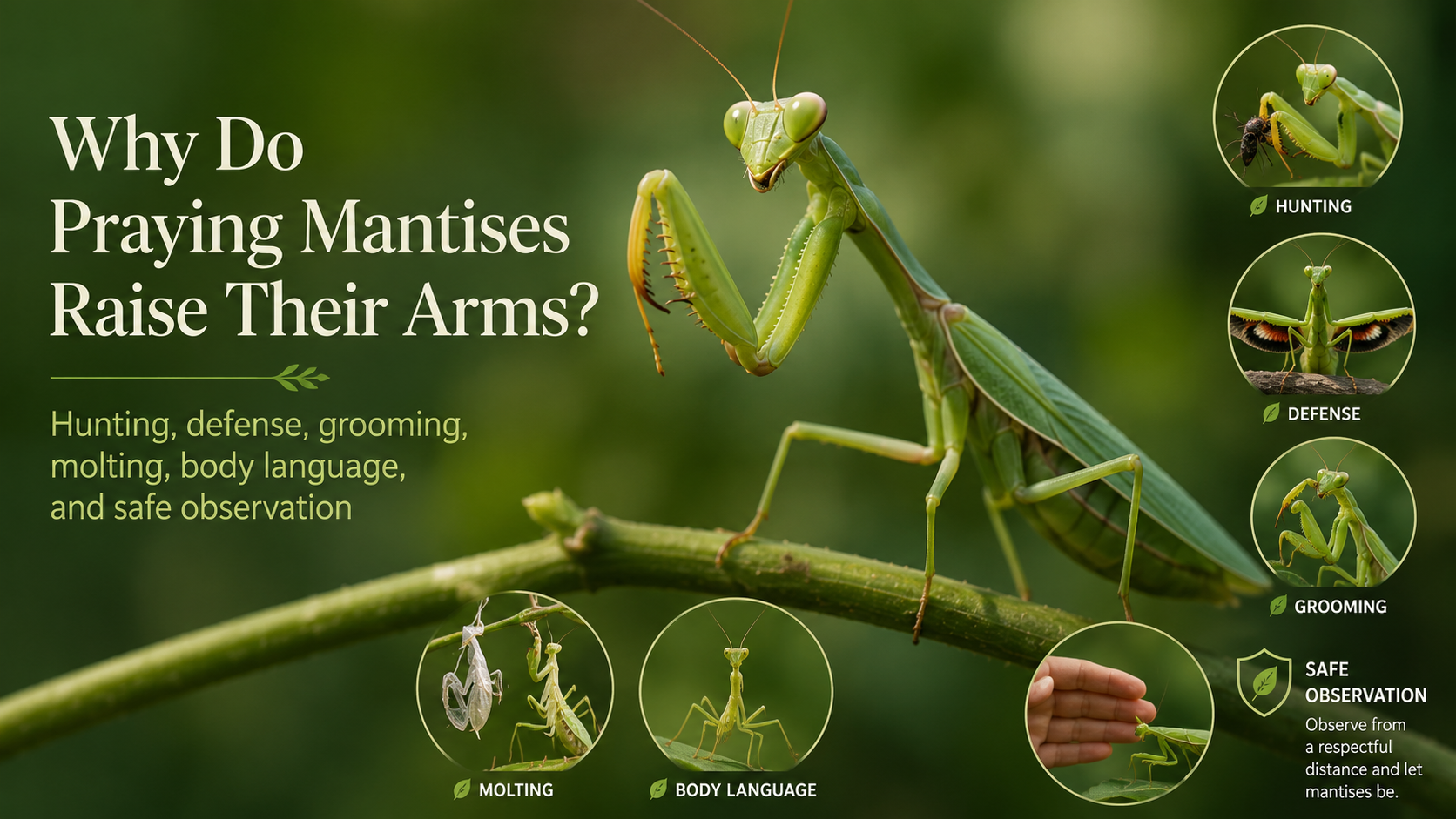
A praying mantis raises its front legs for several possible reasons, including normal resting posture, hunting readiness, tracking movement, grooming, balance, climbing, and defense. The structures commonly called “arms” are actually specialized raptorial forelegs used mainly for catching and holding prey. Folded or slightly raised forelegs usually indicate resting, alertness, tracking, or hunting readiness. Forelegs spread widely together with a raised body or open wings are more likely to indicate a defensive display.
Quick Answer
A praying mantis does not raise its front legs for only one reason. The correct interpretation depends on the position of the legs, wings, body, and head, as well as what is happening nearby.
Are Praying Mantis “Arms” Actually Arms?
No. A praying mantis is an insect, so it has six legs. The structures people commonly call its arms are the front pair of legs.
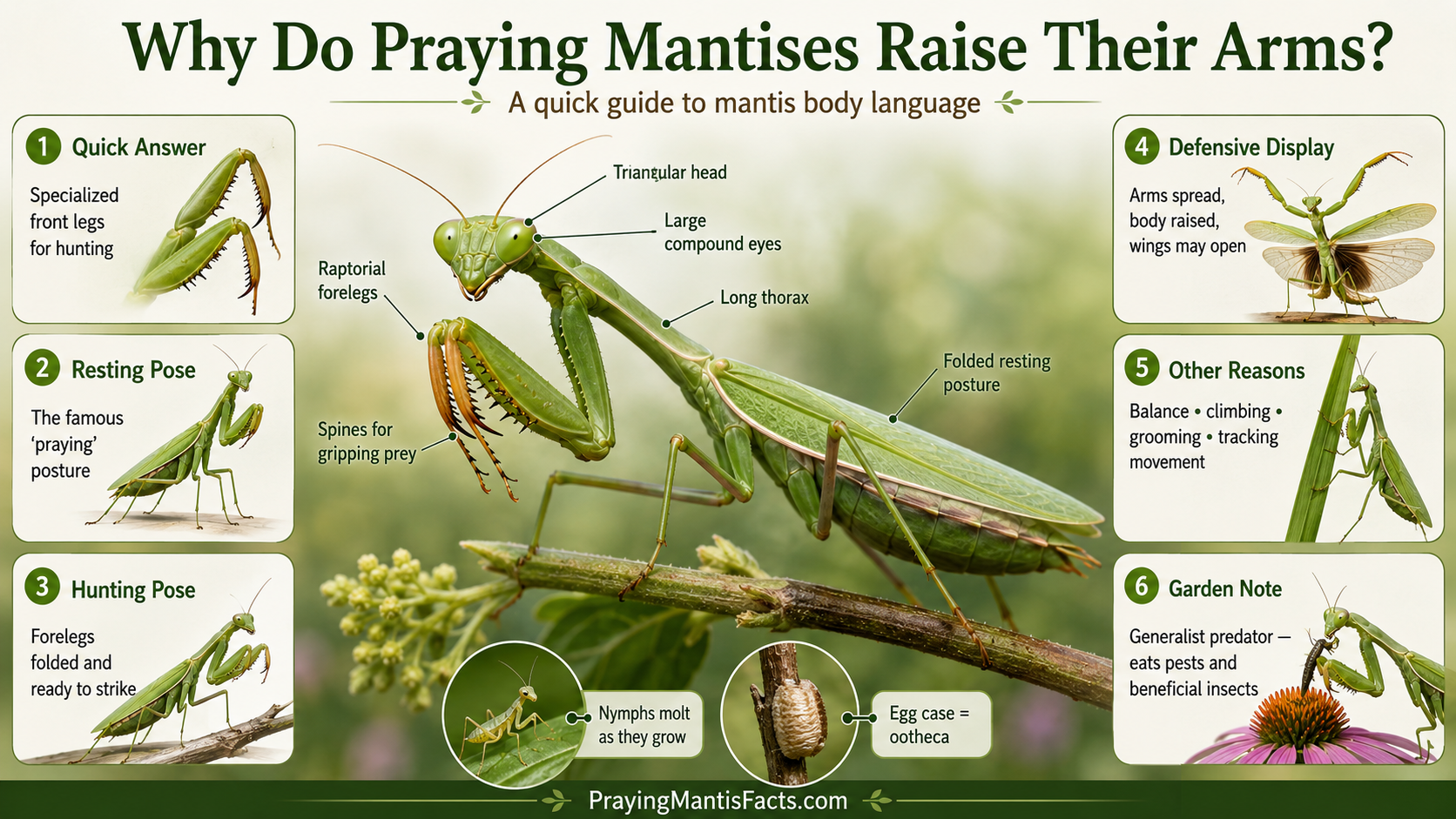
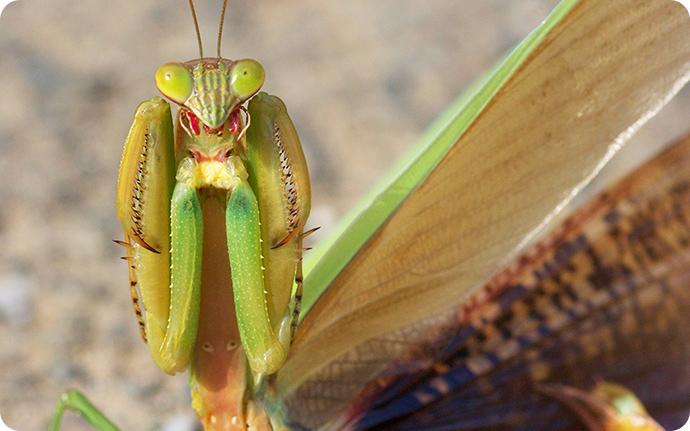
These specialized limbs are known as raptorial forelegs. They are adapted for seizing and restraining prey. Enlarged sections of each foreleg fold together, while rows of spines help prevent a captured insect from escaping.
The middle and hind legs provide most of the support used for walking and gripping vegetation. The front legs can also touch surfaces and assist with positioning, but their defining function is prey capture.
The precise answer: when a praying mantis appears to raise its arms, it is raising or repositioning its specialized front legs.
Why the Raised Pose Looks Like Praying
The common name “praying mantis” comes from the way the forelegs fold in front of the head and thorax. To a human observer, the position resembles hands held together in prayer.
The resemblance is visual, not behavioral. A mantis is not praying, greeting someone, or deliberately copying a human gesture. The pose results from the anatomy of its raptorial forelegs and the way it holds them while resting, watching its surroundings, or waiting for prey.
Main Reasons Praying Mantises Raise Their Front Legs
1Hunting and Waiting for Prey
Many mantises are ambush predators. Instead of continuously chasing prey, they often remain still on a leaf, flower, twig, fence, or other perch and wait for a suitable animal to move close enough.
During this waiting period, the raptorial forelegs are usually folded and ready. The mantis can extend and close them around prey when the target enters striking range.
A folded praying mantis hunting posture does not mean that a strike will happen immediately. The insect may remain in the same position for a long time while waiting.
2Tracking Nearby Movement
A mantis may lift its forelegs slightly while turning its head toward a moving object. That object could be an insect, a shifting leaf, a camera, a finger, or something else entering its visual field.
Mantises are visual predators. Their tracking and striking responses can be influenced by an object’s movement, size, contrast, shape, and distance.
A mantis that appears to be watching a person is responding to visual movement. This should not be interpreted as recognition, affection, greeting, or human-like curiosity.
3Normal Resting or Alert Posture
Folded forelegs are a normal part of praying mantis anatomy and behavior. A motionless mantis with its forelegs close to the body may simply be resting or maintaining an alert ambush position.
Stillness also helps many mantises remain difficult for both prey and predators to detect. A slightly raised foreleg does not, by itself, indicate aggression, fear, or an imminent attack.
4Defensive Display
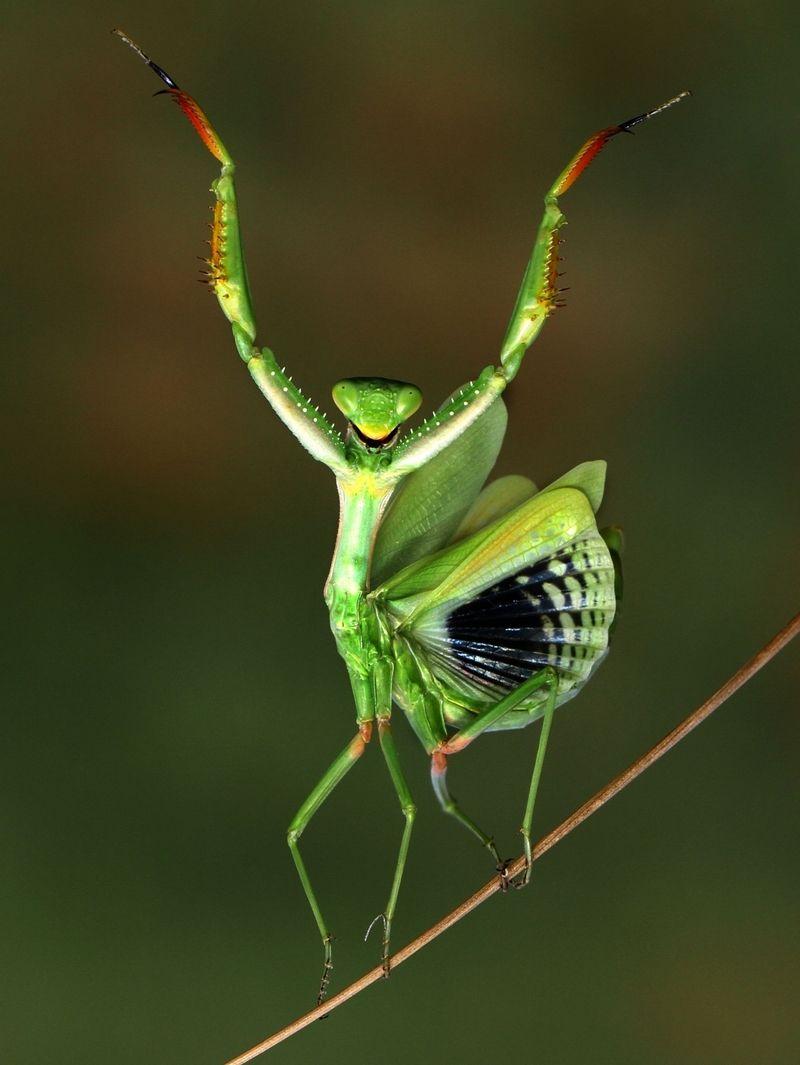
A mantis may spread its forelegs when it detects a nearby threat. Some species combine this movement with a raised front body, opened wings, exposed colors, rocking, lunging, or defensive striking.
This praying mantis threat display is different from the ordinary folded position. It may help interrupt or discourage an approaching predator, make the mantis appear larger, or create an opportunity to escape.
Not every species performs the same display. Age, sex, developmental stage, environment, and the type of threat can affect the response.
5Balance and Climbing
Mantises move across complex surfaces, including stems, leaves, bark, walls, screens, and narrow branches. During movement, a mantis may lift one foreleg, test a nearby surface, or adjust its body position.
A mantis raising one leg while crossing an uneven surface may therefore be balancing or preparing its next movement, especially when its body is moving forward and no defensive signals are visible.
6Grooming
Praying mantises regularly clean their bodies. Grooming may involve moving a foreleg toward the mouthparts, rubbing the forelegs together, or cleaning around the head and antennae.
One foreleg moving repeatedly toward the mouth is more consistent with grooming than with a defensive display. The action is usually controlled and repetitive rather than wide, sudden, or directed toward an approaching object.
7Stress or Possible Pre-Molt Behavior
Environmental disturbance can change how a mantis holds its body. Repeated handling, a nearby pet, an unsuitable enclosure, or a large object moving too close may produce freezing, escape attempts, defensive movements, or unusual postures.
Molting should be considered only when several signs occur together. A nymph that remains suspended, becomes less active, refuses food, and maintains an unusual position may be approaching a molt.
Raised forelegs alone are not a reliable pre-molt sign. A mantis that briefly lifts its legs while watching movement should not automatically be described as preparing to molt.
Raised Arms During Hunting
During hunting, a mantis may remain almost completely still before making small adjustments as prey approaches. Its forelegs stay folded but ready, allowing the insect to respond when the target enters reach.
- Remaining still on a suitable perch
- Turning toward movement with the head and body
- Adjusting body position and judging distance
- Holding the forelegs ready while the prey approaches
- Striking when the prey is within reach
Does a praying mantis raise its arms before attacking? It may hold its forelegs in a ready position before striking prey, but the same folded posture also occurs during ordinary resting. A likely hunting sequence usually includes focused tracking, body orientation toward a prey-sized target, and careful adjustment of striking distance.
Learn more about the full capture sequence in How Do Praying Mantises Hunt? and Praying Mantis Hunting Behavior.
Raised Arms During Defense
A clearly defensive mantis usually looks different from a quietly hunting or resting mantis. The insect may become taller, wider, and more visually conspicuous.
A strong defensive posture may include:
- Forelegs spread outward
- The front of the body raised
- Wings opened
- Hidden colors or patterns exposed
- Rocking or swaying
- Lunging or striking
- Facing the perceived threat
These signals should be interpreted together. Spread forelegs without open wings may represent a moderate defensive response, while widely displayed forelegs, open wings, exposed markings, and repeated strikes suggest a stronger reaction.
The mantis is not preparing to hunt a human. It is more likely attempting to discourage a large approaching object, protect itself from contact, or create an opportunity to escape.
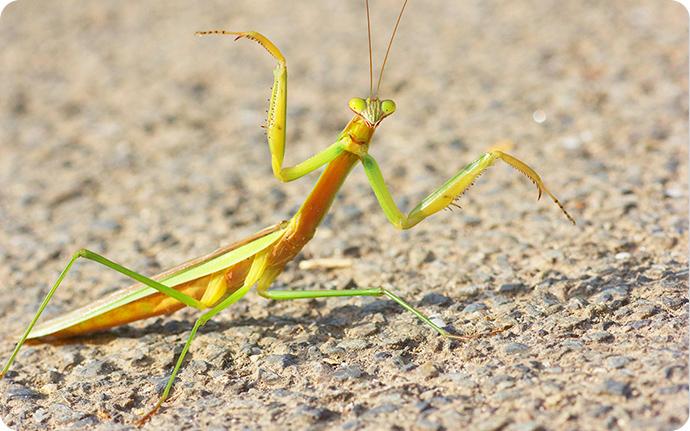
Raised Arms vs. Spread Arms
The position and intensity of the movement help distinguish normal posture from a defensive response.
Usually normal resting, alert waiting, or hunting readiness.
May indicate visual tracking, balance, climbing, grooming, or adjustment of position.
May indicate a defensive response, particularly when a large object is nearby.
More likely to be a strong defensive or startle display.
The mantis probably feels directly threatened, cornered, or repeatedly disturbed.
Most important distinction: folded forelegs are normal for a mantis. Widely spread forelegs accompanied by a raised body, open wings, or repeated strikes are much more suggestive of defense.
How to Read Praying Mantis Body Language
Do not judge praying mantis body language from the forelegs alone. Observe the complete posture and immediate surroundings.
- Are the wings closed or open?
- Is the front of the body raised?
- Is the head following a moving object?
- Is one foreleg moving toward the mouth?
- Is suitable prey nearby?
- Is the mantis climbing or testing a surface?
- Is a hand, camera, or pet too close?
- Is a nymph hanging still and refusing food?
Species, age, sex, body size, environment, temperature, life stage, and previous activity can all affect how a posture appears. One movement should therefore be treated as a clue rather than a complete explanation.
Additional posture and movement guides can be found in the Mantis Behavior section.
Praying Mantis Posture Comparison Table
| Observation | Possible Meaning | Other Signs | Recommended Response |
|---|---|---|---|
| Forelegs folded close to the body | Normal resting or hunting readiness | Wings closed, body still, neutral posture | Observe without disturbing it |
| Forelegs slightly raised | Alertness, tracking, balance, or movement preparation | Head follows movement; body may slowly turn | Keep some distance and watch the complete posture |
| One foreleg moving toward the mouth | Grooming | Repeated rubbing or cleaning near the mouth, head, or antennae | No action is needed |
| Forelegs ready while prey is nearby | Hunting posture | Head and body oriented toward a small moving animal | Avoid interrupting the hunting sequence |
| Forelegs spread wide | Possible defensive response | Body raised; mantis faces a large nearby object | Move back and give it space |
| Forelegs spread with wings open | Strong defensive or startle display | Colors exposed, rocking, lunging, or turning toward the threat | Stop approaching and do not provoke it |
| Nymph hanging still before a possible molt | Possible pre-molt behavior when combined with other signs | Reduced feeding, prolonged inactivity, secure hanging position | Do not handle or disturb it |
| Forelegs striking toward a nearby hand or object | Direct defensive reaction or repeated disturbance | Facing the object, raised body, or attempted escape | Withdraw the object and leave the mantis alone |
What Should You Do When a Mantis Raises Its Arms?
First, stop moving closer and look at the full posture. A mantis with calmly folded forelegs may simply be resting or watching movement. No intervention is necessary.
If the mantis spreads its legs, lifts the front of its body, opens its wings, retreats, or strikes, increase the distance between it and the perceived threat. Move away any hand, camera, pet, or other large object.
Do not poke the insect to make it repeat a dramatic display. Defensive behavior consumes energy and indicates that the mantis is reacting to a possible threat.
A mantis found safely outdoors should usually be left alone. If it must be moved from an indoor or dangerous location, allow it to climb onto a leaf, stick, or container rather than grabbing its body.
Can Raised Forelegs Mean a Mantis Is About to Molt?
Raised forelegs alone are not enough to identify pre-molt behavior. Molting becomes a more reasonable possibility when a young mantis also remains suspended for a prolonged period, reduces its activity, stops accepting food, and maintains a stable hanging position.
Nymphs need room to hang while shedding the old exoskeleton. Handling or moving them during this period can interfere with the process.
For a broader explanation of development and shedding, see Praying Mantis Life Cycle: Eggs, Nymphs, Molting, and Adults Explained.
Frequently Asked Questions
Why do praying mantises raise their arms?
Praying mantises raise their front legs while resting, waiting for prey, tracking movement, grooming, climbing, balancing, or responding defensively. The meaning depends on the complete posture. Folded forelegs are usually normal, while widely spread forelegs combined with a raised body or open wings are more likely to indicate defense.
Are praying mantis arms actually legs?
Yes. A praying mantis has six legs, and the structures commonly called arms are its front pair of legs. They are known as raptorial forelegs because they are modified for grasping prey. Enlarged segments and rows of spines help the mantis capture and restrain moving animals.
Does a praying mantis raise its arms before attacking?
A mantis may hold its forelegs ready before striking prey, but folded or slightly raised legs do not prove that an attack is about to occur. Look for visual tracking, body orientation toward a prey-sized target, and careful positioning. A defensive strike toward a hand is different from hunting.
Why does a praying mantis spread its arms and wings?
A mantis that spreads its forelegs and opens its wings is probably performing a defensive or startle display. Some species also expose contrasting colors or markings. The display may discourage a predator, make the mantis appear larger, or give it time to escape.
Is a praying mantis scared when it raises its arms?
Raised forelegs alone do not show that a mantis feels threatened. Folded or slightly lifted legs are common during resting and hunting. A defensive reaction becomes more likely when the mantis also raises its body, opens its wings, turns toward a large object, retreats, or strikes.
Why do praying mantises look like they are praying?
Their front legs fold together in front of the head and thorax, creating a shape that resembles hands held in prayer. The posture comes from the anatomy of the raptorial forelegs and the way mantises rest and wait for prey. It is not religious or symbolic behavior.
Can a praying mantis hurt a person when it raises its arms?
Praying mantises are not hunting people and do not have a venomous sting. A large mantis may pinch with its spiny forelegs or bite defensively if grabbed or repeatedly handled. The safest response is to avoid touching or cornering it.
What should I do if a praying mantis raises its arms at me?
Stop moving closer and observe the complete posture. If the forelegs are simply folded, the mantis may be resting or watching movement. If it spreads its legs, raises its body, opens its wings, or strikes, move your hand, camera, or pet away and allow it to leave.
References and Further Reading
- Bäumler, Fabian, Stanislav N. Gorb, and Sebastian Büsse. Extrinsic and Intrinsic Musculature of the Raptorial Forelegs in Mantodea . Journal of Morphology, 2023.
- Prete, Frederick R., Robert Theis, Salina Dominguez, and Wil Bogue. Visual Stimulus Characteristics That Elicit Tracking and Striking in Praying Mantises . Journal of Experimental Biology, 2013.
- Umbers, Kate D. L., and colleagues. The Evolution of Startle Displays: A Case Study in Praying Mantises . Proceedings of the Royal Society B, 2020.
- Zeimet, Timo, Stanislav N. Gorb, and Wencke Krings. Morphology and Material Composition of Raptorial Foreleg Cuticles in Praying Mantises . Scientific Reports, 2025.
- Australian Museum. Praying Mantises: Order Mantodea .
The Bottom Line
A praying mantis raises its front legs for several ordinary biological reasons. Folded or slightly raised forelegs are usually connected with resting, visual tracking, movement, grooming, or hunting readiness. Widely spread forelegs combined with a raised body, open wings, or repeated strikes are more consistent with a defensive response.
The front legs alone cannot reveal the exact meaning. Read the wings, body height, head direction, nearby objects, and overall movement together.