
The praying mantis life cycle is one of those small backyard dramas that feels almost hidden in plain sight. One day you notice a strange foamy lump attached to a twig. Weeks or months later, dozens—sometimes hundreds—of tiny mantises may emerge from it, already shaped like miniature predators.
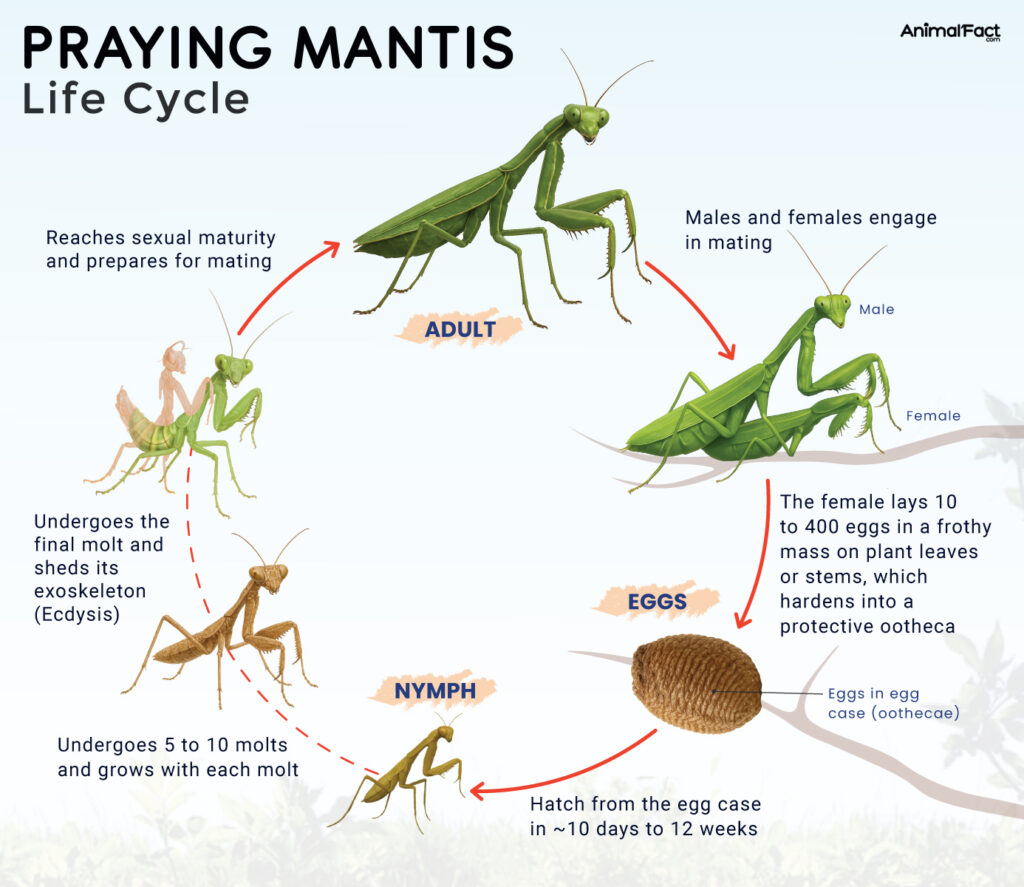
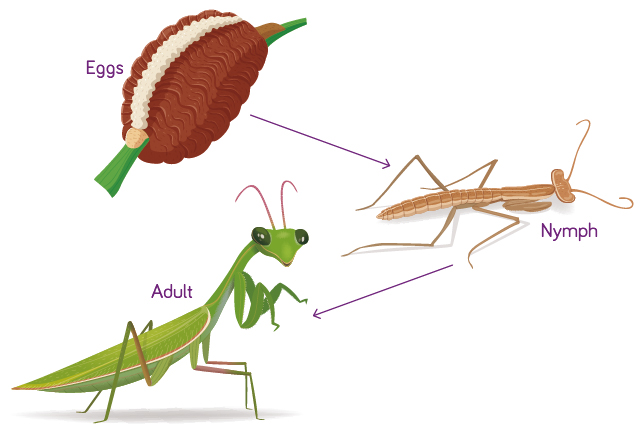
Unlike butterflies, praying mantises do not go through a caterpillar and chrysalis stage. They develop through incomplete metamorphosis, which means their life cycle has three main stages: egg, nymph, and adult. The young mantises look like tiny wingless adults, then grow through repeated molts before reaching maturity.
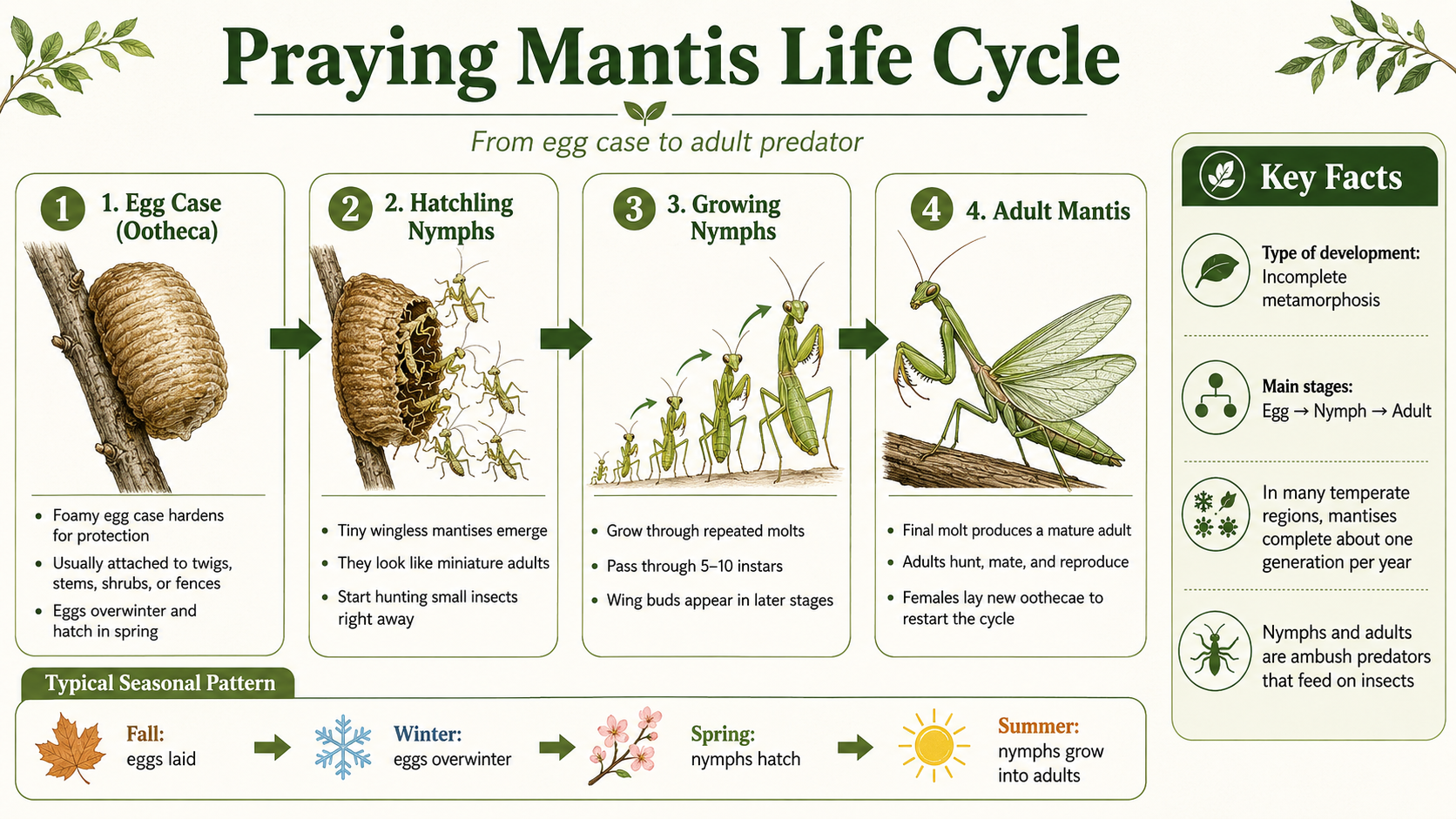
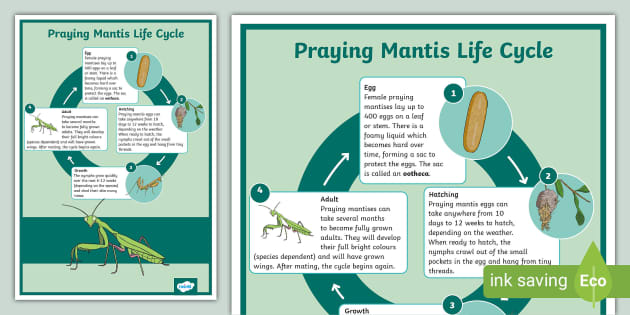
In many temperate regions, mantises complete about one generation per year. Adults usually mate and lay eggs in late summer or fall, the eggs overwinter inside a protective case, and the nymphs hatch in spring when food becomes available.
What Are the Main Stages of the Praying Mantis Life Cycle?
The praying mantis life cycle can be divided into three core stages:
- Egg stage — eggs develop inside a protective egg case called an ootheca.
- Nymph stage — young mantises hatch, hunt small prey, and molt several times.
- Adult stage — mature mantises develop wings, mate, and produce the next generation.
This simple structure makes the mantis life cycle easy to follow, but each stage has its own fascinating details.
Stage 1: Praying Mantis Eggs and the Ootheca
A female praying mantis does not lay her eggs one by one in the open. Instead, she produces a protective egg case called an ootheca. This case begins as a soft, foamy material secreted by the female, then hardens into a tough protective structure around the eggs.
Depending on the species, an ootheca may contain dozens to hundreds of eggs. For example, Utah State University Extension notes that mantid egg cases may contain 12–400 eggs, while NC State Extension describes Chinese mantid oothecae that can contain 50–600 eggs.
Where Do Praying Mantises Lay Eggs?
Praying mantises usually attach their oothecae to places that offer support and protection, such as:
- plant stems
- twigs and branches
- shrubs and garden vegetation
- fences, posts, walls, or outdoor structures
- sometimes other firm objects in the environment
The exact location depends on the species and habitat. In gardens, oothecae are often easier to spot in winter, when leaves have fallen and the hardened egg cases remain attached to stems or other surfaces.
What Does a Praying Mantis Ootheca Look Like?
A praying mantis ootheca usually looks like a small, hardened foam mass. It may be tan, beige, brown, gray-brown, or straw-colored. Some are long and narrow, while others are more rounded or block-like.
Different species can produce noticeably different egg cases. NC State Extension notes that Carolina mantid egg cases are often elongated and slender, while Chinese mantid egg cases are larger and more cube-like.
Inside this hardened case, the eggs are protected from cold, dryness, predators, and other environmental hazards until hatching time.
Stage 2: Baby Praying Mantises Hatch as Nymphs
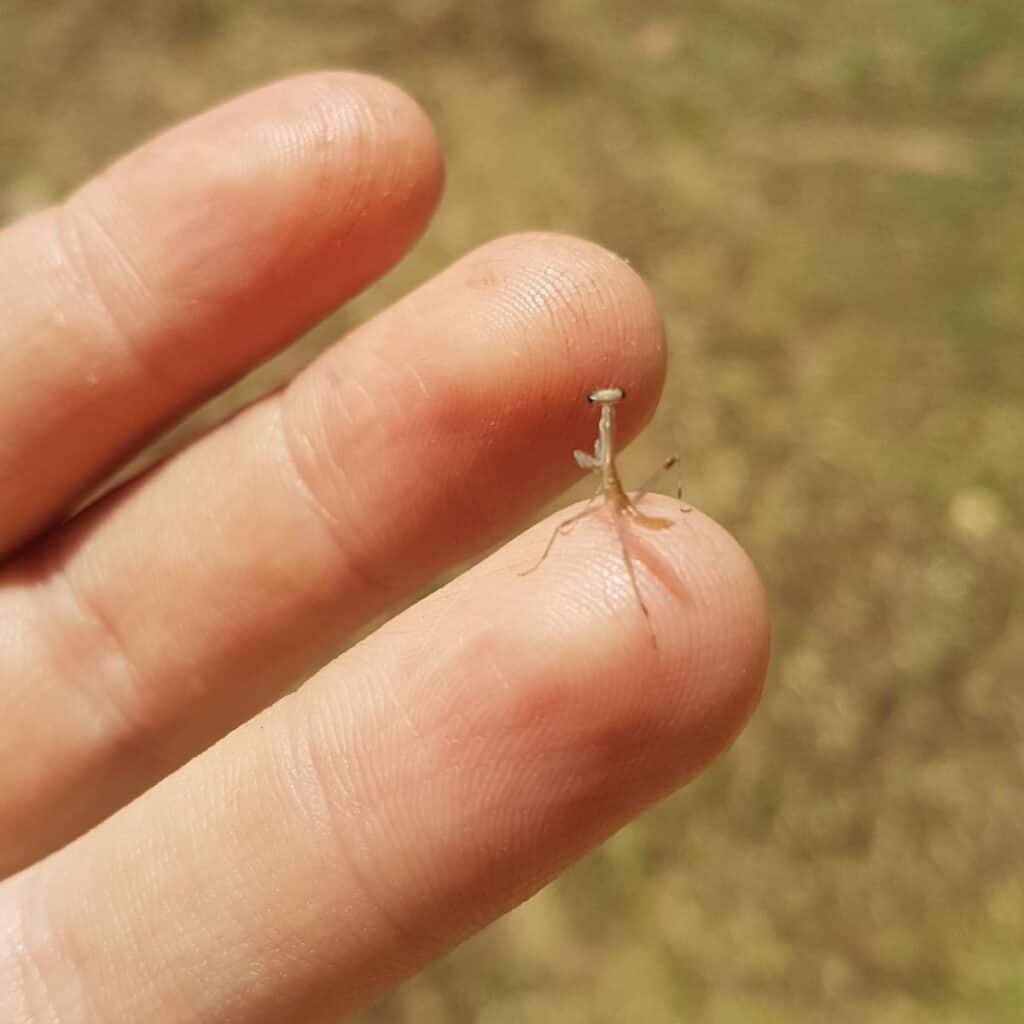
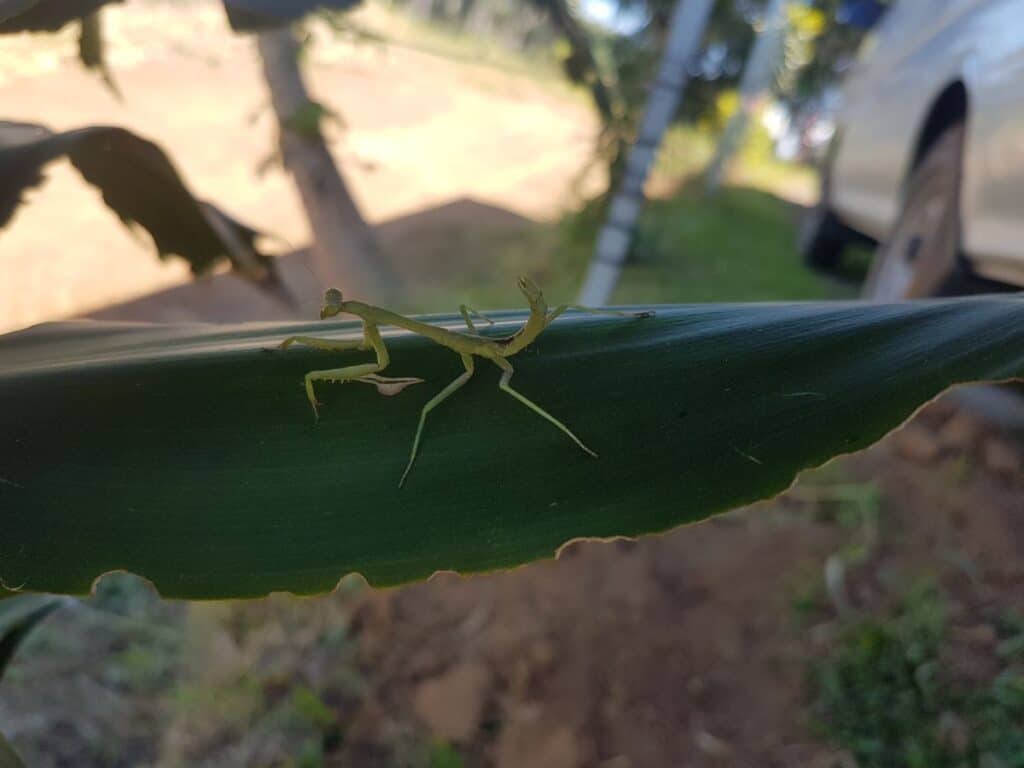
When the eggs hatch, baby mantises emerge as nymphs. They do not look like worms or caterpillars. Instead, they look like very small, delicate versions of adult mantises—except they are wingless.
Newly hatched nymphs may appear in large numbers at once. Some may briefly dangle from the ootheca before dispersing into nearby vegetation. Their bodies are soft at first, but they soon harden and begin searching for food.
What Do Praying Mantis Nymphs Eat?
Praying mantis nymphs are predators from the beginning. They feed on small insects and other tiny arthropods they can capture, such as aphids, flies, mosquitoes, small moths, and other soft-bodied prey.
They are also opportunistic. If food is limited, newly hatched mantises may eat their siblings. Cannibalism is common enough that extension sources warn that young mantises kept together may begin feeding on each other shortly after hatching.
What Is an Instar?
An instar is a growth stage between molts. Because insects have hard outer skeletons, a praying mantis cannot simply stretch and grow the way a mammal does. Instead, it must shed its old exoskeleton and expand into a larger one.
Each time a mantis molts, it enters a new instar. The number of molts varies by species, but NC State Extension notes that Chinese mantid nymphs molt six or seven times as they grow.
Stage 3: Growing Nymphs and Molting
The nymph stage is the most active growth period in the praying mantis life cycle. During this time, the young mantis hunts, eats, molts, and gradually becomes larger.
With each molt, the body becomes more adult-like. Older nymphs may begin to show wing buds, but they still do not have fully functional wings until adulthood.
Why Is Molting Risky?
Molting is necessary, but it is also dangerous. During and shortly after a molt, the mantis is soft and vulnerable. A fall, a lack of humidity, a predator, or an unsuccessful shed can be fatal.
In the wild, many nymphs do not survive to adulthood. Predators such as birds, reptiles, amphibians, spiders, larger insects, and even other mantises may eat them. Environmental stress, lack of food, and habitat disturbance can also reduce survival.
Still, the nymphs that survive this stage become increasingly efficient hunters.
Stage 4: Adult Praying Mantis
After the final molt, the mantis becomes an adult. This is when its adult body form is complete, and in many species, wings are fully developed.
Immediately after the final molt, the wings are soft and folded. They expand and harden over the next several hours. Once fully hardened, they may allow flight, although flight ability varies by species and sex. For example, NC State Extension notes that female Chinese mantids are flightless, even though they have wings.
What Do Adult Praying Mantises Eat?
Adult praying mantises are generalist predators. They feed on many kinds of live prey, including moths, crickets, grasshoppers, flies, and other insects. They can be useful in gardens, but they are not selective pest-control agents. They may also eat pollinators, beneficial insects, butterflies, and other mantises.
Their hunting style is part patience, part precision. Mantises often wait quietly with their front legs folded, then strike quickly when prey comes close. Their raptorial forelegs are lined with spines that help hold struggling prey.
Praying Mantis Mating and Egg Laying
Once adults are sexually mature, mating begins. Males often approach females cautiously, and in many species courtship can involve careful movement, body positioning, and chemical cues.
Praying mantises are famous for sexual cannibalism, where the female eats the male during or after mating. This does happen in some species and situations, but it is not accurate to treat it as a rule for every mantis encounter. Extension sources describe it as an unusual but real mating behavior, not a universal requirement of reproduction.
After mating, the female produces one or more oothecae. In temperate climates, these egg cases often overwinter, and the adults die from age or freezing before the next generation hatches.
Can Praying Mantises Reproduce Without Males?
Some mantises are capable of parthenogenesis, a form of reproduction in which offspring develop from unfertilized eggs. This does not mean every praying mantis can reproduce this way, but it has been documented or investigated in certain mantid species.
Recent research on Brunneria subaptera, a South American mantis, found an absence of males in sampled Uruguayan populations and suggested the species reproduces through thelytokous parthenogenesis, meaning females produce female offspring without fertilization. A later Scientific Reports study further tested parthenogenetic reproduction in Brunneria subaptera and confirmed the reproductive potential of virgin females from Uruguay.
For a general backyard mantis guide, the important point is this: most familiar mantises reproduce sexually, but parthenogenesis is a real and fascinating part of mantis biology in some species.
How Long Does the Praying Mantis Life Cycle Take?
The timing depends on species, climate, food supply, and local conditions. In many temperate areas, the cycle follows this general pattern:
- Late summer to fall: adults mate and females lay oothecae
- Winter: eggs remain protected inside the ootheca
- Spring: nymphs hatch
- Spring to summer: nymphs feed, molt, and grow
- Late summer to fall: adults mate and lay eggs again
Iowa State University Extension describes the natural cycle as eating and growing through summer, mating and laying eggs in a stiff foamy case in fall, and repeating the next year from overwintered eggs.
In warmer regions or captive conditions, timing can differ. Temperature, humidity, food availability, and species biology all influence development.
Observing the Praying Mantis Life Cycle at Home
Finding a praying mantis egg case can be exciting, especially for children or nature lovers. However, there is one important caution: if you bring an ootheca indoors too early, warmth may cause the eggs to hatch before outdoor conditions are safe.
Iowa State University Extension recommends keeping a found egg case at winter-like temperatures, such as in an unheated garage or porch, rather than keeping it in a warm indoor room where it may hatch in midwinter.
If nymphs hatch, they should not be kept crowded for long. They may begin eating each other, and raising them all to adulthood is difficult. For most people, the best approach is to observe them briefly and release them outdoors when conditions are suitable.
Final Thoughts on the Praying Mantis Life Cycle
The praying mantis life cycle is simple in structure but rich in detail. It begins inside a hardened ootheca, continues through the fragile but hungry nymph stage, and ends with a mature predator capable of mating and starting the cycle again.
What makes mantises so interesting is the contrast between their calm appearance and their intense survival strategy. They hatch ready to hunt. They grow by shedding their bodies again and again. They rely on camouflage, speed, patience, and sharp forelegs. And before winter returns, the next generation is already sealed inside its protective egg case, waiting for spring.
FAQ
What are the stages of the praying mantis life cycle?
The praying mantis life cycle has three main stages: egg, nymph, and adult. This is called incomplete metamorphosis because young mantises resemble small wingless adults rather than passing through a caterpillar-like larval stage.
What is a praying mantis egg case called?
A praying mantis egg case is called an ootheca. It is a hardened, foam-like protective case that contains the eggs and helps protect them until they hatch.
How many eggs are in a praying mantis ootheca?
The number varies by species. Some oothecae may contain a few dozen eggs, while others may contain several hundred. Extension sources report ranges such as 12–400 eggs or 50–600 eggs depending on the mantis species.
When do praying mantis eggs hatch?
In many temperate regions, eggs overwinter inside the ootheca and hatch in spring, when temperatures rise and small prey becomes available.
What do baby praying mantises look like?
Baby praying mantises, called nymphs, look like tiny versions of adults. They are usually wingless at first and become larger through repeated molts.
Do praying mantises have complete or incomplete metamorphosis?
Praying mantises have incomplete metamorphosis. Their life cycle includes egg, nymph, and adult stages, without a pupal stage.
What do praying mantis nymphs eat?
Praying mantis nymphs eat small live prey, including tiny insects and other arthropods. They may also eat each other, especially when crowded or when food is limited.
Do all female praying mantises eat the male?
No. Sexual cannibalism can occur in some mantis species and situations, but it is not universal. Mating behavior varies by species, environment, and individual conditions.
Can praying mantises reproduce without mating?
Some mantis species can reproduce through parthenogenesis, where offspring develop from unfertilized eggs. This is not true for every mantis, but it has been documented or studied in certain species such as Brunneria subaptera.
How long do praying mantises live?
Lifespan varies by species and climate. In many temperate areas, mantises follow an annual cycle: eggs overwinter, nymphs hatch in spring, adults mature in summer, and females lay egg cases in late summer or fall.