
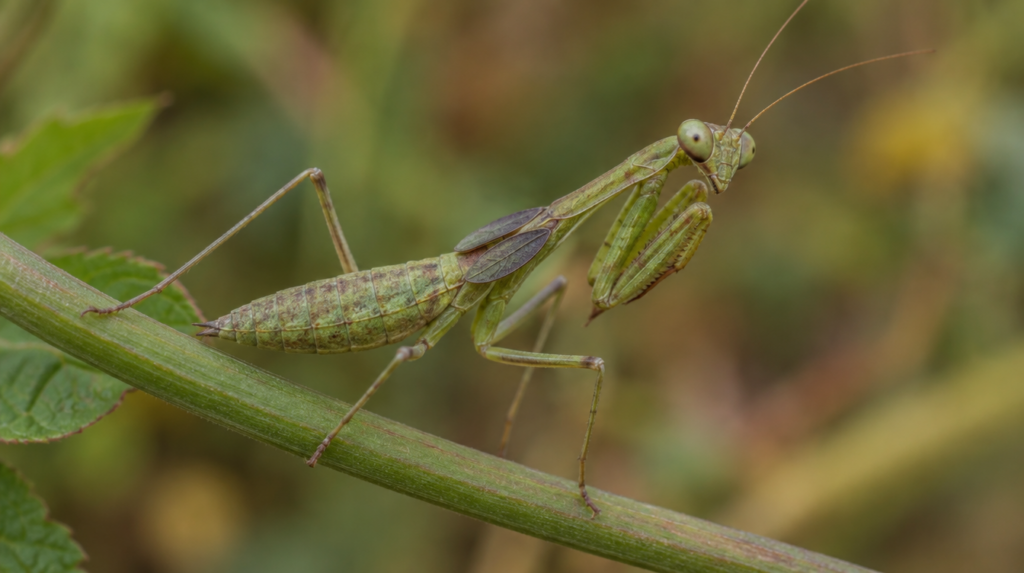
Praying mantises grow up through incomplete metamorphosis: three stages — egg, nymph, adult — with no caterpillar-like larva and no pupa, chrysalis, or cocoon in between. A mantis that has just left the egg case already looks like a mantis, complete with the triangular head and folded raptorial forelegs. It reaches adulthood by shedding its exoskeleton several times, not by rebuilding its body inside a sealed case.
Entomologists call this developmental pattern hemimetaboly. Mantodea sits alongside cockroaches, grasshoppers, dragonflies, earwigs and true bugs among the insect orders that develop this way.
Key points
- Three stages: egg, nymph, adult.
- The young are called nymphs, not larvae.
- Wings develop on the outside of the body, growing a little at each molt.
- There is no resting, non-feeding pupal stage.
- The number of molts varies by species, sex, and conditions.
What incomplete metamorphosis means
“Incomplete” describes how much the body is reorganized, not how finished the insect is. A mantis nymph is a fully functional predator from its first day. It hunts, grows, and behaves much like a smaller adult.
Two features define this kind of development. The immature insect resembles the adult in form and habits, differing mainly in size, proportions, and colour pattern, and its wings develop externally as visible rudiments. Because those wing rudiments are on the outside, insects like mantises are also described as exopterygotes. In a butterfly or beetle, the wings develop from internal tissue and only appear during the pupal stage. Encyclopedia Britannica
A note on vocabulary, since it trips people up: the same process is called incomplete, simple, or gradual metamorphosis in different books, and the technical labels hemimetabolous and paurometabolous are sometimes used interchangeably and sometimes not. Some entomology sources reserve “hemimetabolous” for insects whose immature stage is aquatic, such as dragonflies, and use a separate term for terrestrial insects that develop gradually. Debate over the correct terms for insect juveniles has a long history in the entomological literature. For a mantis, all of these labels point to the same thing: egg, nymph, adult, no pupa.
The three stages in a mantis
Egg. A female mantis does not scatter her eggs. She produces a frothy secretion that encloses them and hardens into a protective egg case, the ootheca. The foam originates from a pair of accessory reproductive glands and sets into a protective case, and in temperate climates the eggs enter dormancy when cold weather arrives and resume development in spring. Timing depends on climate and species; mantises in warm regions do not necessarily follow the overwintering pattern familiar to gardeners in cooler areas.
Nymph. Hatchlings emerge from the case in a group and disperse. They are wingless, pale at first, and immediately predatory. In much of the temperate United States, mantis eggs persist through winter and nymphs emerge around mid-spring, and newly hatched nymphs kept together will soon begin feeding on one another. Each stage between molts is an instar.
Adult. After the final molt, the mantis has fully formed wings (in most species) and mature reproductive organs. It does not molt again. This is the stage that mates and, in females, produces oothecae.
If you want the full seasonal walkthrough of these stages, the praying mantis life cycle guide covers each one in detail.
What actually changes between molts
Growth in an insect is not continuous. The exoskeleton is rigid, so the mantis can only get bigger by shedding it and expanding before the new cuticle hardens. Between molts, several things change in a predictable direction:
Wing pads. This is the clearest visual marker of gradual development. Wing buds develop on the mantis’s back and increase in size with each molt; when the wings are fully developed, the mantis has reached adulthood. On a late-instar nymph they look like two small, flattened pads over the thorax.
Size and proportions. Body length increases in steps, and the head, eyes, and forelegs shift in proportion.
Antennae. These lengthen by adding segments. A study of the Asian mantis Tenodera aridifolia found that new antennal segments are added at each molt, at two distinct sites along the antenna.
Visible sex differences. These appear partway through nymphal development rather than at the start. In the same species, males and females could be readily separated by the genital region at the terminal abdomen from the sixth instar onward.
The final molt. At the last molt the wings expand and harden and the mantis becomes reproductively mature. Molting is a vulnerable process at any stage — the mantis hangs from a support while the soft new cuticle is still expanding — and failed molts are a well-known cause of death, particularly in early instars.
How many molts does it take?
There is no single number, and any source that gives one without naming a species is overstating the case. Animal Diversity Web reports that Tenodera aridifolia nymphs pass through as many as seven instars before developing wings and becoming adults in late summer, and the antennal study of the same species describes seven instars before adulthood. Counts published for other species commonly fall somewhere in the range of about six to nine, and the sexes do not always go through the same number of stages.
Development speed is also flexible. Temperature and food supply influence how long each instar lasts, so two mantises of the same species can reach adulthood weeks apart.
Incomplete vs complete metamorphosis
| Incomplete (mantises) | Complete (butterflies, beetles, flies) | |
|---|---|---|
| Stages | Egg → nymph → adult | Egg → larva → pupa → adult |
| Name for the young | Nymph | Larva (caterpillar, grub, maggot) |
| Do the young resemble adults? | Broadly yes | No |
| Wing development | External, as pads that enlarge each molt | Internal, revealed at the pupal stage |
| Resting, non-feeding stage | None | Pupa (chrysalis, cocoon, puparium) |
| Feeding | Nymphs and adults take similar live prey | Larva and adult often eat entirely different food |
| Final transition | Last molt produces the winged adult | Adult emerges from the pupa |
One practical consequence of that table: a mantis nymph and an adult mantis compete for broadly the same kinds of prey in broadly the same places. A caterpillar and a butterfly do not.
Why there is no cocoon
A common assumption is that the ootheca is the mantis equivalent of a chrysalis. It is not. The egg case is built by the mother before the young exist as free-living insects, and it protects eggs. A pupa is a transitional stage of an individual insect that has already hatched and fed. Nothing in the mantis life cycle corresponds to it.
The evolutionary background is straightforward. Complete metamorphosis arose in one large branch of the insect tree, and mantises are not in it. Mantises share a common ancestor with cockroaches and termites in the group Dictyoptera — a lineage in which gradual, molt-by-molt development is the norm. PLOS
The other frequent mix-up is the shed skin itself. A discarded exoskeleton hanging from a stem is thin, hollow, and mantis-shaped, and it is sometimes mistaken for a dead mantis or a cocoon.
What this means when you find a mantis outdoors
Understanding the developmental pattern makes field observation easier, and it also sets limits on what you can conclude.
Short or absent wings usually indicate a nymph — but not always. Wing pads that do not reach the end of the abdomen point toward a nymph. However, adults of some species and some sexes are genuinely short-winged. In the Carolina mantis, for example, adult males are smaller and more slender than females and have longer wings, while the adult female’s wings do not reach the end of her heavy abdomen and she does not fly. A stubby-winged mantis in late summer may well be an adult female, not a juvenile.
Size alone tells you little. Mantodea contains roughly 2,500 described species with a wide range of adult sizes, so a small mantis may be a young nymph of a large species or an adult of a small one. Body structure, wing condition, season, and location all matter together. Our guide to identifying small mantises and nymphs walks through those clues.
Season is a useful clue, not proof. In temperate regions, nymphs are typical in late spring and early summer and adults in late summer and autumn — but that pattern belongs to specific climates and species, not to mantises everywhere.
A small stage most people never see
There is one more wrinkle worth knowing if you are studying this formally. In many insects that develop this way, the individual that leaves the egg is briefly wrapped in a thin embryonic cuticle before it becomes a free-moving first-instar nymph. This short-lived, non-feeding form is called a pronymph, and in most modern hemimetabolous insects it occurs within the egg, with the first-instar nymph emerging at hatching.
In mantises, hatchlings commonly work their way out of the ootheca still enclosed in this membrane, dangle briefly, and shed it within moments of emerging. Whether that shed is counted as a molt, and whether the emerged nymph is labelled the first instar, varies between sources — which is one reason published instar counts do not always line up neatly.
More explanations of how mantises develop through the seasons are collected in the Mantis Life Cycle section.