
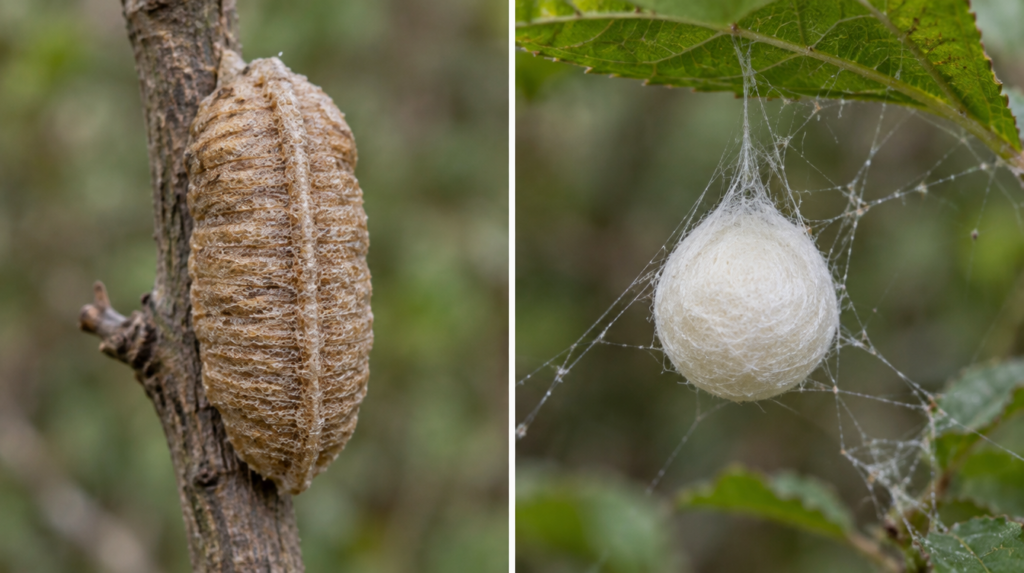
If you have found a pale lump attached to a twig, a fence rail, or the corner of a shed and you are trying to work out whether a praying mantis or a spider made it, one difference settles most cases: a mantis egg case is hardened foam, and a spider egg sac is spun silk.
A praying mantis egg case, properly called an ootheca, starts as a frothy secretion the female whips out as she lays. It hardens within hours into a rigid, tan or brown mass that is glued firmly to whatever she laid it on. A spider egg sac is built from silk drawn out of the spider’s spinnerets — the same material family as webbing. It stays flexible, fibrous, and usually much paler.
Once you know what to look at, the two are rarely confused. The difficulty is that people often photograph them from a distance, where both can look like “a whitish blob on a stick.”
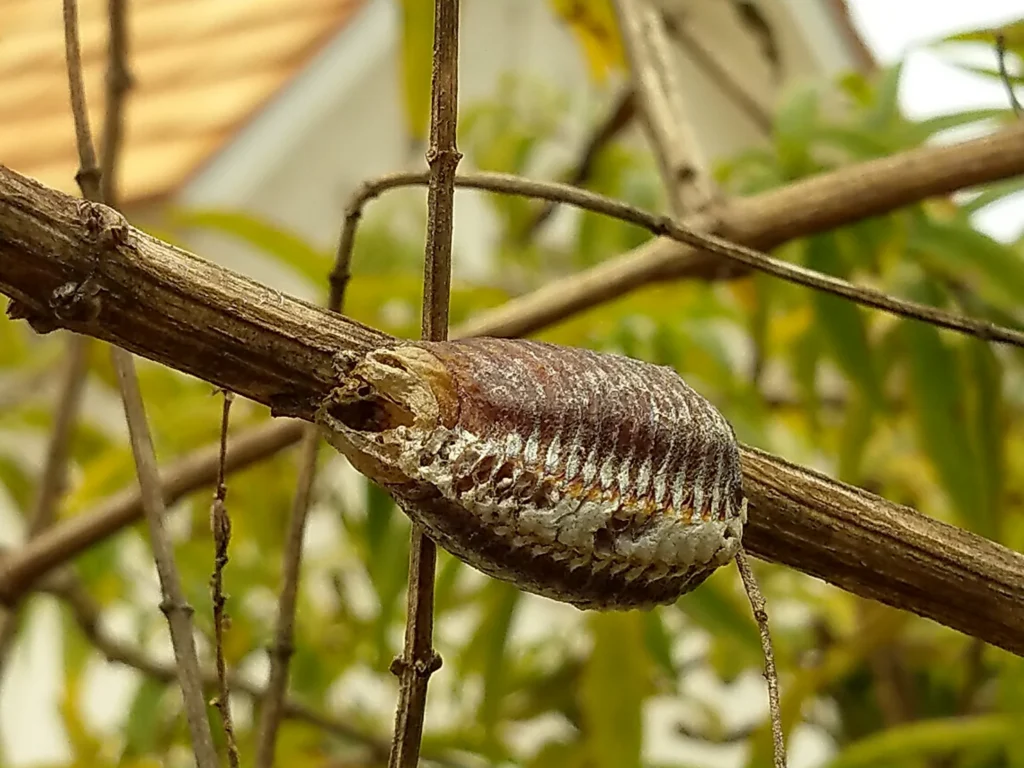
The fastest way to tell them apart
| Feature | Mantis egg case (ootheca) | Spider egg sac |
|---|---|---|
| Material | Hardened foam | Spun silk |
| Texture | Rigid, papery-to-woody, layered and ribbed | Soft, fibrous, fluffy or papery, slightly flexible |
| Typical colour | Tan, beige, straw, grey-brown; darkens with age | White, cream, off-white, tan, sometimes yellow or greenish |
| Shape | Rounded, block-like, or elongated pod with a raised seam down the middle | Sphere, teardrop, flat disc, or loose bundle of threads |
| Attachment | Cemented flat against a firm surface | Suspended in a web, tucked into a sheltered spot, or carried by the mother |
| Usual size | Roughly 1.5–4 cm | Often pea to marble size; rarely larger than a coin |
| Adult nearby? | Almost never — the female leaves and usually dies | Often yes; many females guard or carry the sac |
What a praying mantis egg case looks like
The female mantis produces the ootheca from accessory glands near the end of her abdomen, working the secretion into a foam as she deposits her eggs in internal chambers. The foam then cures. Freshly laid, it is soft and slightly tacky; within a short time it sets hard. Older cases can feel almost woody.
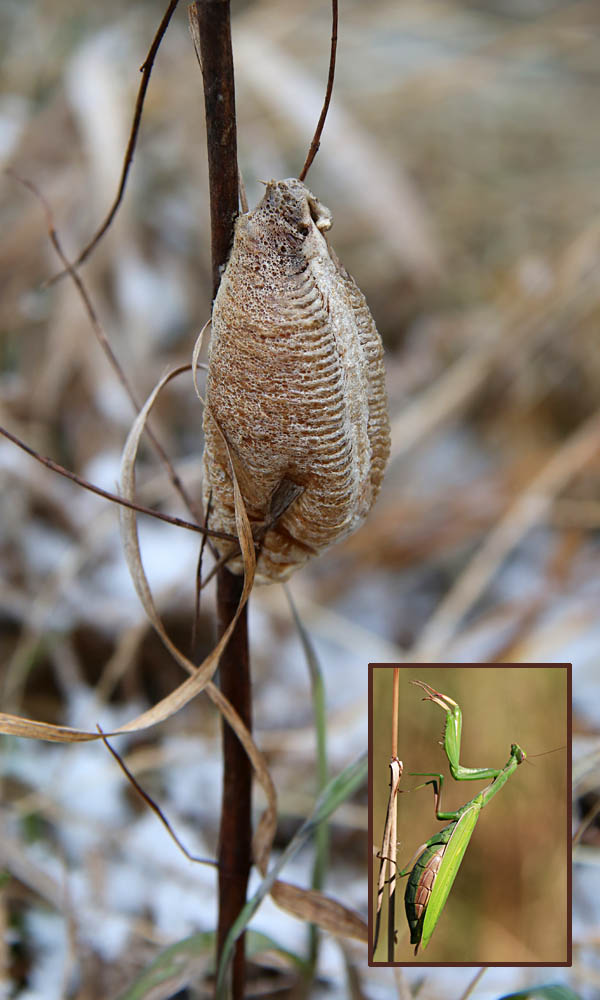
Texture is the strongest clue. Extension educators frequently compare a mantis ootheca to spray-foam insulation: a dense, bubbly, matte surface with visible layers. Most have a raised ridge or seam running lengthways along one face. That seam matters — it is where the nymphs will push out, through a line of small exit openings, when the case hatches.
Colour ranges from pale straw and tan through beige to grey-brown. Colour alone is not a reliable identifier for anything in this article, because weathering, age, and species all shift it.
Placement is deliberate and exposed. Females attach oothecae to twigs, woody stems, bark, rocks, fence posts, brick, siding, window frames, and garden furniture. She needs a firm, usually vertical or angled surface that will bear her weight while she lays. Brick walls and fence rails are popular for exactly that reason, which is why so many people find them on buildings rather than in vegetation.
Contents. A single case holds dozens to hundreds of eggs depending on species — one ootheca is a whole brood, not one insect. In temperate regions, egg cases laid in late summer and autumn overwinter in place and hatch in spring.
Persistence. The glue is strong. A spent ootheca often stays attached for a long time after hatching, weathered and split along the emergence seam. Empty spider sacs, by contrast, tend to collapse, tatter, and blow away.
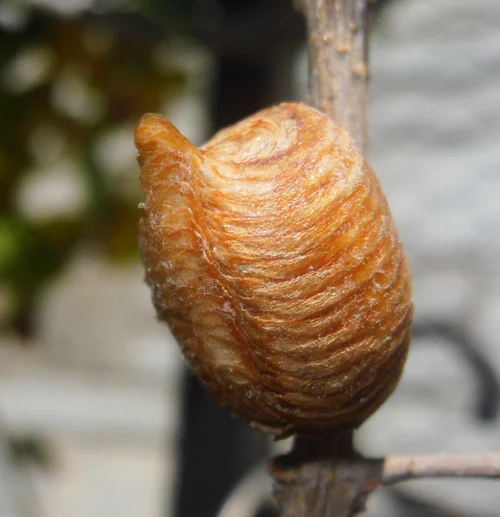
Species differences (North American examples)
Shape differs enough between species to be a useful starting point, though there is overlap and it should never be your only evidence:
- Chinese mantis (Tenodera sinensis) — the bulkiest and most frequently noticed: rounded to cube-like, uniform straw-brown, often compared to a ping-pong ball or a marshmallow.
- Carolina mantis (Stagmomantis carolina) — smaller, longer, and distinctly flatter; often greyer, with a paler band running along the midline.
- European mantis (Mantis religiosa) — elongated and tapered, usually a fairly even pale brown without the contrasting midline banding.
- Narrow-winged mantis (Tenodera angustipennis) — long and slender; reddish streaking sometimes becomes noticeable as the case ages.
Outside North America, local species produce their own shapes, from slim cases under a centimetre long to large foamy masses. If you want to work through the rest of the identification — nymphs, adults, and field clues — the mantis identification guides cover the other stages.
What a spider egg sac looks like
Spiders wrap their eggs in silk, and the results are far more varied than mantis oothecae.
Texture is the giveaway again. Silk sacs look fibrous rather than foamed. Some are densely woven and papery, like a small parchment pouch. Some are cottony and loose. In a few groups, the eggs are barely wrapped at all — just a cluster held by a handful of threads. None of them have the layered, ribbed, insulation-like surface of a mantis case, and none are rigid in the way a cured ootheca is.
Shape varies by family: spherical balls, flattened discs, teardrops, and pouches suspended on silk lines. Some species add spikes, loops, or debris to the outer layer; others coat the sac in a smooth, tough sheet of silk.
Colour is most often white, cream, or off-white, ageing to tan or grey as it collects dust and weathers. Yellow and pale green sacs occur too.
Location is where the two really diverge. Spider sacs turn up inside or beside a web, under leaves, in bark crevices, beneath rocks and leaf litter, and indoors in quiet corners, behind furniture, in basements and garages, and along the top edges of window frames. Mantises do not build webs, and they do not tuck their egg cases into hidden crevices the way many spiders do.
Parental behaviour can identify a sac instantly. Female wolf spiders carry a rounded egg sac attached to their spinnerets and haul it around while hunting; the spiderlings then ride on the mother’s back for their first weeks. Nursery web spiders carry theirs in their jaws, then build a silken tent around it before hatching and stand guard. Cellar spiders also carry their eggs. If the lump is moving, it is not a mantis.
Numbers range from a handful to several hundred eggs depending on species, and many spiders produce more than one sac in a season — another reason several similar white bundles in the same corner point toward a spider rather than a mantis.
Five clues that settle almost every case
- Is it rigid or flexible? Hard, foam-like, and unyielding points to a mantis. Soft, fibrous, and slightly giving points to a spider. Look before you press, and avoid squeezing sacs in regions where medically significant spiders are common.
- Is it glued flat, or hanging? Mantis cases are cemented against a surface along one face. Spider sacs are often suspended on threads, wedged in a crevice, or carried.
- Is there a web? Silk lines, sheeting, or a retreat nearby strongly favour a spider.
- Is there a seam? A raised ridge down the centre, with a row of small openings after hatching, is a mantis feature.
- What season is it? In temperate climates, a conspicuous foam pod on a bare twig in autumn or winter is most likely a mantis ootheca overwintering. Spider sacs peak in the warmer months, though some persist through winter in sheltered spots.
Other things that get mistaken for both
Not everything lumpy is an egg mass, and a few genuine egg masses belong to neither group:
- Spotted lanternfly egg masses (parts of North America) are flat, grey, and look like a smear of dried mud or mortar — nothing like the three-dimensional, foamy mantis pod.
- Spongy moth egg masses are covered in a buff or yellowish fuzzy coating, felt-like rather than foamed.
- Moth cocoons and pupal cases are silk, often incorporating leaves or debris, and are usually elongated rather than spherical.
- Mud dauber wasp nests are made of hardened mud in cylindrical tubes, typically under eaves and roof overhangs.
- Cockroach oothecae are also called oothecae — mantises and cockroaches are related — but they are small, dark brown, purse-shaped, and hard, with a ridged keel along one edge. Nothing like a foamy mantis case.
- Galls and lichens on bark fool people at a distance more often than either egg type.
- Wrapped prey in a web is silk-covered and can look like a sac; it is usually more irregular, and the shape of the insect inside sometimes shows through.
What to do with the one you found
The default answer for both is leave it where it is. Neither structure damages the surface it is attached to, and both represent a functioning part of the local food web.
Do not pull an egg case apart or open a sac to see what is inside. With a mantis ootheca, the hardened foam is the eggs’ insulation and protection through winter; breaking it usually kills the brood. With a spider sac, opening it exposes the eggs and achieves nothing useful for identification that a photograph will not.
If a mantis egg case is genuinely in the way — on a door frame, on furniture you need to use, on a branch you are about to prune — moving it is sometimes possible, but timing, height, orientation, and shelter all matter, and cases placed on the ground are quickly lost to ants. The dedicated guide on moving a praying mantis egg case covers how to do that with the least harm.
One point worth knowing for gardeners: several of the mantis species commonly encountered in North America are not native there, and regional programmes differ in what they recommend doing about non-native oothecae. Native-versus-introduced status and the guidance attached to it depend on your location and on which authority you consult, so check with your local extension office or wildlife agency rather than assuming a single rule applies everywhere.
For spider sacs indoors, removal is a personal decision. Outdoors, most are best left alone; spiders are significant predators of garden and household insects.
If you still aren’t sure
Photograph it in place, in good light, with something for scale, and record what it is attached to, roughly how high, and the date. Substrate, season, and geography narrow the possibilities more than a close-up of the object alone does. Local extension offices, natural history museums, and regional naturalist groups can usually identify an egg mass from a decent photograph.
If it does turn out to be a mantis case, what happens next is worth knowing in advance — a single ootheca can release a large number of nymphs within a short window. The praying mantis life cycle guide explains what emergence looks like and what the nymphs do afterwards.