
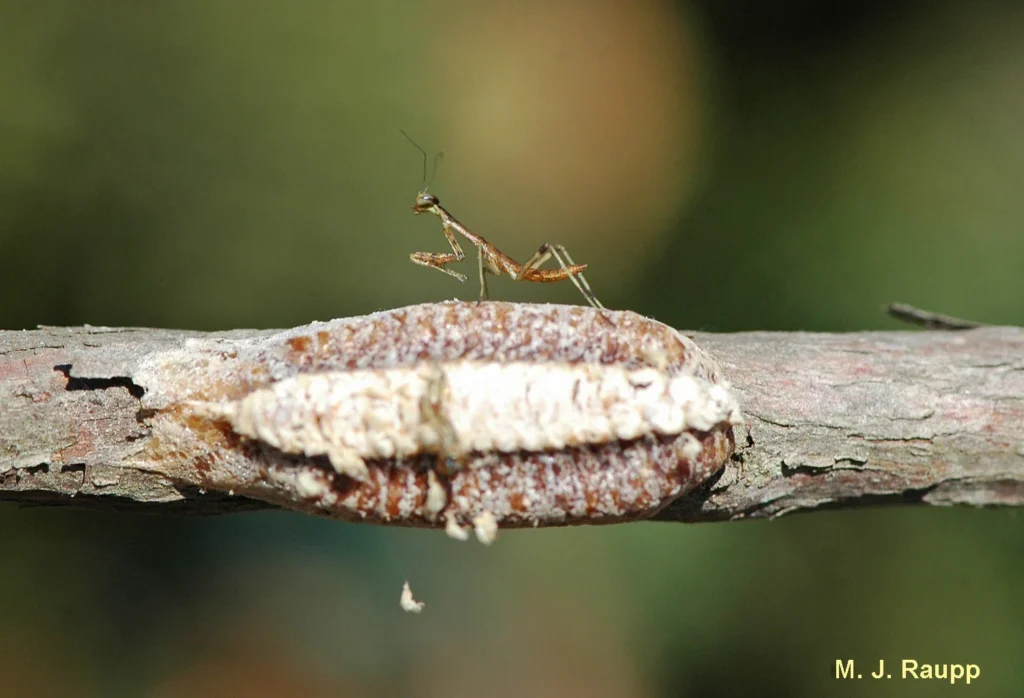
If small, pale, long-legged insects are streaming out of a brown, foam-like lump on a twig, a wall, a wreath, or a houseplant, you are watching a praying mantis egg case hatch. The brown case is called an ootheca, and it is not one egg. It is an entire brood. Depending on the species, a single case can release anywhere from a few dozen to several hundred nymphs, usually within a short window of time.
Nothing has gone wrong, and nothing in your house is being damaged. What matters now is timing and space.
Quick answers
- The brown case is an ootheca, a hardened foam egg case laid by a female mantis.
- The tiny mantises are nymphs — wingless miniature versions of the adult.
- They hatch nearly all at once and disperse immediately.
- Kept crowded, they begin eating each other within a day or two.
- Most will not survive to adulthood even outdoors. That is normal mantis biology, not a failure on your part.
- They cannot infest a house, and they are not venomous.
What the brown case actually is
A female mantis produces her eggs inside a frothy secretion called spumaline. It hardens into a tough, insulated shell that Missouri Department of Conservation describes as feeling something like crusty, dry Styrofoam. That case protects the eggs through cold, drying, and many predators.
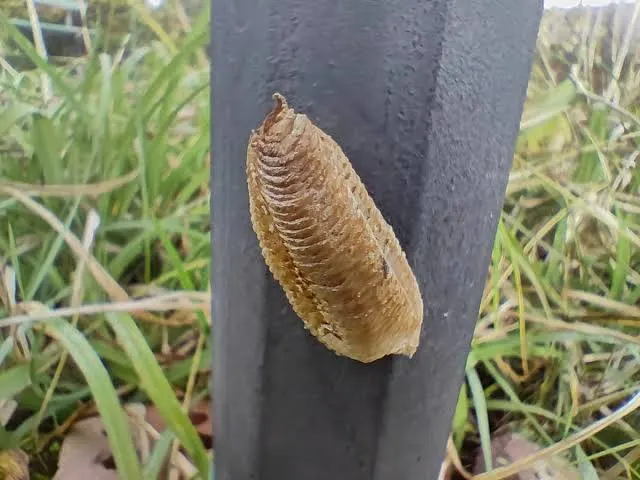
Egg counts vary by species. NC State Extension reports that a female Chinese mantid lays roughly 50 to 600 eggs in a single case, and the Connecticut Agricultural Experiment Station notes that hundreds of nymphs may emerge from one ootheca. Illinois Extension puts it simply: within each foam-like case are dozens or hundreds of eggs.
The nymphs do not chew their way out randomly. They emerge through a seam along the middle of the case, which is why the exits usually appear as a row rather than scattered holes.
What a normal hatch looks like
Most of a brood leaves the case over a short period, often a couple of hours. Newly emerged nymphs are soft and pale, and many briefly hang below the case on fine threads or in a small dangling cluster before their exoskeletons harden. NC State Extension describes exactly this behavior in Chinese mantids: the nymphs dangle, harden, then disperse to hunt tiny insects.
That dispersal is not optional. Missouri Department of Conservation is direct about it — the young hatch almost all at once, and if they cannot spread out, they will eat each other. Iowa State University Extension gives a practical time frame: newly hatched nymphs are usually fine together for a day or two, and then they begin feeding on one another.
Make sure they really are mantis nymphs
A few other brown cases and capsules also release small insects, so it is worth a ten-second check. Mantis nymphs have:
- a pair of folded raptorial forelegs held up under the head
- a triangular, mobile head with prominent eyes
- a long, slender body and thread-like antennae
- six legs, no wings
- an abdomen tip that is often curled upward, a detail noted in field descriptions of very young mantids
Compare that with the usual confusions. A cockroach ootheca is much smaller, darker, purse-shaped and ridged, and its nymphs are flattened ovals that run rather than stalk — no raptorial forelegs. A spider egg sac is made of silk, not hardened foam, and spiderlings have eight legs and no antennae. If what you are seeing folds its front legs and turns its head to look at you, it is a mantis.
Newly hatched nymphs of different mantis species look broadly alike, so the hatch itself rarely identifies the species. The empty case is the better clue.
Why it is hatching now
In temperate regions, the pattern is seasonal: adults mate and lay in late summer and autumn, the eggs overwinter inside the case, and nymphs emerge in spring once temperatures stay warm. Some species and some warmer climates follow different schedules, and a few hatch over a longer, less synchronized period.
An off-season hatch almost always has an indoor explanation. Warmth ends the wait. The Connecticut Agricultural Experiment Station specifically warns that a case found on a cut Christmas tree should not be kept warm or indoors for long, because it will likely hatch prematurely and scatter hundreds of nymphs around a room. Iowa State University Extension makes the same point, recommending that a found egg case be kept at winter temperatures in an unheated garage or porch rather than indoors, where it may hatch in January or February when there is no chance of releasing the nymphs.
Common indoor triggers: cut evergreen branches, wreaths and holiday greenery, pruned stems brought in for arrangements, potted plants moved inside for winter, firewood, and purchased egg cases stored in a heated room.
What to do right now
If it happened outdoors, in season. Leave them alone. Do not collect them, do not spray anything, and do not move the case mid-hatch. They will scatter into surrounding vegetation on their own within a few hours.
If it happened indoors and outdoor conditions are mild. Get them outside promptly and spread them out. Release them into dense low vegetation — shrubs, tall plants, hedge growth — in several separate spots rather than one pile, ideally a foot or two above the ground rather than on bare soil. If part of the brood is still inside the case, move the whole twig or branch outdoors and secure it in a sheltered shrub in roughly the orientation it was laid, instead of trying to handle individual nymphs.
Handle as little as possible. Freshly hatched nymphs are fragile. A sheet of paper and a soft brush work better than fingers.
If it happened indoors in mid-winter. This is the hard case, and it deserves an honest answer. Releasing hatchlings into freezing conditions will kill them, and so will keeping a crowded brood in a jar. Raising more than a couple of nymphs is genuinely demanding: they need individual containers and a steady supply of very small live prey such as fruit flies, which most households cannot sustain for weeks. Iowa State University Extension’s practical guidance is that to maximize survivors, nymphs must be separated into individual cages — or, more realistically, scattered outdoors after a short period of observation. If neither option is available, most of the brood will not survive. That outcome is common even under natural conditions.
Before releasing nymphs from a purchased egg case, or from a case you suspect belongs to a non-native species, check guidance from your local extension service, agriculture department, or wildlife authority. Several regional conservation programs in North America take an active interest in non-native mantis egg cases, and recommendations differ by area and by species.
Will they cause any problem in the house?
No. Mantis nymphs do not breed indoors, do not feed on food, fabric, wood, or plants, and do not establish populations in buildings. They are predators of small live arthropods, and an ordinary home does not supply enough of those. Without prey and moisture, stray nymphs die within a few days.
They are also not venomous. The Connecticut Agricultural Experiment Station notes that mantids can strike with their forelegs in defense, but injuries to people are rare and generally follow prolonged provocation. A newly hatched nymph a few millimeters long cannot do anything to human skin.
Reading the empty case to guess the species
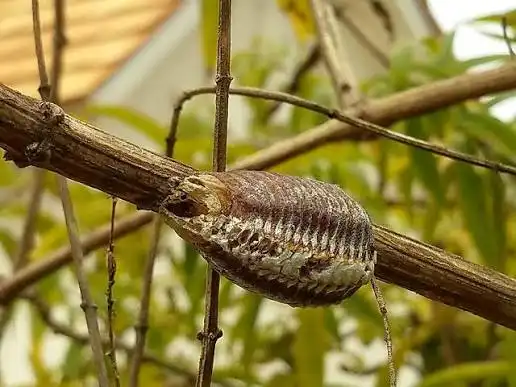
Once the hatch is over, the shape and texture of the case is the most useful identification clue you have. For species commonly encountered in much of North America:
- Chinese mantis (Tenodera sinensis) — roundish, roughly the size of a ping-pong ball, uniformly tan, coarse and foam-like. Often compared to a toasted marshmallow.
- Carolina mantis (Stagmomantis carolina) — elongated, slender, flatter and smoother, grayer in tone, often with a paler central ridge.
- European mantis (Mantis religiosa) — elongated like the Carolina case but less flattened and more uniformly pale brown, without banding.
- Narrow-winged mantis (Tenodera angustipennis) — elongate, often with darker or reddish streaks flanking the center, more visible as the case ages.
Treat these as strong hints rather than proof, and remember that they apply to a specific regional species set. Elsewhere in the world, different mantises produce different cases, and location is always part of an identification.
If you want to keep one or two
Keeping a couple of nymphs from a brood is more realistic than keeping the whole hatch. Each needs its own small ventilated container with something to climb and hang from, very small live prey offered regularly, and light misting for drinking water rather than a soaked enclosure. Molting is the vulnerable moment — a nymph hanging motionless should not be handled, disturbed, or fed.
Specific temperature and humidity figures depend on the species, so a generic set of numbers is not useful here. If you can identify what hatched, look for husbandry information written for that species rather than for mantises in general. And if the nymphs came from a non-native or purchased case, decide before you start whether you have a responsible plan for the survivors, since releasing captive-reared non-native insects is not automatically appropriate.