
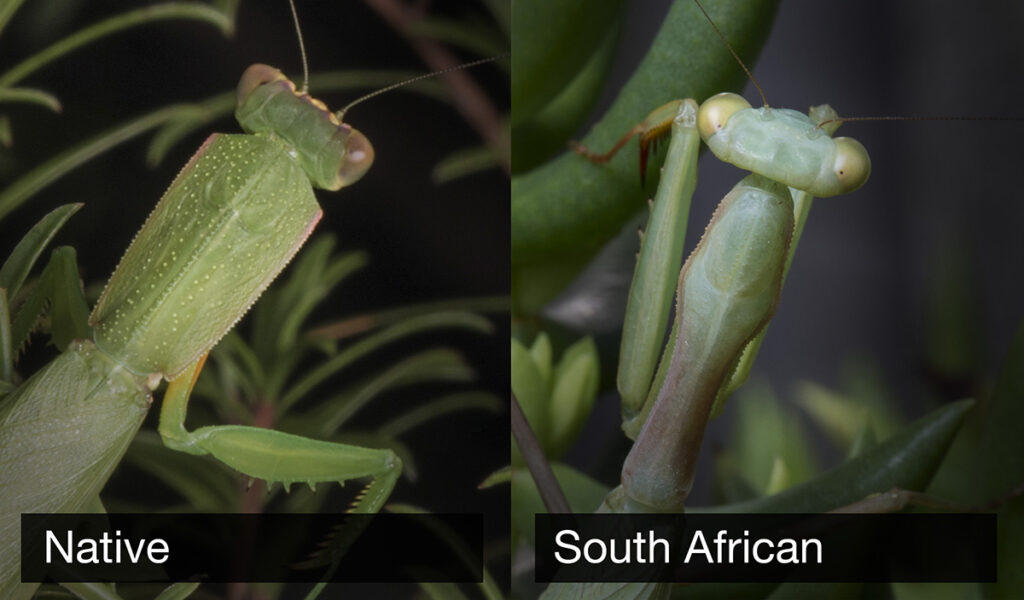
A praying mantis is one of those insects many people recognize instantly — at least at first glance. The folded front legs, the alert triangular head, and the slow, watchful posture all make it look almost too calm for a predator.
But learning how to identify a praying mantis is not just about spotting the “praying” pose. If you look a little closer, you can tell a true mantis from similar insects, recognize young mantises, and sometimes even separate native species from non-native ones.
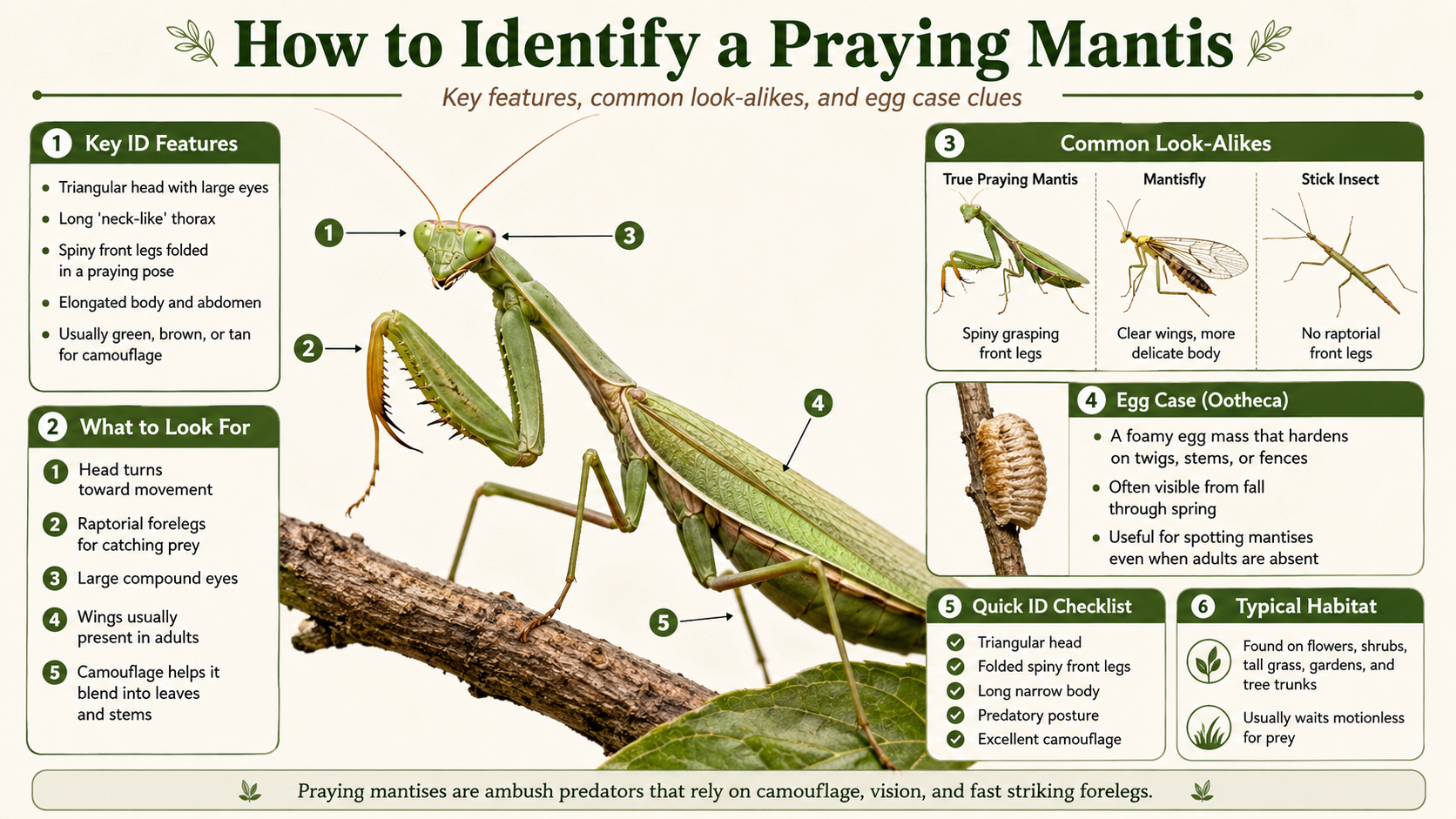
This guide walks through the main features to look for: body shape, front legs, head, wings, behavior, egg cases, and a few common species you may see in gardens or wild habitats.
What Does a Praying Mantis Look Like?
A praying mantis usually has a long, narrow body, a triangular head, large eyes, and a pair of powerful front legs held in a folded position. These front legs are not for walking in the usual way. They are raptorial legs, built for grabbing prey with sharp spines. Britannica describes mantises as insects with enlarged, spined front legs used to seize living prey, along with a head, thorax, abdomen, and six legs like other insects.
Most adult praying mantises are green, brown, grayish, tan, or yellowish. Their colors often help them disappear into leaves, bark, dry grass, stems, or garden plants. This camouflage is one reason they can sit motionless for long periods while waiting for an insect to come close.
A typical praying mantis has:
- A triangular head
- Large, widely spaced compound eyes
- A long thorax that acts almost like a neck
- Two folded, spiny front legs
- Four walking legs behind the front pair
- A long abdomen
- Wings in many adults, though wings may be reduced or less useful in some females
The overall impression is slender, alert, and slightly alien-looking — but in a very real, natural way.
How to Identify a Praying Mantis by Its Front Legs
The easiest way to identify a praying mantis is to look at the front legs.
Praying mantises hold their front legs folded in front of the body, which is why they seem to be “praying.” But those legs are actually hunting tools. They are lined with small spines that help the mantis trap insects in a quick strike.
If the insect has long, folded front legs with visible teeth or spines, you may be looking at a mantis or a mantis-like insect. To confirm it is a true mantis, check the rest of the body too: the triangular head, long thorax, and overall insect shape are important clues.
Look for the Triangular Head and Large Eyes
A praying mantis has a very recognizable head. It is usually triangular, with large eyes on the sides. The head can turn toward movement, which makes the mantis seem unusually aware of its surroundings.
This head movement is one of the most memorable mantis traits. When you approach slowly, the mantis may turn and look directly at you. That does not mean it is curious in a human way, but it does show how visually oriented these predators are.
The eyes are large because mantises rely heavily on vision when hunting. They need to judge distance and movement before striking.
Check the Body Shape
Most praying mantises have an elongated, stick-like body. Some species are slender and grass-like, while others look broader or leaf-like depending on their environment.
The body has three main sections:
Head: triangular, mobile, with large eyes
Thorax: long and narrow, giving the head its flexible “neck-like” movement
Abdomen: longer rear section, often broader in females
Adult size varies by species. Some mantises are quite small, while others can reach several inches long. In North America, commonly noticed species such as Chinese mantises, European mantises, and Carolina mantises fall within a size range that gardeners can usually see clearly without magnification. Utah State University Extension lists European mantids at about 50–65 mm, Chinese mantids at about 65–85 mm, and Carolina mantids at about 48–57 mm.
How to Identify a Praying Mantis Nymph
A praying mantis nymph is a young mantis. It looks a lot like a miniature adult, but without fully developed wings.
Nymphs hatch from an egg case, then grow through several stages called instars. After each molt, they become larger and more adult-like. Missouri Department of Conservation notes that immature mantids resemble adults but lack fully developed wings, and very young ones may have the abdomen tip curled upward.
To identify a mantis nymph, look for:
- Tiny folded front legs
- A triangular head
- A long, narrow body
- Quick, jerky movement
- No full adult wings
- A posture similar to adult mantises
Young mantises are often seen in spring or early summer, especially near vegetation where egg cases have hatched.
Where Are Praying Mantises Found?
Praying mantises are usually found around vegetation. You may see them on flowers, tall grasses, shrubs, tree trunks, vegetable plants, fence posts, or garden stems.
They prefer places where insects are active, because mantises are ambush predators. They do not usually chase prey over long distances. Instead, they wait, stay still, and strike when something comes close.
Common places to look include:
- Flower gardens
- Meadows
- Vegetable patches
- Shrubs and low branches
- Tall grasses
- Wild edges near fields or forests
- Around outdoor lights, especially where flying insects gather
Some mantises may also live closer to the ground, especially species adapted to dry or open habitats.
Praying Mantis Behavior: Another Clue for Identification
Behavior can help confirm that you are looking at a mantis.
A praying mantis often remains still for long periods. It may sway slightly, which can help it blend in with moving leaves or grass. When disturbed, it may freeze, move behind a stem, run away, or raise its wings and front legs in a defensive display.
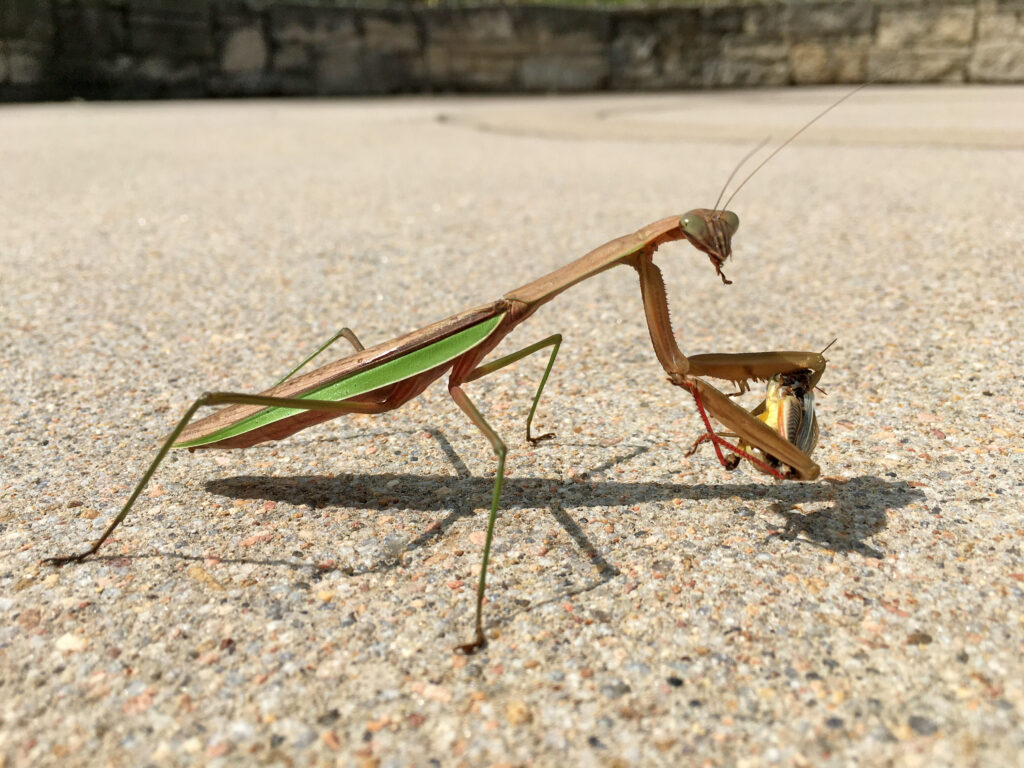
Mantises are predators. They mainly eat insects and other arthropods, but larger species have occasionally been recorded taking small vertebrates. The Missouri Department of Conservation notes that large Chinese mantis females have occasionally been recorded eating small reptiles, amphibians, and even hummingbirds, though such events are rare and not considered a major population-level threat to those animals.
How to Identify a Praying Mantis Egg Case
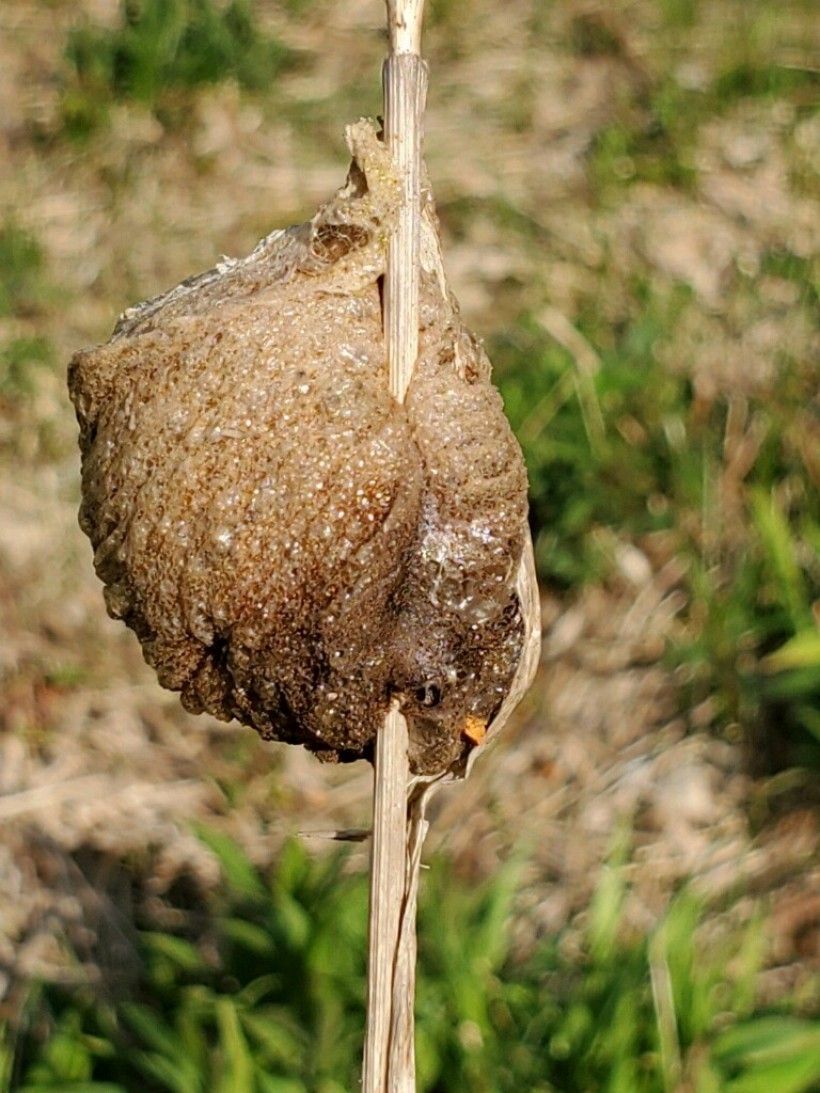
A praying mantis egg case is called an ootheca. This is one of the best clues for identifying mantis species, especially in winter and early spring when adults are gone.
A female mantis lays eggs in a foamy material that hardens into a protective case. The texture can look a bit like dried foam or Styrofoam. Oothecae may be attached to twigs, stems, fence posts, siding, rocks, or garden structures.
You may find mantis egg cases from late fall through early spring. In many regions, they are easier to notice after leaves have dropped.
Chinese Mantis vs European Mantis vs Carolina Mantis
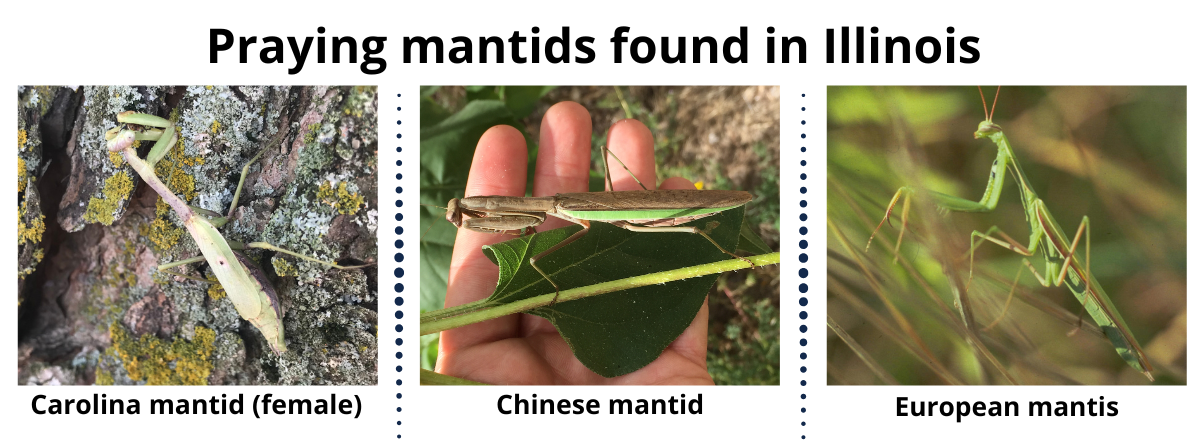
In parts of North America, especially the eastern United States, three commonly discussed mantises are the Chinese mantis, European mantis, and Carolina mantis. The Carolina mantis is native, while the Chinese and European mantises are non-native in North America.
These species can be difficult to separate by color alone because all may appear green, brown, tan, or grayish. Body size, markings, facial shape, and egg cases are more useful.
| Feature | Chinese Mantis | European Mantis | Carolina Mantis |
|---|---|---|---|
| Scientific name | Tenodera sinensis | Mantis religiosa | Stagmomantis carolina |
| Native status in North America | Non-native | Non-native | Native |
| General size | Often large, sometimes 4 inches or more | Usually around 2–3 inches | Usually smaller, about 2–2¼ inches in some field guides |
| Color | Green, tan, or brown | Green, tan, yellowish, or cream | Green, tan, brown, gray, or mottled |
| Useful adult ID clue | Squarer facial shield with vertical stripes | Dark round spot under the foreleg base | Longer, narrower facial shield |
| Egg case clue | Round, puffy, tan, marshmallow-like | Pale, layered, egg-shaped | Elongated, flatter, teardrop-like |
Missouri Department of Conservation notes that the Chinese mantis often has a fairly square facial shield with vertical stripes, while the Carolina mantis has a longer, narrower facial shield. European mantises have a round black dot on the underside of the foreleg base, sometimes with a white center.
How to Identify Mantis Egg Cases by Species
Egg cases can be more reliable than adult color when trying to identify common mantis species.
Carolina Mantis Ootheca
A Carolina mantis egg case is usually elongated, flatter, and somewhat teardrop-shaped. It may show lighter and darker brown striping or a paler central area. It tends to look smoother and less puffy than a Chinese mantis ootheca.
Chinese Mantis Ootheca
A Chinese mantis egg case is usually puffier, rounder, and more foam-like. It is often tan or straw-brown and may look like a small toasted marshmallow attached to a twig or stem.
European Mantis Ootheca
A European mantis egg case can look somewhat elongated or layered, but it is usually more uniformly pale brown and lacks the stronger striping seen in many Carolina mantis oothecae.
Brandywine Conservancy describes Carolina mantis oothecae as elongated and slender, Chinese mantis oothecae as puffier and round to cube-shaped, and European mantis oothecae as solid pale brown without striping. Natural Lands also notes that mantis color can be hard to use by itself and that egg cases are often more distinct.
Should You Remove a Praying Mantis Egg Case?
This depends on the species and your region.
If you are in an area where non-native Chinese or European mantises are common and you can confidently identify their egg cases, some conservation groups recommend removing those egg cases before they hatch. The reason is that non-native mantises may compete with native mantises and prey on beneficial insects.
However, do not destroy an egg case unless you are reasonably sure of the identification. If it is a native mantis egg case, leave it in place. When in doubt, take a clear photo and compare it with local extension or conservation resources for your state or region.
What Looks Similar to a Praying Mantis?
A few insects can be confused with praying mantises, especially at a quick glance.
Mantisflies
Mantisflies have raptorial front legs, so they can look like tiny mantises. However, they are not true mantises. Their wings are usually clear and held roof-like over the body when resting. They often look more delicate than mantises.
Stick Insects
Stick insects may have long, narrow bodies like mantises, but their front legs are not spiny hunting tools. Their heads are often less triangular, and they usually lack the folded “praying” front-leg posture.
Grasshoppers and Katydids
Young mantises may sometimes be mistaken for small grasshoppers or katydids, especially if they jump or move quickly. The front legs are the key difference. Grasshoppers and katydids do not have the mantis-style grasping forelegs.
Are Praying Mantises Good for the Garden?
Many gardeners like seeing praying mantises because they eat pest insects. That is true, but the full picture is more complicated.
Praying mantises are not selective predators. They may eat pests, but they may also catch pollinators, butterflies, bees, other beneficial insects, and even other mantises. So while a mantis can be part of a healthy garden ecosystem, buying mantis egg cases as a pest-control solution is not always the best approach.
A better garden strategy is to support overall biodiversity: native plants, fewer pesticides, leaf litter where appropriate, and habitat for many kinds of beneficial insects.
Quick Checklist: How to Identify a Praying Mantis
Use this simple checklist when you find a possible mantis:
- Does it have a triangular head?
- Are the eyes large and widely spaced?
- Are the front legs folded and spiny?
- Is the body long and narrow?
- Does it sit still on vegetation and wait for prey?
- Does it turn its head toward movement?
- If it is young, does it look like a wingless miniature adult?
- If you found an egg case, is it foamy, hardened, and attached to a stem or surface?
If most of these traits match, you are probably looking at a praying mantis.
Final Thoughts
Learning how to identify a praying mantis starts with the obvious clues: the folded front legs, triangular head, and patient hunting posture. But the more you look, the more details you notice.
Color alone is not enough. A green mantis is not automatically one species, and a brown mantis is not automatically another. Size, body shape, wing length, facial markings, foreleg spots, and egg case shape all matter.
The next time you see a mantis in the garden, pause for a moment. Look at the front legs, the head, the wings, and the place where it is resting. If you find an egg case in winter, take a closer look before deciding what to do with it. A little careful observation can tell you far more than a quick glance.
FAQ
How can I tell if an insect is a praying mantis?
Look for the folded, spiny front legs, triangular head, large eyes, and long body. A true praying mantis usually holds its front legs in a “praying” position and uses them to grab prey.
What is the easiest way to identify a praying mantis?
The easiest clue is the front legs. Praying mantises have raptorial front legs with sharp spines. These legs fold in front of the body and are used for catching insects.
What does a praying mantis egg case look like?
A praying mantis egg case, called an ootheca, is a hardened foamy structure attached to a twig, stem, fence, wall, or similar surface. Depending on the species, it may be round and puffy, elongated and smooth, or pale and layered.
What is the difference between a Chinese mantis and a Carolina mantis?
A Chinese mantis is usually larger and non-native in North America. It often has a squarer facial shield with vertical stripes. A Carolina mantis is native, usually smaller, and has a longer, narrower facial shield. Their egg cases are also different: Chinese mantis oothecae are usually rounder and puffier, while Carolina mantis oothecae are more elongated and flatter.
Are praying mantises good or bad for the garden?
They can eat pest insects, but they also eat beneficial insects. A praying mantis is a natural predator, not a targeted pest-control tool. It is best to see them as part of the wider garden ecosystem rather than a perfect solution for pests.
Can praying mantises fly?
Many adult mantises have wings, but they are not usually strong long-distance fliers. Some fly in short bursts. In certain species, females may have reduced wings or fly poorly.
Do praying mantises bite people?
Praying mantises are not aggressive toward people. They may pinch or bite if handled roughly, but they are not venomous and usually prefer to escape or stay still.
What insects are commonly mistaken for praying mantises?
Mantisflies and stick insects are two common sources of confusion. Mantisflies have grasping front legs but different wings, while stick insects have long bodies but do not have the mantis-style spiny hunting legs.