
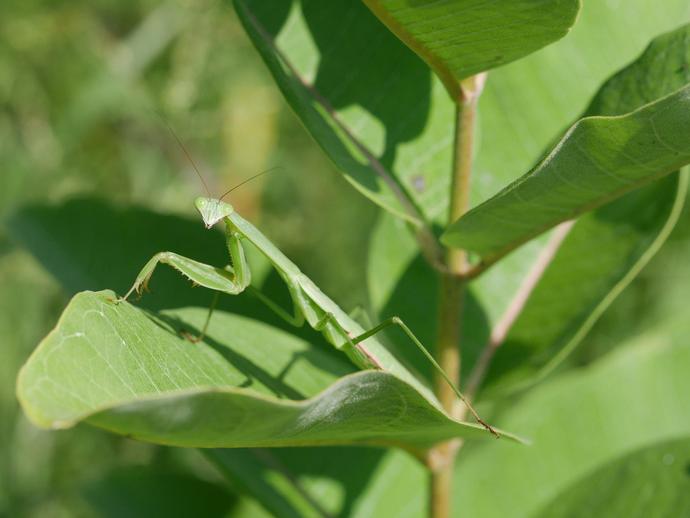
The Chinese Mantis is one of those insects that can stop you in the middle of a garden walk. Tall, still, and strangely alert, it looks almost thoughtful as it turns its triangular head and waits among stems and leaves. Its folded front legs give it the classic “praying” posture, but this insect is not praying at all. It is hunting.
Scientifically known as Tenodera sinensis, the Chinese Mantis is a large mantid species native to parts of Asia, including China, Japan, the Korean Peninsula, Micronesia, and Thailand. It is now long established in North America, where it was introduced in the late 1800s and has spread widely in many open and semi-open habitats.
For many people, the Chinese Mantis is fascinating, useful, and even beautiful. For others, it raises a more complicated ecological question: is this large non-native predator helpful in gardens, or is it a problem for native insects?
What Is a Chinese Mantis?
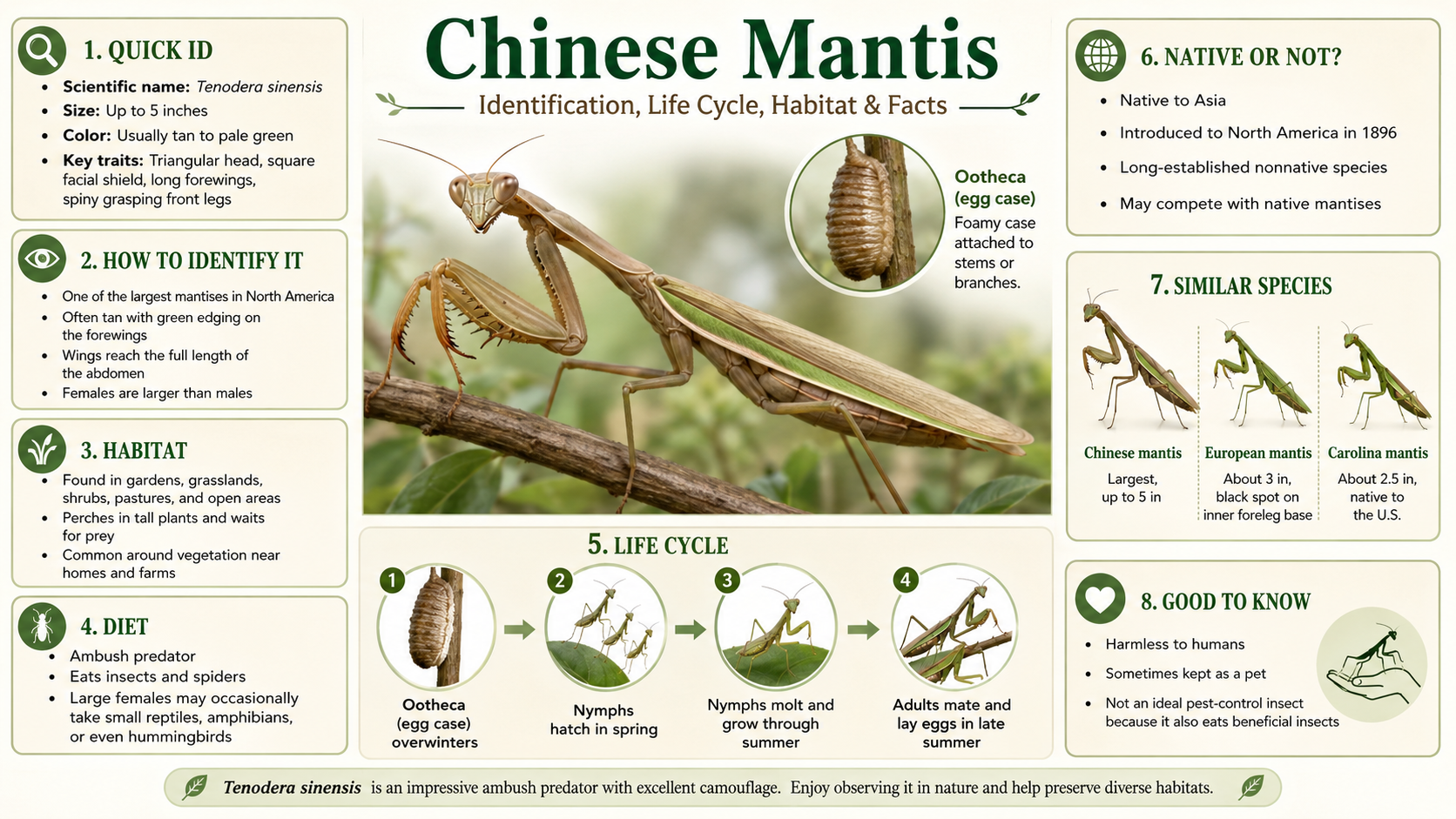
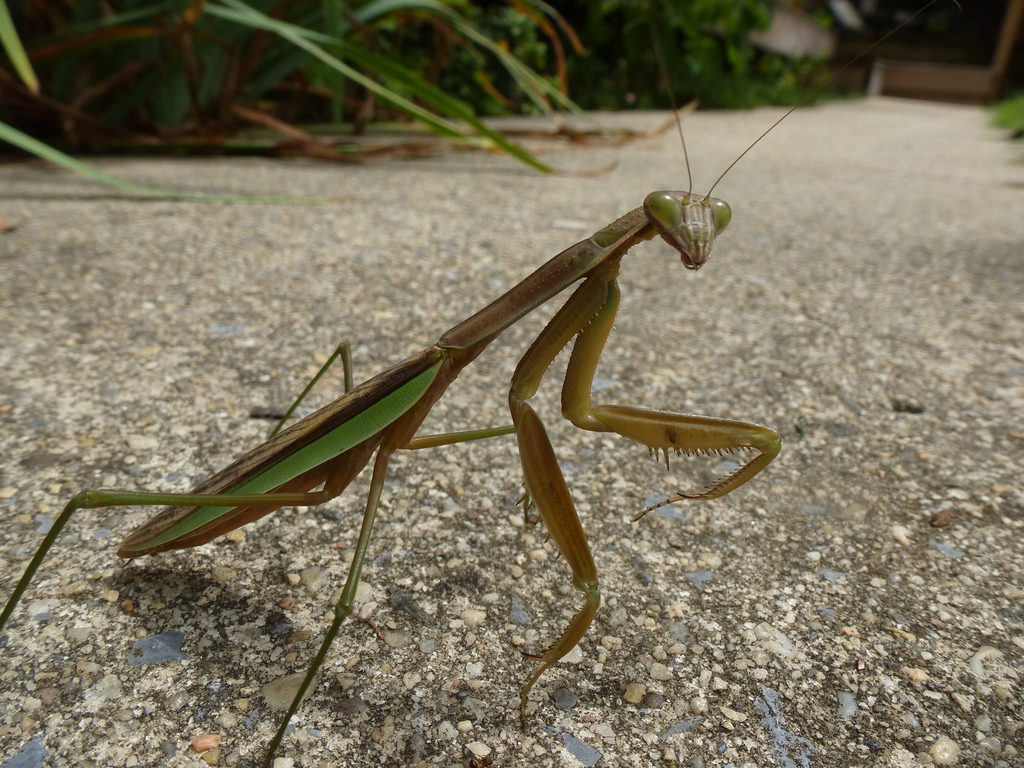
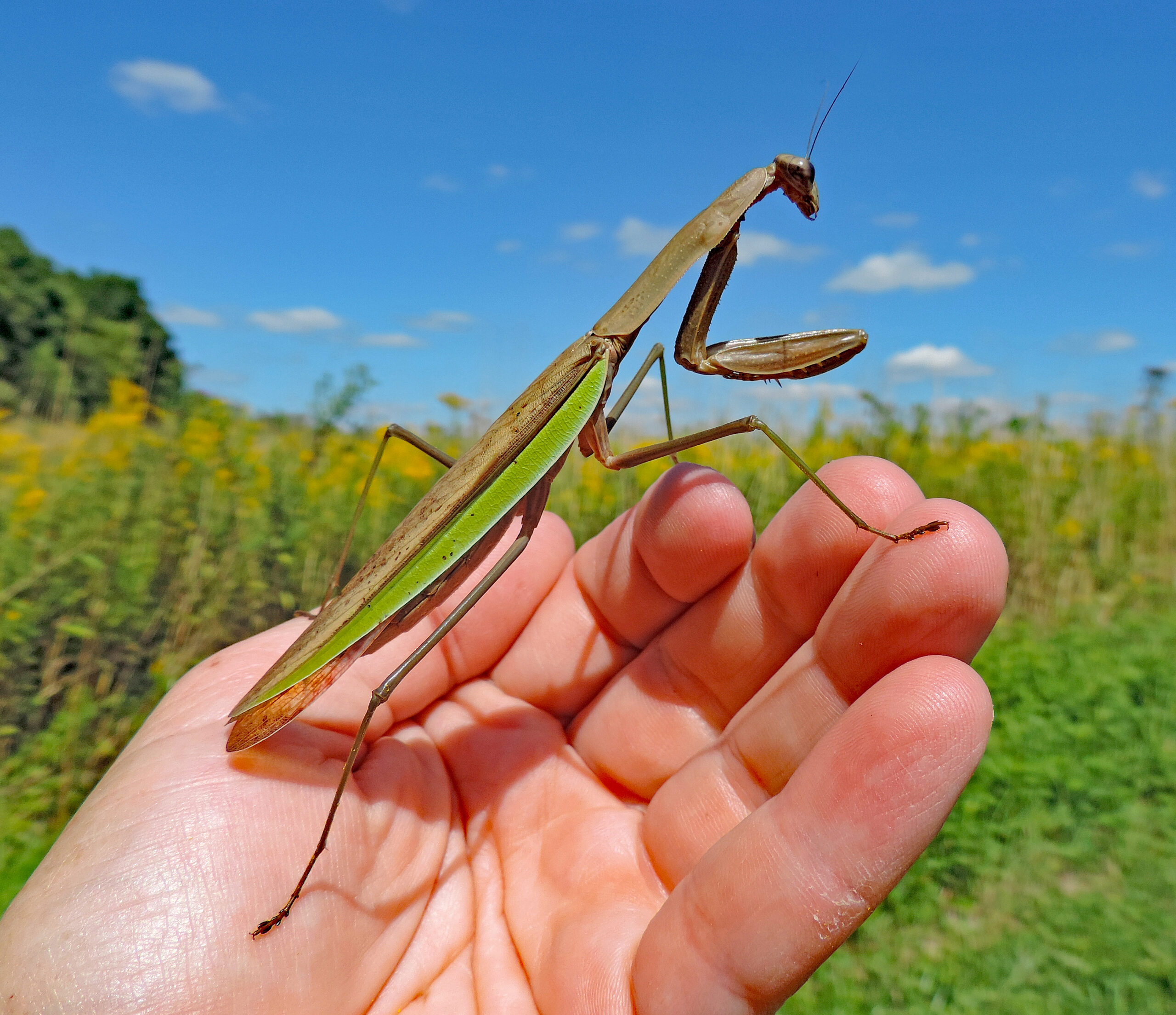
The Chinese Mantis, also called the Chinese mantid, is a large predatory insect in the order Mantodea. Adults are usually green, tan, or a mix of both, often with a green line along the edge of the forewings. Females are generally larger than males and can reach around 4 to 5 inches long, making this one of the largest mantises commonly seen in North America.
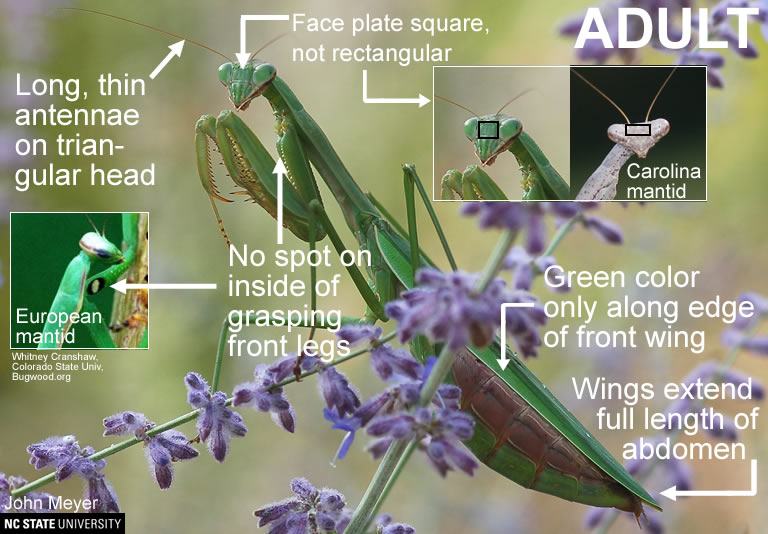
Like other mantids, the Chinese Mantis is built for ambush. Its front legs are specialized, spined, and folded close to the body until prey comes near. Then, in a quick strike, the mantis grabs its target and holds it while feeding.
Its head is triangular and highly mobile, which allows the mantis to track movement without shifting its whole body. This stillness is part of what makes mantises so effective. They do not chase prey like a dragonfly or wasp. They wait, blend into vegetation, and strike when the moment is right.
How to Identify a Chinese Mantis
A Chinese Mantis is usually easier to identify when you know what to look for. Size is the first clue. Adults are noticeably large, often longer and more slender than many other mantises found in the eastern United States.
Key identification features include:
- Large body size, often 3 to 5 inches long
- Tan, pale green, or mixed green-and-brown coloration
- Long wings that extend the full length of the abdomen
- A fairly square facial shield with vertical striping
- Green only along the front edge of the forewings in many individuals
- No large black spot on the inside base of the front legs
The egg case, or ootheca, is another useful clue. Chinese Mantis egg cases are usually tan, rounded, and somewhat like a small toasted marshmallow attached to a twig, stem, fence, or garden structure.
Chinese Mantis vs. Carolina Mantis vs. European Mantis
The Chinese Mantis is often confused with other mantises, especially the native Carolina mantis and the non-native European mantis.
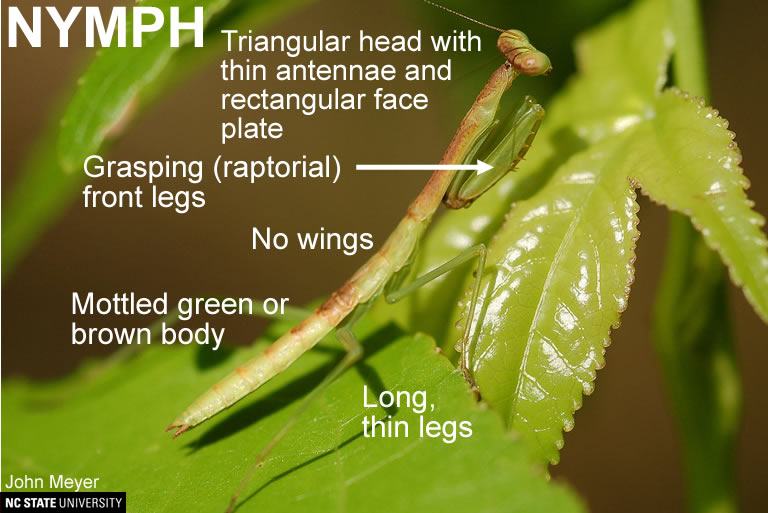
The Carolina mantis (Stagmomantis carolina) is native to the United States and is smaller, usually reaching about 2.5 inches. Adult females often have wings that cover only part of the abdomen, instead of reaching the full body length.
The European mantis (Mantis religiosa) is also non-native in North America. It is usually smaller than the Chinese Mantis and often has a distinctive black spot, sometimes with a pale center, on the inside base of each front leg. This spot may be difficult to see when the mantis holds its legs folded.
A simple field rule is this: if the mantis is very large, long-winged, tan or greenish, with a square-looking face and no obvious black “arm” spot, it may be a Chinese Mantis.
Where Do Chinese Mantises Live?
Chinese Mantises are most often seen in places with tall plants, shrubs, grasses, garden beds, and open vegetation. They like perching where insects pass by, so you may notice them around house gardens, meadows, pastures, field edges, roadsides, and agricultural areas.
They are not dangerous to people. A large mantis may grasp or pinch if handled roughly, but it is not venomous and is generally considered harmless to humans. Still, it is better to observe rather than bother it. A mantis is most interesting when it is doing what it naturally does: waiting quietly among leaves.
What Does a Chinese Mantis Eat?
The Chinese Mantis is a sit-and-wait predator. It feeds on insects and other small arthropods, including flies, moths, grasshoppers, crickets, beetles, spiders, bees, wasps, and even other mantises. Its diet is broad, and that is exactly why its role in gardens is not as simple as “good bug” or “bad bug.”
A Chinese Mantis may eat pest insects, but it does not choose pests only. It may also catch pollinators, butterflies, beneficial predatory insects, and native species. Recent diet research on introduced mantids found that they consume arthropods across many ecological roles, including herbivores, predators, and pollinators. This broad diet makes them unreliable as targeted biological control agents.
Large female Chinese Mantises have also been recorded eating small vertebrates such as small reptiles, amphibians, and even hummingbirds, though these events appear uncommon compared with their normal insect diet.
Is the Chinese Mantis Beneficial or Invasive?
This is where the Chinese Mantis becomes interesting from an ecological point of view.
Many people buy mantis egg cases for gardens because they hope mantises will control pests naturally. The idea sounds reasonable: mantises eat insects, and some insects damage plants. But in practice, Chinese Mantises are not precise pest-control tools. They are generalist predators. They wait for whatever comes close enough to catch.
NC State Extension describes the Chinese mantid as a common non-native species that has been sold for pest management for decades but appears to have little value in that role because it is a non-selective ambush predator.
The concern is not only that Chinese Mantises eat beneficial insects. They may also compete with native mantises, such as the Carolina mantis, for prey and habitat. Because the Chinese Mantis has been present in North America for so long and is already widespread, its full ecological impact is difficult to measure clearly.
So, is it invasive? In many regions, it is best described as a non-native, long-established mantis with debated ecological effects. Some conservation-minded gardeners choose not to buy or release Chinese Mantis egg cases and instead focus on habitat-friendly pest control: native plants, diverse vegetation, reduced pesticide use, and support for a wide range of native predators.
Chinese Mantis Life Cycle
The Chinese Mantis has a seasonal life cycle that usually lasts about one year.
In spring, young mantises hatch from overwintering egg cases. These tiny nymphs look like miniature adults, but they do not yet have fully developed wings. They begin feeding quickly and grow by molting through the warmer months.
By late summer and early fall, adults are ready to mate. Females produce egg cases called oothecae, attaching them to twigs, stems, bark, fences, or other firm surfaces. The foamy material hardens into a protective case that shelters the eggs through winter. When spring arrives, many nymphs may emerge from the same case almost at once.
Cannibalism is also part of mantis biology. Nymphs may eat each other if crowded, and adults may also consume other mantises. The famous story of a female eating the male during mating can happen, though it is often more commonly observed under captive or close-quarter conditions than people assume.
Chinese Mantis Egg Cases
Chinese Mantis egg cases are among the easiest signs to notice in winter or early spring. They are usually tan, rounded, and foam-like, often attached to plant stems or woody twigs.
If you are trying to support native mantises, identification matters. Non-native Chinese and European mantis egg cases are sometimes removed by gardeners who want to reduce pressure on native mantis populations. However, egg case identification can be tricky, especially for beginners, so it is worth comparing reliable images before removing anything.
For a general nature blog, a good approach is to encourage observation first. Teach readers to identify the egg case, compare it with native species, and avoid buying non-native mantis egg cases for release.
Can You Keep a Chinese Mantis as a Pet?
Yes, some people keep Chinese Mantises as pets, but they need proper space, ventilation, and safe molting conditions. Because this is a large mantis, the enclosure should be tall enough for the insect to hang upside down when molting. A common guideline is to use an enclosure at least three times as tall as the mantis is long and at least twice as wide as the mantis is long.
Good ventilation is important, especially in glass or plastic enclosures. A screen top or mesh enclosure helps prevent excess moisture. The mantis also needs branches, mesh, or other surfaces it can grip securely.
Chinese Mantises generally do well near room temperature, roughly around 70°F to 85°F, with moderate humidity around 50% to 60%. Light misting provides drinking water, but it is best not to spray the mantis directly. They are also cannibalistic and should not be housed together after the early nymph stages.
Are Chinese Mantises Dangerous?
Chinese Mantises are not dangerous to humans. They do not sting, they are not venomous, and they do not seek out people. A large individual may grab with its front legs or bite defensively if handled carelessly, but this is usually minor.
They are, however, dangerous to many smaller animals. To an insect, spider, or small amphibian, a Chinese Mantis is a serious predator. That is part of what makes it so impressive—and part of what makes its non-native status worth thinking about.
Should You Release Chinese Mantises in Your Garden?
It is better not to release purchased Chinese Mantis egg cases into the garden, especially in areas where native mantises are present. The main problem is that Chinese Mantises do not only eat plant pests. They also consume beneficial insects and may compete with native mantids.
For a healthier garden, a better long-term strategy is to create habitat for many kinds of natural predators. Plant native flowers, allow some structural diversity, reduce broad-spectrum insecticides, and let spiders, lady beetles, lacewings, birds, wasps, and native mantises share the work.
A garden with ecological balance is usually more resilient than a garden that depends on one introduced predator.
Final Thoughts on the Chinese Mantis
The Chinese Mantis is a remarkable insect: elegant, patient, powerful, and a little unsettling in the best possible way. It is easy to understand why people admire it. Watching one turn its head and track movement feels almost like meeting a tiny alien intelligence in the garden.
But its story is not just about beauty or usefulness. The Chinese Mantis is also a reminder that nature rarely fits into simple labels. It can eat pests, but it can also eat pollinators. It can fascinate gardeners, but it may pressure native mantises. It can be harmless to us, while being a formidable predator in the small world of stems, leaves, and wings.
For nature lovers, the best response is curiosity with care: learn to identify it, understand its role, and think twice before releasing non-native mantises into the landscape.
FAQ
What is a Chinese Mantis?
A Chinese Mantis is a large predatory mantis species scientifically known as Tenodera sinensis. It is native to parts of Asia and is now established in North America.
How big does a Chinese Mantis get?
Adult Chinese Mantises can reach about 4 to 5 inches long. Females are usually larger and heavier-bodied than males.
Is the Chinese Mantis native to the United States?
No. The Chinese Mantis is not native to the United States. It was introduced to North America in the late 1800s and has since become widespread in many areas.
What does a Chinese Mantis eat?
A Chinese Mantis eats many kinds of insects and spiders. Large females may occasionally catch small reptiles, amphibians, or hummingbirds, but most of their diet consists of arthropods.
Is the Chinese Mantis good for gardens?
It can eat garden pests, but it also eats beneficial insects, pollinators, and native predators. Because it is not selective, it is not considered a reliable or ideal pest-control solution.
Can I keep a Chinese Mantis as a pet?
Yes, but it needs a tall, well-ventilated enclosure, safe surfaces for molting, moderate humidity, and live insect prey. Chinese Mantises should generally be kept alone because they are cannibalistic.
How can I tell a Chinese Mantis from a Carolina mantis?
A Chinese Mantis is usually larger, with wings that extend the full length of the abdomen. The Carolina mantis is smaller, and adult females often have shorter wings that cover only part of the abdomen.
What does a Chinese Mantis egg case look like?
A Chinese Mantis egg case is usually tan, rounded, and foam-like. It is often attached to twigs, stems, fences, or other outdoor surfaces and may look a bit like a small toasted marshmallow.