
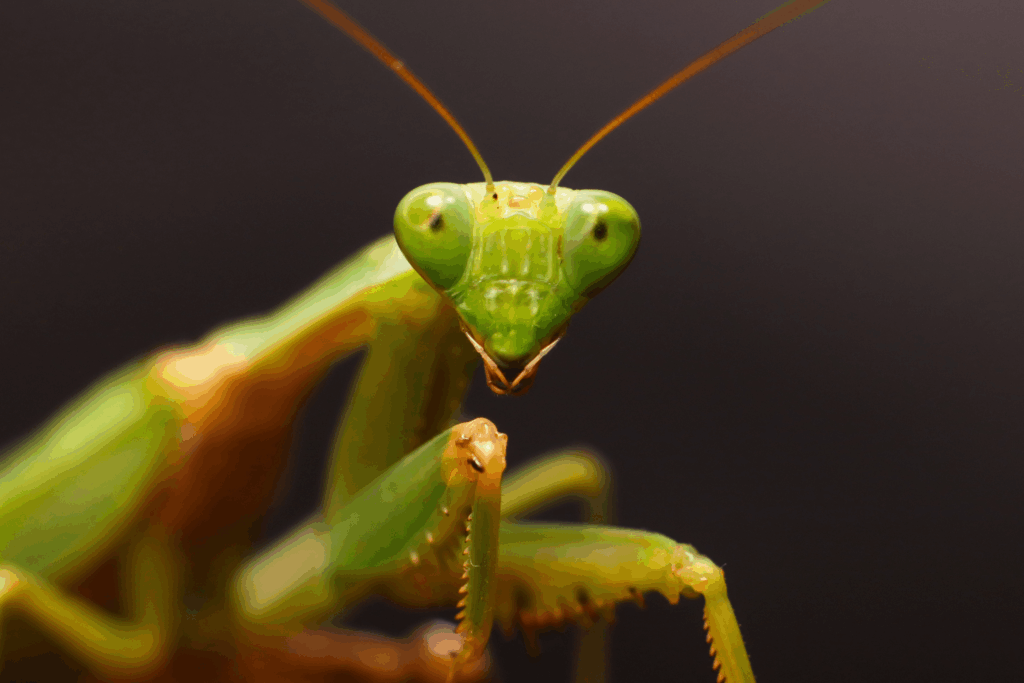
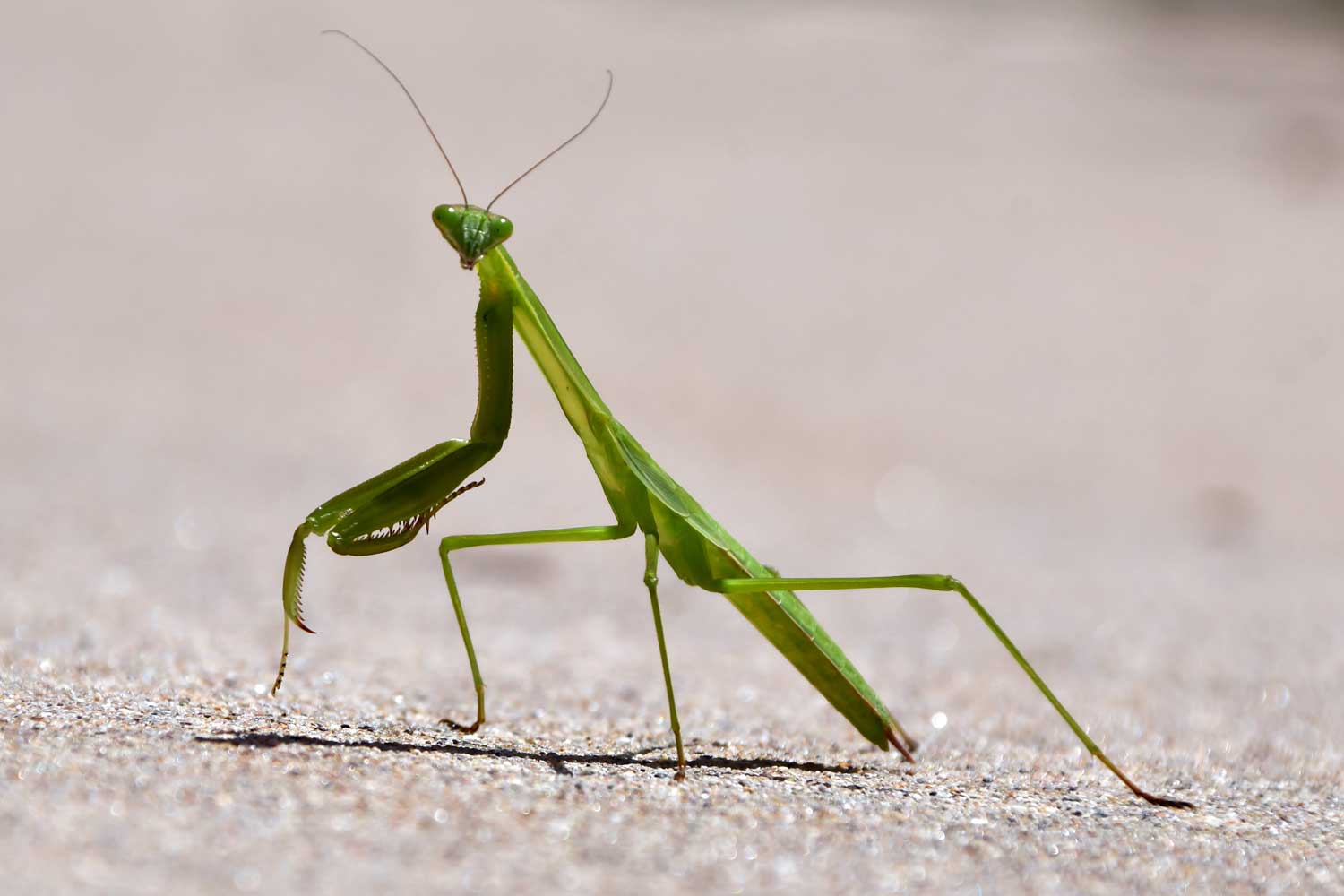
A praying mantis is one of those insects that almost feels designed to make you stop and look twice. With its triangular head, large watchful eyes, long body, and folded front legs, it has a posture that looks strangely calm — even while it is waiting to strike.
So, what is a praying mantis? In simple terms, a praying mantis is a carnivorous insect in the order Mantodea. It gets its common name from the way it holds its front legs together, almost as if it were praying. But behind that peaceful pose is a patient ambush predator with sharp reflexes, excellent camouflage, and a surprisingly complex way of seeing the world.
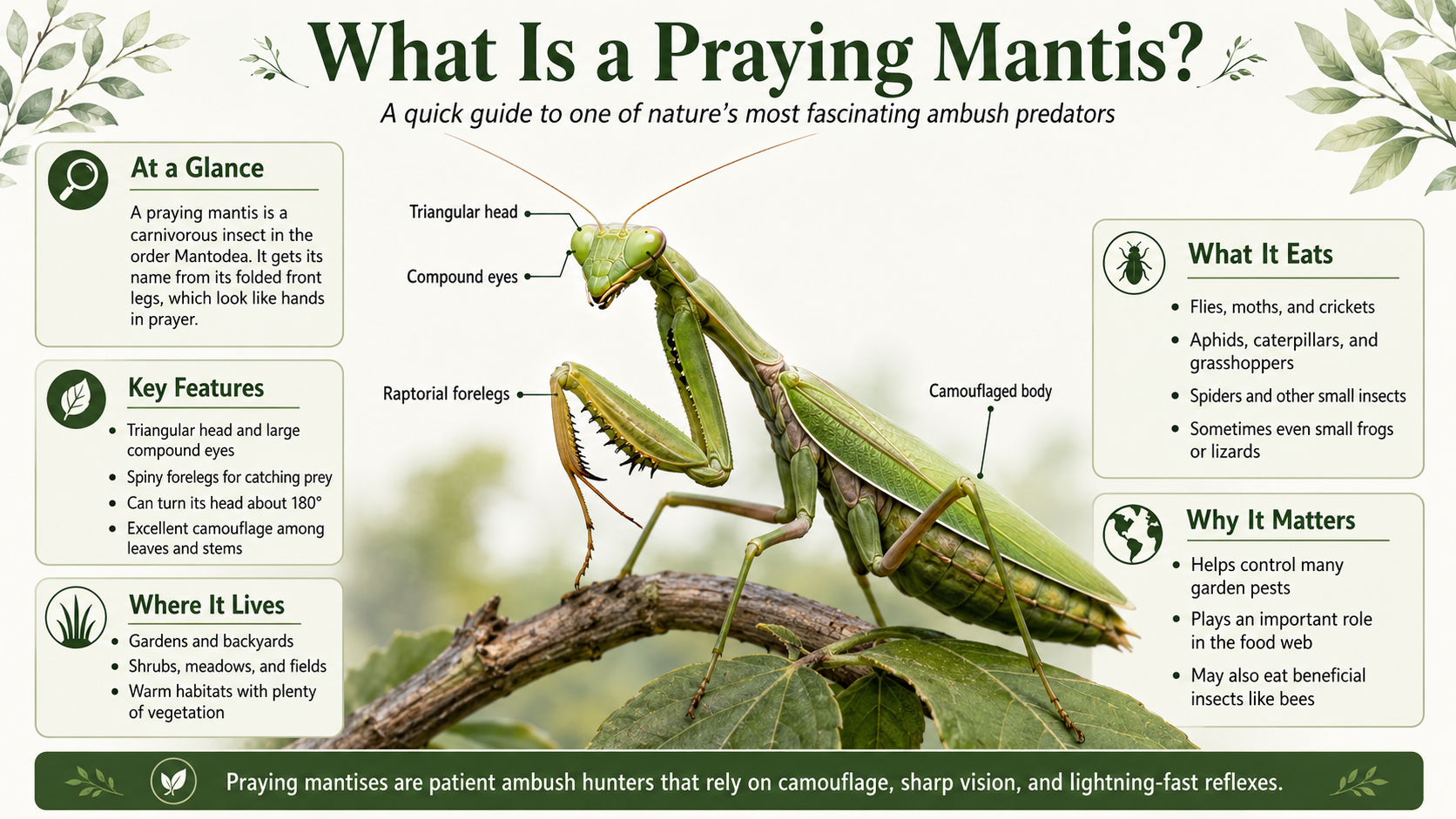
Mantises are found in many warm and temperate parts of the world. They are known for their spiny grasping forelegs, flexible necks, and ability to blend into leaves, stems, flowers, and branches. Britannica describes mantises as carnivorous insects with enlarged, spined front legs used to seize prey in a vise-like grip.
What Does a Praying Mantis Look Like?
A praying mantis has the same basic body plan as other insects: a head, thorax, abdomen, and six legs. But its shape is so distinctive that many people recognize it immediately.
Most praying mantises have:
- A triangular head
- Two large compound eyes
- Three smaller simple eyes
- A long, narrow body
- A flexible neck
- Two folded, spiny forelegs
- Green, brown, or leaf-like camouflage
The front legs are the most famous feature. They are called raptorial legs, meaning they are adapted for grabbing prey. When folded, they create the “praying” posture that gives the insect its name.
One of the mantis’s most striking abilities is its head movement. Praying mantises can turn their heads about 180 degrees, which helps them scan their surroundings without moving the rest of the body and revealing their position.
Is a Praying Mantis Really an Insect?
Yes. A praying mantis is definitely an insect.
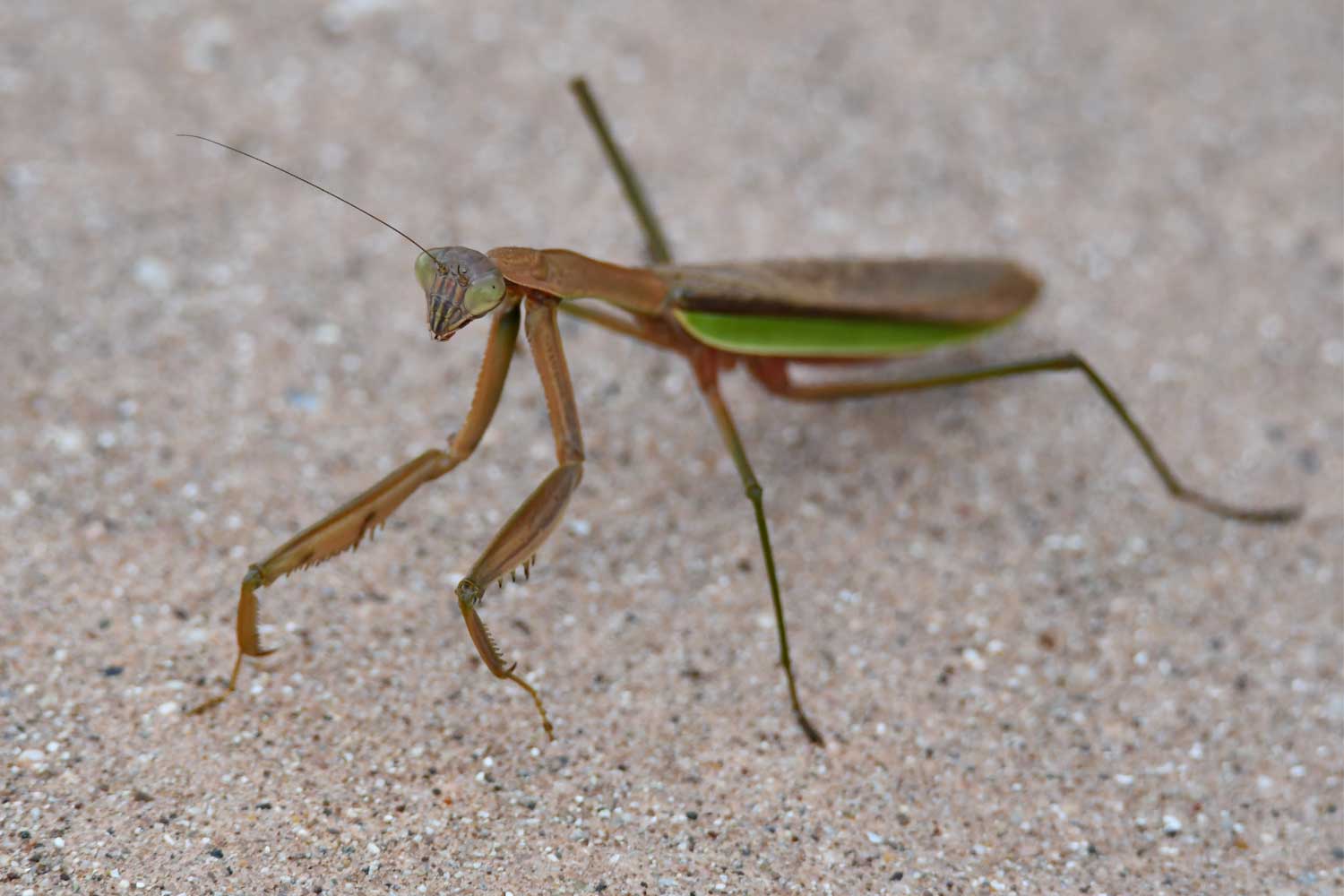
Like bees, butterflies, beetles, and ants, it has six legs and a segmented body. What makes it look unusual is the way its first pair of legs has evolved into hunting tools. Instead of walking with all six legs in the usual way, a mantis often uses four legs for support while keeping its front legs ready to strike.
The scientific order for mantises is Mantodea. The well-known European mantis is called Mantis religiosa, a name that also reflects the insect’s prayer-like stance.
Where Do Praying Mantises Live?
Praying mantises usually prefer places with plenty of vegetation. You may find them in gardens, meadows, shrubs, fields, forest edges, and warm grassy areas.
They like these habitats because plants provide three important things:
First, they offer camouflage. A green or brown mantis can disappear among leaves and stems.
Second, plants attract prey. Flies, moths, crickets, grasshoppers, aphids, bees, and other insects often gather around flowers and foliage.
Third, vegetation gives mantises places to hide, hunt, mate, and lay egg cases.
Mantises are especially common in tropical and subtropical regions, but many species also live in temperate climates. In cooler regions, adults often appear in late summer and fall, while their eggs survive through winter inside protective egg cases called oothecae.
What Do Praying Mantises Eat?
Praying mantises are carnivores. They eat living prey, mostly insects and other small animals.
Common prey includes:
- Flies
- Moths
- Crickets
- Grasshoppers
- Aphids
- Caterpillars
- Beetles
- Spiders
- Bees and butterflies
- Small frogs or lizards in some cases
Larger mantises may even catch small birds, including hummingbirds, although this is not their everyday diet. Their main role is as generalist predators: they eat what they can catch, not just one specific type of pest.
This is important for gardeners to understand. A praying mantis may eat aphids and caterpillars, but it may also eat pollinators or other helpful insects. University extension sources note that mantises are not highly targeted biological control agents because they feed indiscriminately on pests, pollinators, and other beneficial insects.
How Does a Praying Mantis Hunt?
The praying mantis is an ambush hunter. It does not usually chase prey over long distances. Instead, it waits.
A mantis may sit motionless on a stem or leaf, gently swaying as if it were part of the plant. When an insect moves close enough, the mantis strikes with incredible speed. Its spiny forelegs snap shut around the prey, holding it tightly while the mantis begins feeding.
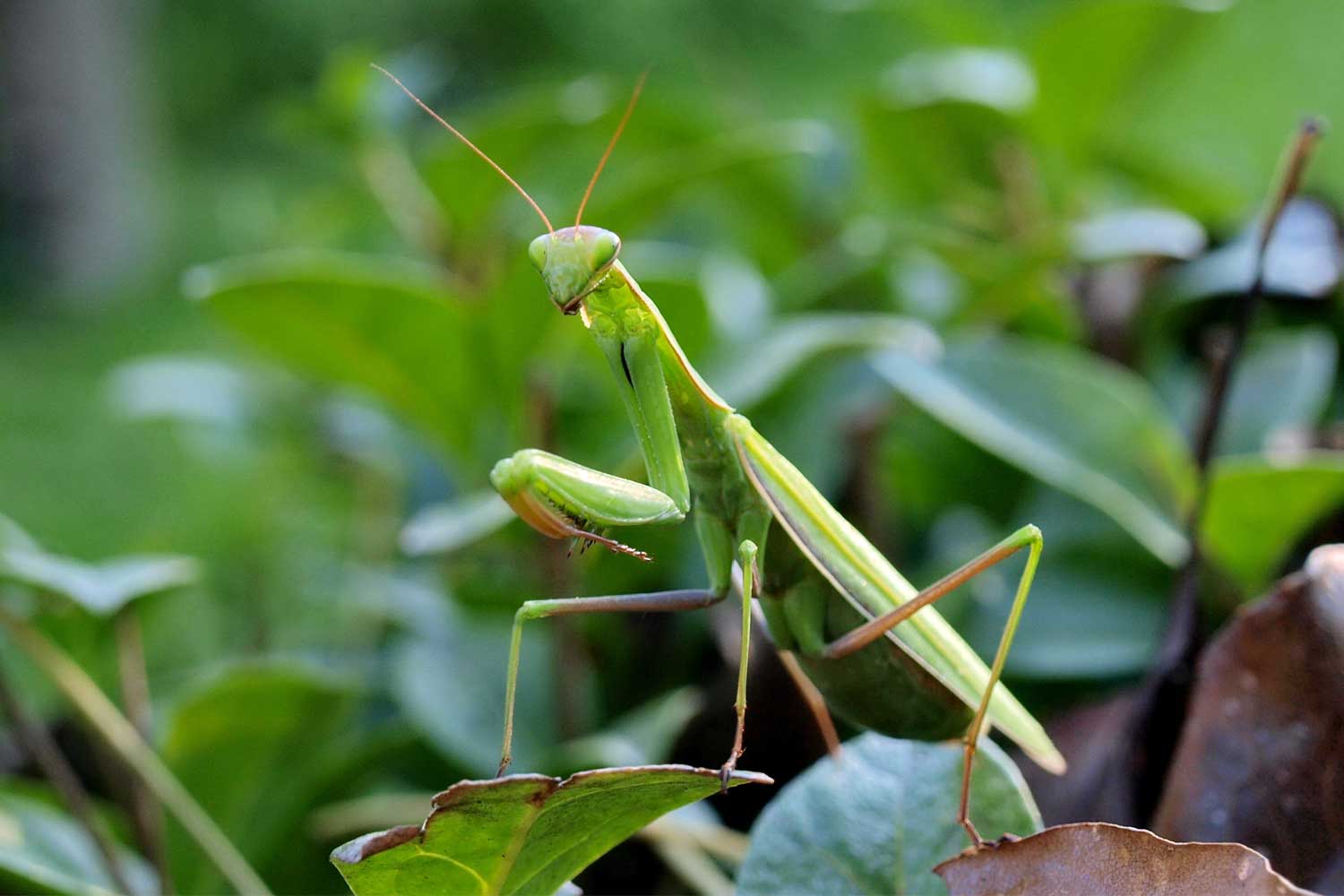
This hunting method depends on patience, camouflage, depth perception, and timing.
Praying mantises are also famous for their unusual vision. Researchers have found that mantises use a form of 3D vision that helps them judge the distance of moving prey. Newcastle University researchers reported that mantis 3D vision works differently from previously known forms of biological 3D vision, relying strongly on change over time.
Why Do Praying Mantises Look Like They Are Praying?
The name comes from the way they hold their front legs.
When resting or waiting for prey, a mantis often folds its forelegs upward in front of its body. To humans, this looks like a person holding their hands together in prayer. That is why the insect is called a praying mantis, not a “preying mantis,” even though it is definitely a predator.
The name is poetic, but also slightly misleading. A praying mantis may look peaceful, but it is one of the most efficient hunters in the insect world.
Are Praying Mantises Good for Gardens?
Praying mantises can be helpful in gardens because they eat many plant-damaging insects. If you see one on your tomato plants, flowers, or shrubs, it may be hunting caterpillars, flies, grasshoppers, or other insects that could damage your garden.
However, they are not perfect pest-control tools.
A praying mantis does not know the difference between a harmful pest and a beneficial pollinator. It may eat a caterpillar that damages leaves, but it may also catch a bee, butterfly, or lady beetle. For this reason, mantises are better viewed as part of a balanced garden ecosystem rather than a complete solution for pest control.
If one appears naturally in your garden, it is usually fine to leave it alone. But buying and releasing mantis egg cases is not always the best strategy, especially if the species is non-native in your area.
Mantis vs. Praying Mantis: What Is the Difference?
People often use the words “mantis,” “mantid,” and “praying mantis” in similar ways, but there are small differences.
Mantis is a general word for insects in the order Mantodea.
Mantid is also commonly used, especially when talking about members of the Mantidae family.
Praying mantis is the popular common name used for mantises with the famous folded-leg posture.
In everyday writing, “praying mantis” is the phrase most readers search for and recognize. For a beginner-friendly nature website, it is usually the best term to use.
Are Praying Mantises Native or Invasive?
That depends on where you live and which species you are seeing.
Some mantises are native to North America, such as the Carolina mantis. Others, including the Chinese mantis and European mantis, were introduced more than a century ago and are now common in many parts of the United States.
This matters because non-native mantises can compete with smaller native species. Larger introduced mantises may also eat a wider range of animals, including native insects and sometimes small vertebrates.
If you are trying to support local biodiversity, it is better to encourage native plants and native insects rather than release non-native mantis egg cases into the environment.
Do Praying Mantises Bite Humans?
Praying mantises are not dangerous to people.
They do not have venom, and they are not aggressive toward humans. If handled roughly, a large mantis may pinch or nip in self-defense, but this is usually harmless. Most mantises would rather escape or stay still than attack a person.
The best approach is simple: observe them without grabbing them. A praying mantis is much more interesting when it is allowed to behave naturally.
The Praying Mantis Life Cycle
The life cycle of a praying mantis has three main stages:
Egg: The female lays eggs inside a foamy protective case called an ootheca. This case hardens and protects the eggs.
Nymph: Young mantises hatch looking like tiny wingless versions of adults. They begin hunting small insects soon after emerging.
Adult: As they grow, nymphs molt several times. After reaching adulthood, many species develop wings and begin mating.
In temperate climates, adults often die after mating and egg-laying, while the next generation survives as eggs until warmer weather returns.
Why Are Praying Mantises So Hard to Spot?
A praying mantis can be surprisingly difficult to see, even when it is right in front of you.
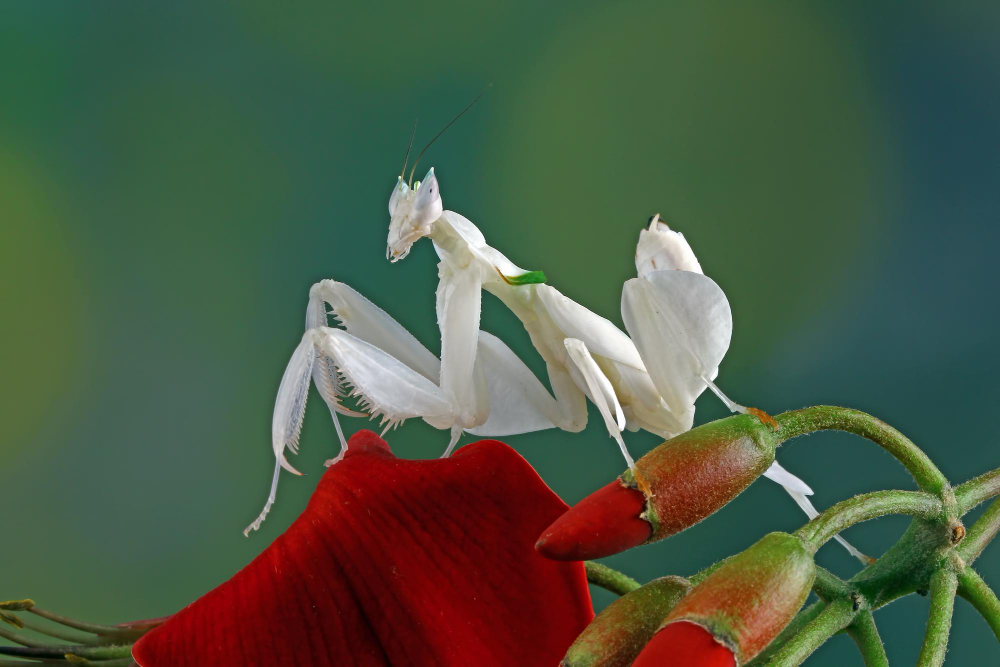
Many species are green, brown, tan, or mottled, allowing them to blend into leaves, dry grass, bark, or twigs. Some tropical mantises look like flowers, dead leaves, or thin branches. This camouflage helps them avoid predators and ambush prey.
Their slow, deliberate movement also helps. Instead of rushing across a leaf, a mantis may move one leg at a time, almost like a twig shifting in the breeze.
Are Praying Mantises Good Luck?
In many cultures, seeing a praying mantis has been linked with stillness, focus, patience, or good fortune. Some people see it as a peaceful visitor. Others find its head-turning stare a little unsettling.
Scientifically, of course, a praying mantis is not a sign of luck. But in a garden, its presence can suggest that the habitat is lively enough to support predators and prey. That alone is a good sign for a healthy outdoor space.
Final Thoughts: What Is a Praying Mantis?
A praying mantis is a carnivorous insect, a camouflage expert, and one of nature’s most memorable ambush hunters. Its folded legs may look peaceful, but those same legs are built to catch live prey with speed and precision.
For gardeners, mantises can be helpful, but they are not selective pest-control machines. They eat harmful insects, beneficial insects, and sometimes even each other. In the wider ecosystem, they are both predators and prey, helping connect many parts of the food web.
So the next time you see a praying mantis on a leaf or garden stem, take a closer look. That quiet little figure is not just sitting there. It is watching, waiting, and reading the world with a patience few creatures can match.
FAQ
What is a praying mantis?
A praying mantis is a carnivorous insect known for its triangular head, folded front legs, excellent camouflage, and ambush hunting style. It gets its name because its front legs often look like hands held in prayer.
Is a praying mantis an insect?
Yes. A praying mantis is an insect. It has six legs, a segmented body, antennae, compound eyes, and belongs to the order Mantodea.
What do praying mantises eat?
Praying mantises eat live prey, mostly insects such as flies, moths, crickets, grasshoppers, aphids, and caterpillars. Larger mantises may also eat spiders, small frogs, lizards, and occasionally small birds.
Are praying mantises good for gardens?
Praying mantises can help reduce some pest insects, but they are generalist predators. This means they may also eat bees, butterflies, and other beneficial insects. They are best seen as part of a balanced garden ecosystem, not as a perfect pest-control solution.
Do praying mantises bite?
Praying mantises can bite or pinch if handled roughly, but they are not venomous and are not dangerous to humans. Most prefer to avoid people.
Can a praying mantis turn its head?
Yes. A praying mantis can turn its head about 180 degrees, which helps it scan for prey and predators without moving its whole body.
What is the difference between a mantis and a praying mantis?
“Mantis” is the broader term for insects in the order Mantodea. “Praying mantis” is the common name used for mantises with the familiar folded front-leg posture.
Where do praying mantises live?
Praying mantises live in gardens, fields, meadows, shrubs, forests, and other habitats with plenty of vegetation. They are especially common in warm regions but can also be found in temperate climates.
Are praying mantises good luck?
Some cultures associate praying mantises with good luck, patience, or spiritual focus. Scientifically, they are simply insects, but seeing one in a garden can be a sign of a lively ecosystem.
Should I release praying mantis egg cases in my garden?
It is better to be cautious. Some commercially sold egg cases may belong to non-native species, and mantises do not only eat pests. A better long-term approach is to plant native flowers, avoid unnecessary pesticides, and support a diverse garden habitat.