
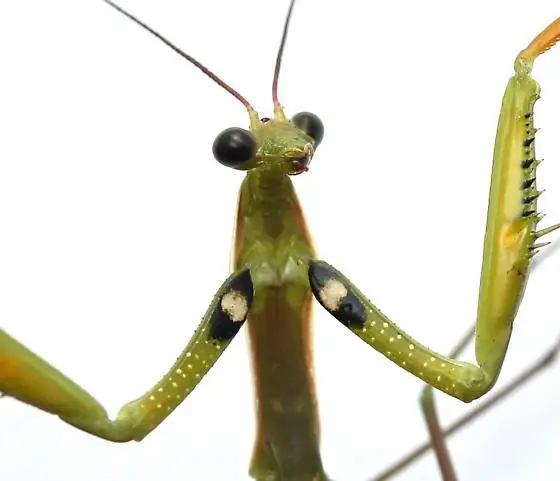
The most useful identification mark on a European mantis (Mantis religiosa) is not its green or brown color. Look instead at the inside of the front legs near where they attach to the body.
European mantises typically have a conspicuous dark patch on the inner surface of each front coxa—the basal segment of the raptorial foreleg. The mark is usually black or very dark and may contain a pale, white, or yellowish center. Importantly, the pale center is not always present. Some individuals have an almost entirely dark spot.
That foreleg marking is one of the strongest field clues for recognizing Mantis religiosa. Color, size, and overall body shape are useful supporting clues, but none is as dependable on its own.
The Key Mark: A Dark Spot on the Inner Foreleg
To find the characteristic mark, look at the thickest segment at the base of one of the mantis’s front grasping legs. This segment is called the coxa.
On a European mantis, the inner face of the fore coxa usually carries a dark, roughly oval or rounded patch near its base. Depending on the individual, the dark patch may surround a conspicuous pale center, producing the familiar “bullseye” appearance. Scientific identification keys likewise use the dark spot on the inner fore coxa as an important character for Mantis religiosa.
There is one practical problem: the marking is often hidden.
When a mantis holds its front legs folded together in the normal resting or “praying” position, the inner surfaces of the coxae face inward. Missouri Department of Conservation notes that the spot can therefore be difficult to see until the forelegs are separated.
For identification photographs, a side or slightly front-facing view showing the inside of at least one foreleg can be much more useful than a photograph taken directly from above.
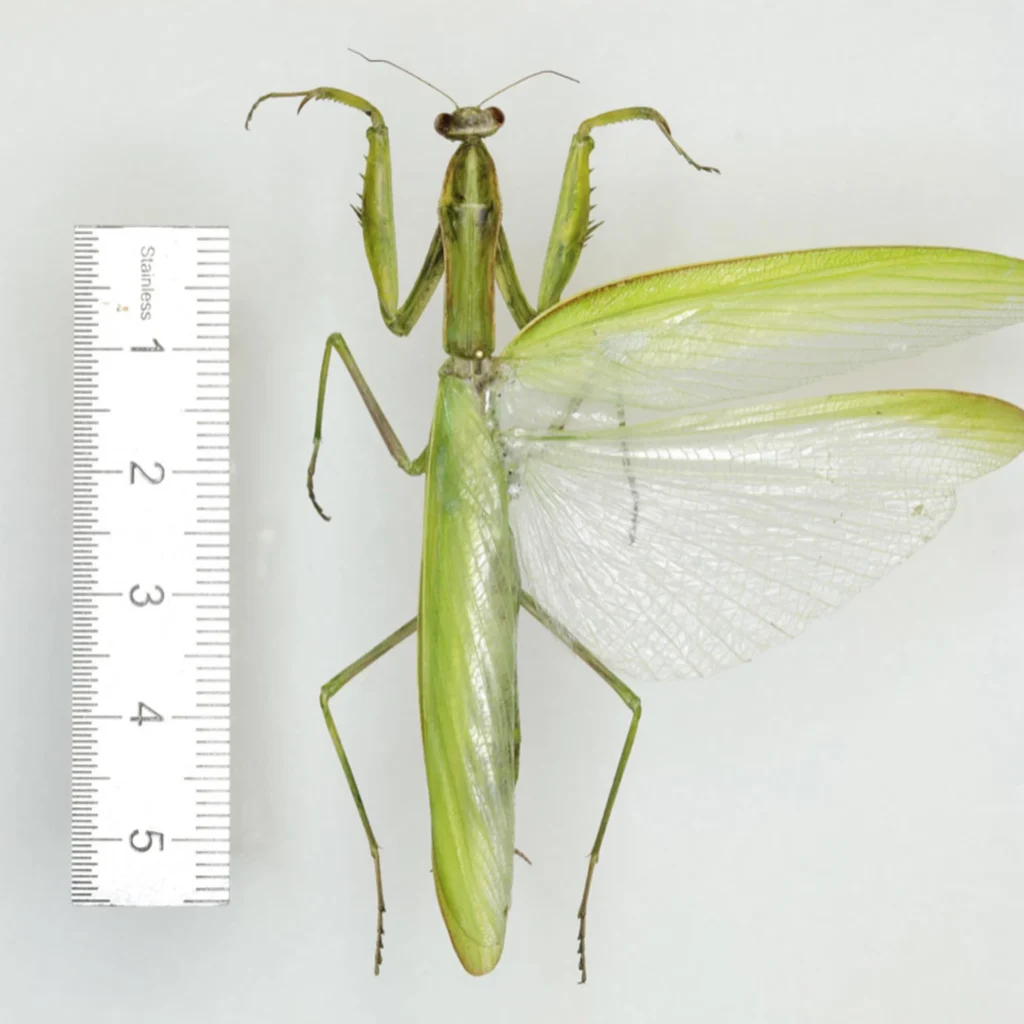
Does the Spot Always Have a White Center?
No.
The European mantis is often illustrated with a striking black-and-white bullseye on each fore coxa, which can give the impression that the white center is required for identification. It is not.
Field references document individuals in which the mark is almost entirely dark. Illinois Extension describes the spot as either solid black or black with a white center, while BugGuide’s species account likewise notes that the pale center may be absent.
So, when examining a possible European mantis, pay attention to the entire dark coxal patch, not just the presence of a perfect white dot.
Green or Brown? Color Does Not Identify a European Mantis
European mantises occur in more than one color form.
Individuals may be bright green, yellowish green, tan, cream-colored, or brown. Both green and brown forms are documented, including in scientific and regional field references.
This makes statements such as “green mantis = European mantis” unreliable.
Several other mantis species can also be green or brown. Lighting, vegetation, age, and natural individual variation can make color even less useful in photographs.
Use color as a supporting observation only. The foreleg marking, geographic location, adult size, wings, and other structural features provide much stronger evidence.
Size and Overall Body Shape
The European mantis is a medium-to-large mantis with the familiar elongated thorax, triangular mobile head, large compound eyes, and powerful raptorial forelegs typical of mantises.
North American field references commonly place adults at roughly 2–3 inches (about 5–7.5 cm), although measurements vary among populations, sexes, specimens, and the method used to measure them.
Size can help rule out some alternatives, but it should not be treated as a diagnostic character. A photograph without a scale can make a mantis appear much larger or smaller than it really is, and males and females can differ in proportions.
The scientific name Mantis religiosa remains an accepted species name in current taxonomic databases.
Check the Wings and Life Stage
Before comparing species, first decide whether the insect is an adult or a nymph.
Adult European mantises have fully developed wings. A young mantis does not yet have the complete adult wing structure, so wing length and shape are much less useful when identifying a nymph.
This matters because many online identification errors come from comparing a young mantis with photographs of adult insects.
For an adult, photograph the full insect from above as well as the inner foreleg. For a nymph, place more weight on structural markings, location, and detailed close-ups rather than trying to match adult wing proportions.
European Mantis vs. Chinese Mantis
In North America, the European mantis is often confused with the Chinese mantis (Tenodera sinensis).
Both species may be green or brown, so color does little to separate them. Chinese mantises can become substantially larger, while the European mantis generally falls closer to the 2–3 inch range. The strongest practical clue remains the European mantis’s characteristic dark patch on the inner fore coxa.
Size alone should still not be used to confirm the species. A small Chinese mantis may simply be immature, and estimating insect length from a photograph is difficult.
If the forelegs are visible, check them before relying on color or apparent size.
European Mantis vs. Carolina Mantis
The Carolina mantis (Stagmomantis carolina) is another species that can create identification problems in parts of the United States.
Carolina mantises may also be green, brown, tan, grayish, or mottled. Adult females are generally smaller than large Chinese mantises, and their wings are proportionally shorter than those of some other commonly encountered mantises. Missouri’s field guide describes the adult female’s wings as extending only partway along the abdomen.
Again, the European mantis’s dark inner coxal marking provides a more useful clue than body color.
Location should also be considered. Species distributions overlap differently from one state or province to another, so an identification guide written for Missouri, California, Ontario, or another region should not automatically be applied everywhere.
Identification in Europe Can Require More Care
The common name “European mantis” does not mean that it is the only mantis occurring in Europe.
Depending on the country, observers may encounter other native or recently established mantis species. European identification keys therefore use several anatomical characters rather than color alone.
A taxonomic key covering Portuguese mantises identifies Mantis religiosa by the dark internal fore-coxal spot, often with a pale center. Research from Romania has similarly used the conspicuous fore-coxal marking to distinguish M. religiosa from some superficially similar mantises occurring there.
The exact set of possible look-alikes varies geographically. For difficult records, country-specific identification keys or expert confirmation are preferable to a generic internet image comparison.
How to Photograph a European Mantis for Identification
If you find a mantis that might be Mantis religiosa, there is usually no need to pick it up.
Photograph the whole insect first. Then, if its position allows, take another photograph showing the inside of the front leg where it joins the thorax. A clear image of that area may reveal the dark coxal patch immediately.
It also helps to record the approximate size, date, and location. A dorsal photograph showing the wings and abdomen can provide additional evidence.
These details are much more useful than taking several photographs that all show only the mantis’s green or brown back.
Is the European Mantis Native to North America?
No. Mantis religiosa is introduced in North America.
Historical records place its discovery around Rochester, New York, at the end of the nineteenth century, and the species later became established across substantial parts of the United States and southern Canada. Recent research continues to examine the origins and expansion of those North American populations.
It is better to describe the species as introduced, non-native, or established where those terms are supported rather than automatically calling it “invasive.” Those words do not mean exactly the same thing, and ecological classifications can differ among authorities and regions. GBIF, for example, records the species as introduced in the United States without categorizing it as invasive in that entry.
The Fastest Way to Check Your Identification
If you think you have found a European mantis, ignore its color at first.
Look at the inner base of the front legs.
A prominent dark patch on the fore coxa—sometimes with a white or pale center—is the most useful visual clue. Then confirm the identification using body size, adult wing development, geographic location, and locally relevant look-alikes.
A green mantis is not automatically a European mantis, and the absence of a perfect white-centered “bullseye” does not automatically rule Mantis religiosa out.
That combination of clues is considerably more reliable than trying to identify the insect from color alone.