
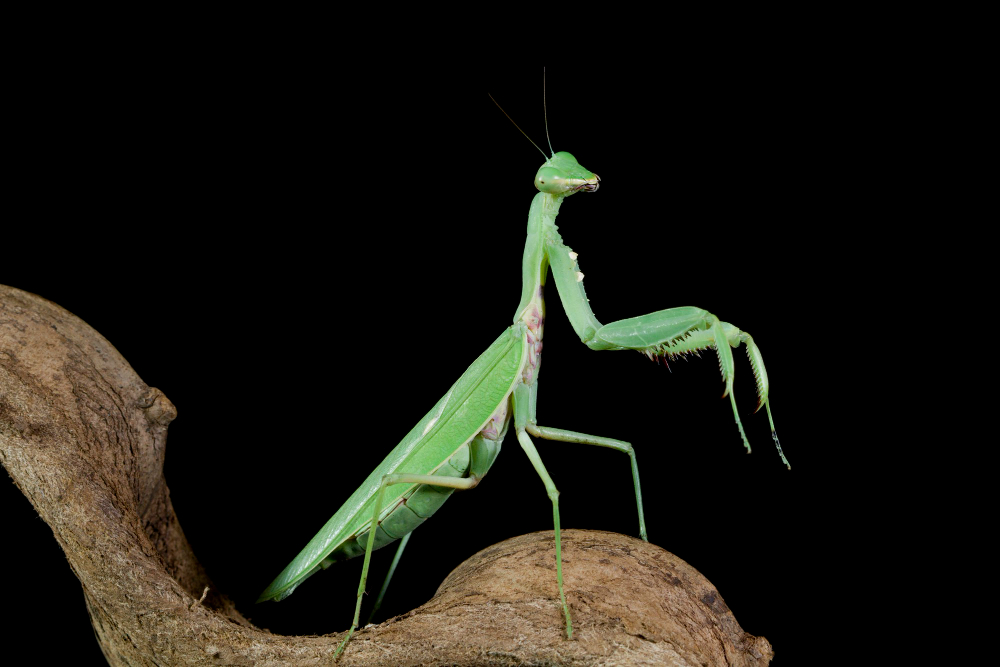
If you are looking at a tan or brown praying mantis with a thin green line running down the outer edge of each folded wing, you are most likely looking at a mantis in the genus Tenodera. Across much of the United States that means the Chinese mantis (Tenodera sinensis), and less often its close relative the narrow-winged mantis (Tenodera angustipennis). Both were introduced from Asia and are now established in many areas.
That green edge is a genuinely useful clue. It is not a complete identification on its own, though, and a few other mantises can produce a similar impression depending on the angle, the light, and the individual insect. Here is how to read the marking properly and what to check alongside it.
Quick answer
- A green stripe along the wing edge on an otherwise brown mantis points to the genus Tenodera.
- In North America, the Chinese mantis is the most common explanation, with the narrow-winged mantis a close second in parts of the East.
- The marking only helps on mantises with fully formed wings, which in temperate regions usually means late-summer and autumn adults.
- Confirm with size, the marking between the front legs, wing length relative to the abdomen, and your location.
- Colour by itself never identifies a mantis species.
What the green stripe actually is
A resting mantis folds its leathery forewings, called tegmina, flat along the top of the abdomen. The outermost edge of each forewing then faces outward, running the length of the body on each side.
In Tenodera mantises, that narrow outer strip of the forewing is green while the rest of the wing is tan or straw-coloured. The result is a clean green line down each side of the insect. The University of Maryland Extension describes the Chinese mantis as brown or green with a pale green or yellow stripe along the wing edges, and Michigan State University Extension notes the same green line along the wings in mature adults. The Missouri Department of Conservation describes Chinese mantises as usually tan with a green line along the side formed by the edges of the forewings.
One thing worth understanding: Chinese mantises occur in brown and green colour forms. On a green individual, the green wing edge blends into the rest of the body and may be almost impossible to pick out. The stripe is a species feature, but whether you can see it depends on which colour form is in front of you.
The most likely answer: Chinese mantis
The Chinese mantis is one of the largest mantises you can encounter in North America. Extension sources commonly give an adult length of roughly 3 to 5 inches (about 8 to 13 cm), well above the native species it shares ground with.
Features to look for:
- Long, drawn-out body. The pronotum, the segment between the head and the wing bases, is noticeably elongated.
- Tan or brown body with a green forewing edge in the brown colour form; plain green in the green form.
- Facial markings. The Missouri Department of Conservation notes that the facial shield, the area between and below the eyes, is fairly square and carries vertical stripes.
- A pale yellow marking between the bases of the front legs, visible when the mantis is viewed from the front with its forelegs opened.
- Egg case. The ootheca is rounded and puffy, tan, and roughly the size of a ping-pong ball.
This species was introduced to North America in the late nineteenth century, with the earliest well-known record from near Philadelphia, and has since spread widely.
The close match: narrow-winged mantis
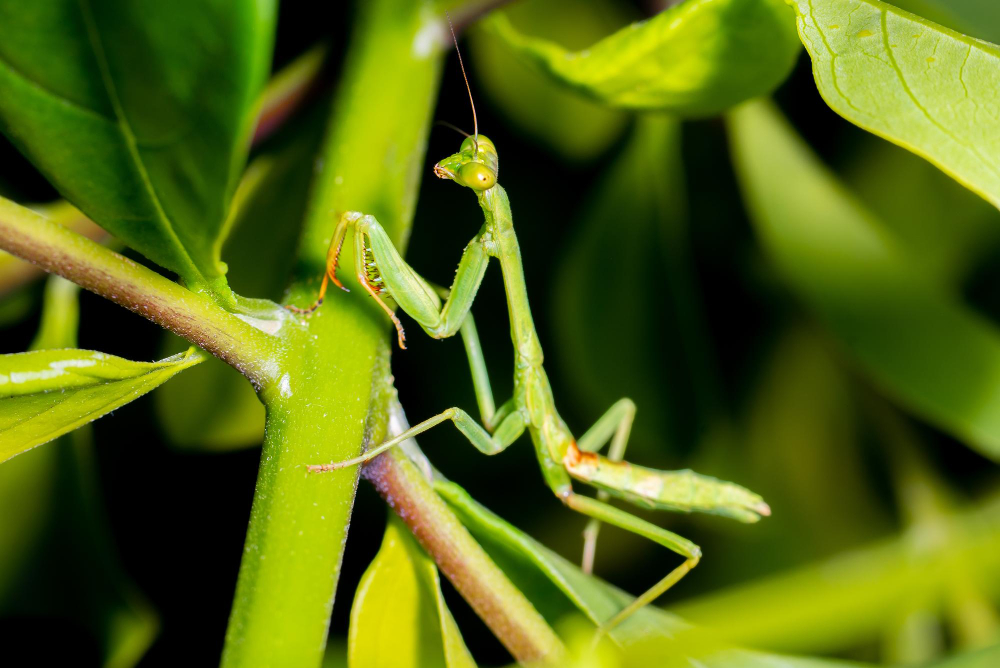
The narrow-winged mantis is also an Asian species established in the eastern United States, and it shows the same green wing edge. Adults are a little smaller and slimmer, with published measurements of roughly 65 to 85 mm in body length, and the green border on the forewing tends to be narrower.
Field-identification references generally separate the two by the marking between the bases of the front legs: orange in the narrow-winged mantis, pale yellow in the Chinese mantis. This is a widely used clue, but it is a small detail that can be genuinely hard to judge in dull light, at a distance, or in a photograph, so it works best alongside size and body proportions.
Egg cases differ more obviously. A narrow-winged mantis ootheca is elongated and flattened, commonly around 4 to 6 cm long, rather than the rounded, foamy ball produced by the Chinese mantis.
If you cannot separate these two with confidence, that is a normal outcome rather than a failure. Both are large introduced Tenodera mantises, and even experienced observers often stop at genus from a single photograph.
Mantises that get mistaken for it
European mantis (Mantis religiosa). Medium-sized at around 3 inches, and more often green than brown. Its reliable field mark is a dark, ringed spot on the inner surface of each foreleg near the body, sometimes with a pale centre. Brown individuals exist, but the sharp green wing border is not this species’ signature.
Carolina mantis (Stagmomantis carolina). A North American native and the smallest of the three species most often seen in the eastern and central United States, at roughly 2 to 2½ inches. Colour ranges from green to mottled grey-brown. Adult females have shortened wings that do not cover the abdomen, so there is no long green-edged wing running the length of the body. If your mantis is small, stout, mottled, and short-winged, this is worth ruling in rather than out.
Bordered mantis (Stagmomantis limbata). A southwestern North American native. Males are often described as green along the sides of the folded forewings with a browner upper surface, which can read as a green edge from certain angles. Location matters here: if you are in the Southwest, this species belongs in your shortlist.
Mediterranean mantis (Iris oratoria). Introduced in parts of the southwestern United States. It matures to a grass-green colour, and its distinctive feature is a pair of dark violet-brown eyespots on the hind wings, visible when the wings are flared.
The stripe only works on mantises with wings
Mantises develop by incomplete metamorphosis: egg, nymph, adult. Nymphs hatch without wings, and wings develop gradually across successive moults, reaching full length only after the final moult. Late-stage nymphs carry short wing pads that cannot be read the same way.
So a small wingless mantis cannot be identified by a wing stripe at all, no matter how carefully you look. In temperate parts of North America, fully winged adults are mainly a late-summer-to-autumn sight. If your mantis is small and wingless, size, body proportions, and location will take you further than wing colour.
A short checklist before you commit to a name
- Where you are. Region narrows the candidate list faster than any other single factor.
- Overall body length, ideally against something of known size.
- Wing length compared with the abdomen, and whether the individual looks like a broad-bodied female or a slender male.
- The marking between the bases of the front legs, if you can see it from the front.
- Facial and head markings, visible in a good head-on photograph.
- Hind wings, if the mantis happens to flare them.
- Any egg case nearby, since ootheca shape is often more diagnostic than the adult.
- Season and life stage.
Photographs from the side and from the front are far more useful than a single top-down shot. If you want a second opinion, a regional naturalist community or your local extension service can usually help.
If you are outside North America
In much of eastern Asia, Tenodera mantises are native, and a brown mantis with a green wing edge is an ordinary local sight rather than anything unusual. In much of Europe, the widespread species is the European mantis, which is normally identified by the foreleg marking rather than a wing stripe. Elsewhere, local mantis faunas differ considerably, and a field guide or natural history institution for your own region will serve you better than a North American key.
What to do with a mantis you have identified
Watching is almost always the better option than handling. Mantises are not venomous, but a large adult can grip firmly with its spined forelegs and may bite if it is restrained, which is startling and occasionally breaks the skin.
Some regional conservation groups encourage removing non-native mantis egg cases, and gardeners sometimes ask whether they should act on that. Two points are worth keeping in mind. First, a tentative identification is not a basis for removing anything, since native and introduced oothecae can look similar to an untrained eye. Second, recommendations and regulations differ by region, so your local wildlife or agriculture authority or extension service is the right place to ask.
It is also worth being realistic about mantises in the garden. They are generalist ambush predators that take whatever they can catch, including bees, butterflies, and other mantises, so they are not a targeted pest-control tool.
Frequently asked questions
Does the green stripe tell me whether it is male or female? No. It is a wing feature of the species, and both sexes can show it. Sex is better judged from body proportions and, in some species, from how far the wings extend over the abdomen.
Can a green mantis have the stripe too? Yes, but the contrast largely disappears. The green edge shows clearly against a tan wing and blends in against a green one.
Is a Chinese mantis invasive? It is introduced and established across large parts of the United States. Whether the formal label “invasive” is applied depends on the agency and the jurisdiction, and those classifications are not interchangeable, so it is worth checking how your own state or regional authority describes it.
Should I be worried about finding one in my garden? Not for your own safety. The more meaningful question is ecological rather than personal, and it centres on the fact that large introduced mantises prey on native insects, including pollinators.
References
- University of Maryland Extension — Praying Mantid (Mantis). https://extension.umd.edu/resource/praying-mantid-mantis
- Michigan State University Extension — What’s that bug: Identifying the praying mantids of Michigan. https://www.canr.msu.edu/news/what-s-that-bug-identifying-the-praying-mantids-of-michigan
- University of Illinois Extension — What praying mantid have I found? Identifying praying mantids in Illinois. https://extension.illinois.edu/blogs/good-growing/2022-10-28-what-praying-mantid-have-i-found-identifying-praying-mantids-illinois
- Missouri Department of Conservation — Chinese Mantis field guide. https://mdc.mo.gov/discover-nature/field-guide/chinese-mantis
- Animal Diversity Web, University of Michigan Museum of Zoology — Tenodera aridifolia. https://animaldiversity.org/accounts/Tenodera_aridifolia/
- BugGuide, Iowa State University Department of Entomology — Tenodera sinensis. https://bugguide.net/node/view/10098
- BugGuide, Iowa State University Department of Entomology — Tenodera angustipennis. https://bugguide.net/node/view/214178
- BugGuide, Iowa State University Department of Entomology — Stagmomantis limbata. https://bugguide.net/node/view/149885