
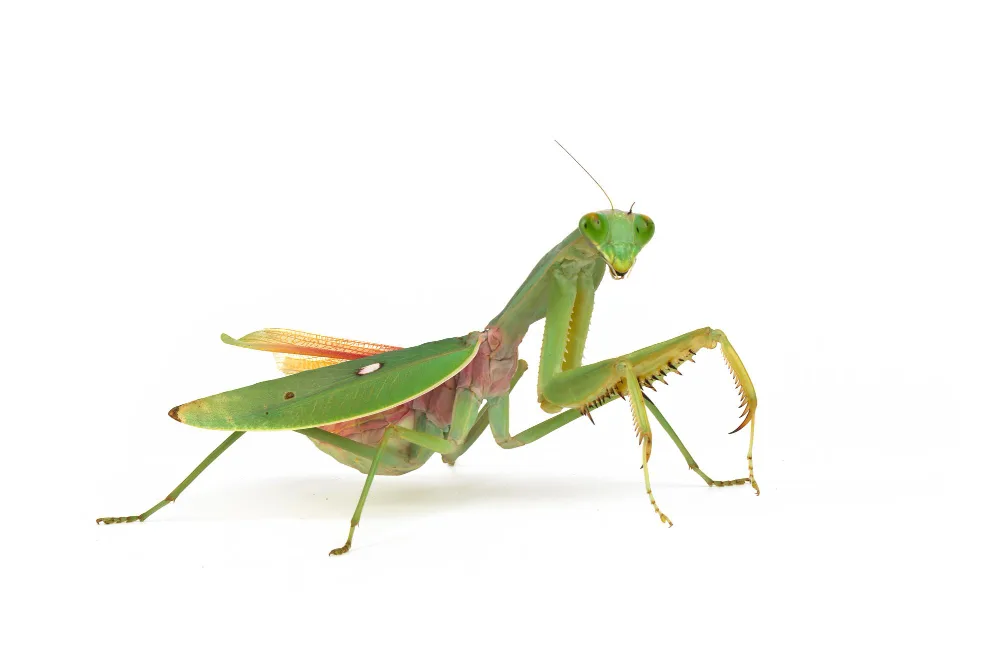
If you find a praying mantis with short wings, there is no single explanation.It may be an immature mantis with developing wing pads, an adult female of a species in which females naturally have shorter wings, or an adult of a species that has reduced wings throughout adulthood.
Wing length can therefore be a useful identification clue, but it should never be used by itself. Location, body size, sex, life stage, markings, and the overall shape of the wings all matter.
Quick Answer: Why Does This Praying Mantis Have Short Wings?
There are three common possibilities.
| What you see | Likely explanation |
|---|---|
| Tiny or medium-sized mantis with small wing-like pads | Probably a nymph |
| Broad-bodied adult with complete but shortened wings | Possibly an adult female of a sexually dimorphic species |
| Small adult with clearly formed but very short wings | Could be a naturally short-winged species |
Immature mantises resemble adults but do not yet have fully developed wings. Older nymphs gradually develop visible wing pads before their final molt.
Adult wing length is much more variable. For example, female Carolina mantises (Stagmomantis carolina) normally have wings that end well before the tip of the abdomen, while males have proportionally longer wings.
Other mantises can have naturally reduced wings as adults as well, so short wings do not automatically mean you have found a Carolina mantis—or even a female.
First Question: Are They Really Wings or Just Wing Pads?
This is the most useful place to start.
Praying mantises develop through incomplete metamorphosis. A young mantis, called a nymph, looks broadly similar to an adult rather than passing through a caterpillar or pupal stage.
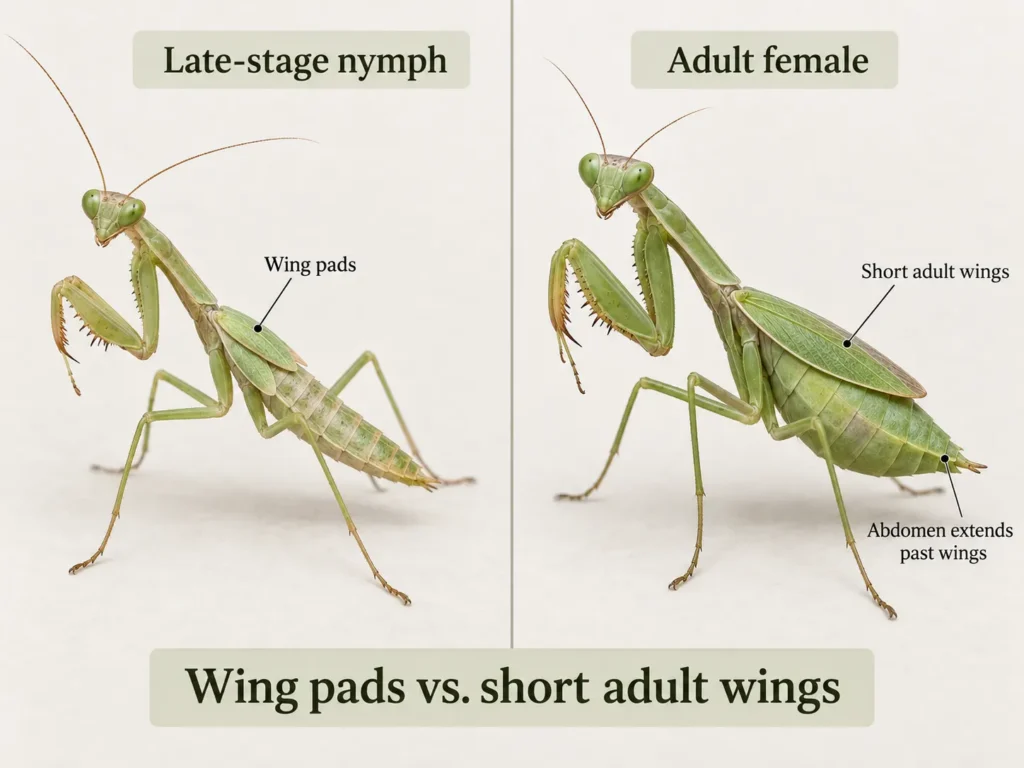
Nymphs begin without adult wings. As they grow and molt, small structures called wing pads become increasingly obvious on the thorax. NC State Extension notes that older Chinese mantis nymphs can have noticeable wing buds, while Colorado State University shows the same pattern in late-stage nymphs.
Wing pads usually look like short, compact lobes lying on the back rather than fully expanded adult wings.
After the final molt, the adult wings take their mature form.
So if the “short wings” look more like small buds than complete wings, you are probably looking at a nymph rather than a short-winged adult.
Signs the mantis may still be a nymph
Look for several clues together:
- Small wing pads rather than clearly formed wings
- A generally juvenile body size for local species
- Wings covering only a very small portion of the back
- A mantis that otherwise resembles a miniature adult
- A season when immature mantises are common in your region
Do not rely on size alone. Naturally small adult mantis species exist, and development timing varies with species and climate.
Adult Female Carolina Mantises Naturally Have Short Wings
One of the best-known North American examples is the Carolina mantis (Stagmomantis carolina).
Adult females have relatively broad abdomens and wings that normally stop before the end of the abdomen. Mississippi State University Extension describes mature females as having wings shorter than the abdomen, while males are more slender and have wings reaching approximately to its tip.
The Missouri Department of Conservation similarly describes female Carolina mantises as having wings that usually extend only about three-quarters of the way down the body.
This makes short wings a useful clue when identifying an adult female Carolina mantis.
But it is still only one clue.
Carolina mantises can be green, gray, tan, or brown, so color is not enough. Geographic location, body proportions, facial structure, wing markings, and other features should also be considered.
The site’s existing identification approach follows the same principle: wings should be evaluated together with location, structure, markings, size, and life stage rather than used as a single-feature identification test.
Does Short Wings Mean the Mantis Is Female?
Not necessarily.
In some species, wing length is strongly sexually dimorphic: males have longer functional wings while females have reduced wings.
The Carolina mantis is a familiar example.
But praying mantises are a diverse group, and the same rule does not apply across all Mantodea.
Some species have short-winged females. Others have short-winged or wingless adults of both sexes. Colorado State University, for example, describes female ground mantids (Litaneutria minor) as having short nonfunctional wings, while males may be either winged or wingless. It also describes grasshopper mantids as wingless or having extremely short nonfunctional wings.
There are even documented mantis groups in which adult males can have reduced wings, so “short wings = female” is not a reliable global rule.
Wing length can help with sex identification only after you have narrowed down the species or species group.
What Does “Brachypterous” Mean?
You may encounter the word brachypterous in field guides or scientific descriptions.
It simply means short-winged.
An adult brachypterous insect has wings that are naturally shorter or more reduced than the fully developed wings found in a typical flying form.
This is different from a nymph.
A nymph has not completed wing development yet. A brachypterous adult has completed development, but its mature wings remain short.
Some mantises are also described as apterous, meaning wingless.
Colorado State University specifically describes female ground mantids as brachypterous and notes that some males may be apterous.
How to Tell a Short-Winged Adult From a Nymph
This can be difficult from a single photograph, especially with an unfamiliar species.
Start by looking at the shape rather than simply measuring how far the wings extend.
Nymph
The structures on the back tend to look like developing wing pads rather than complete wings.
Older nymphs may have surprisingly large wing pads immediately before the final molt, which is why they can easily be mistaken for short-winged adults.
Short-winged adult
The wings look structurally complete even though they are reduced in length.
In an adult female Carolina mantis, for example, the wings lie neatly over the abdomen but stop well before its tip.
If you are uncertain, a good identification photograph should include:
- A full side view
- A top view showing the wings and abdomen
- The face
- The inside and bases of the front legs
- An approximate size
- Your geographic location
Those details are far more useful than color alone.
Can a Praying Mantis With Short Wings Fly?
It depends on the species, sex, and type of wings.
A nymph cannot use its wing pads for normal flight because the adult wings have not developed.
Adults with naturally reduced wings may also have limited or no flight ability.
Female Carolina mantises illustrate why it is better not to make this an absolute rule. Some extension references describe them as essentially flightless, while Mississippi State University notes that females can fly with their shortened wings but that flight becomes difficult, especially when the abdomen is enlarged with eggs.
Ground mantids provide a clearer example: Colorado State describes their females’ short wings as nonfunctional.
So wing length tells you something about potential flight ability, but it does not provide a universal yes-or-no answer.
Are Short Wings a Sign of Injury?
Usually not if the wings are symmetrical and naturally shaped.
A healthy short-winged adult may simply belong to a species or sex in which reduced wings are normal.
A mantis with developmental problems or wing damage may look different. One wing may be twisted, crumpled, torn, asymmetrical, or fail to expand normally after the final molt.
That is different from an adult whose two wings are naturally short and proportionate.
If both wings have the same shape and length and the insect otherwise appears normal, do not assume that something is wrong simply because the abdomen extends beyond them.
Does a Short-Winged Mantis Mean It Is a Carolina Mantis?
No.
Short wings can be an important Carolina mantis clue in the appropriate region, especially in an adult female, but other mantises also have shortened wings.
Colorado alone has several examples. Female Stagmomantis species may have shortened wing covers, female ground mantids have reduced wings, and grasshopper mantids may be wingless or nearly so.
This is why geographic location matters so much.
The correct identification process is:
life stage → location → size → wing structure → body proportions → markings → local species possibilities
rather than:
short wings → Carolina mantis
What If the Mantis Has Long Wings Instead?
Long wings do not necessarily identify a species either.
Male Carolina mantises, for example, normally have substantially longer wings than females. A long-winged Carolina mantis is therefore possible.
Other familiar mantises may also have well-developed adult wings.
That means wing length works best as a comparative trait within a known species, rather than as a universal test for all praying mantises.
How to Identify Your Short-Winged Mantis
If you have found one outdoors, first determine whether the structures on its back are adult wings or developing wing pads.
Then note where you found it.
Geographic location dramatically narrows the possible species. A mantis found in Florida, Colorado, Missouri, California, or Europe may belong to a completely different group even if the insects look superficially similar.
Next, record:
- Approximate body length
- Whether the abdomen is slender or broad
- How far the wings extend along the abdomen
- Whether the wings look complete or bud-like
- Color and patterns
- Markings on the wings
- Markings inside the front legs
- Facial shape or stripes
- Location
- Time of year
A clear photograph from above is particularly valuable because it shows the relationship between the wings and abdomen.
Frequently Asked Questions
Why does my praying mantis have tiny wings?
If they look like small pads rather than complete adult wings, the mantis is probably still a nymph. Wing pads become larger as the mantis approaches its final molt.
Are female praying mantises short-winged?
Some are, but not all. Female Carolina mantises are a well-known example of females with shortened wings. Wing length varies considerably among mantis species.
Do short wings mean a praying mantis is young?
Sometimes. Young mantises have undeveloped wing pads, but some fully mature adults naturally have reduced wings.
Can an adult praying mantis have wings shorter than its abdomen?
Yes. Adult female Carolina mantises commonly have wings that end before the abdomen tip. Several other mantis species also have reduced adult wings.
Can a short-winged praying mantis fly?
It depends. Nymphs cannot fly with wing pads. Some short-winged adults are flightless or weak fliers, while flight ability can vary even among closely related species.
Is a short-winged mantis definitely a Carolina mantis?
No. Wing length should be combined with location, body shape, markings, size, sex, and life stage before identifying a mantis to species.