
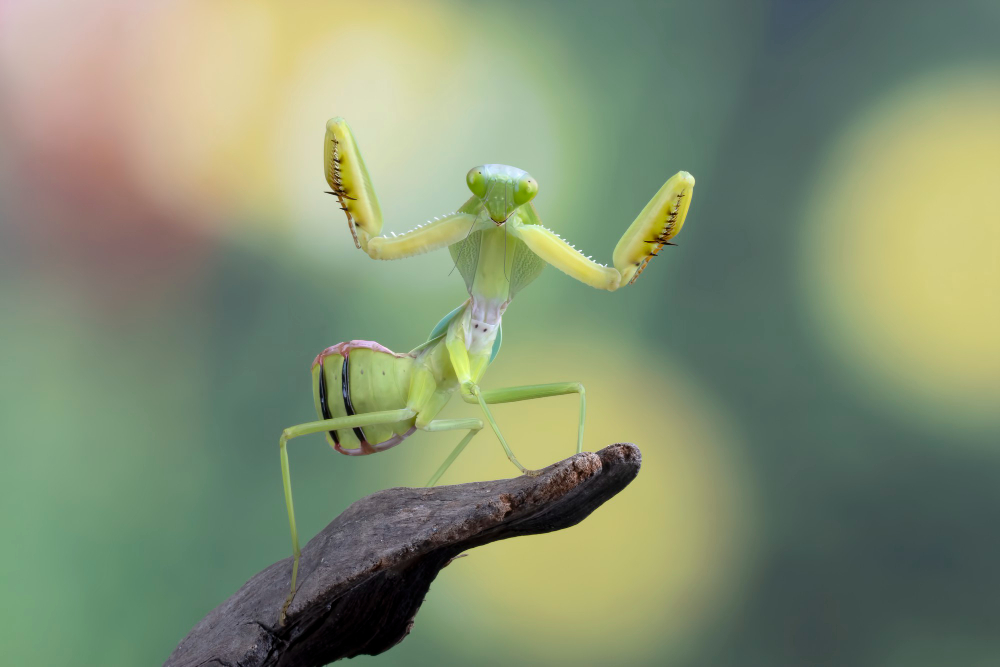
Praying mantises appear to “dance” because they often sway, rock, bob, or shift their bodies from side to side while walking, hunting, watching prey, avoiding danger, or moving through plants. In most cases, this behavior is completely normal. It is not a dance in the human sense. It is usually a practical behavior connected to vision, balance, camouflage, hunting, or defense.
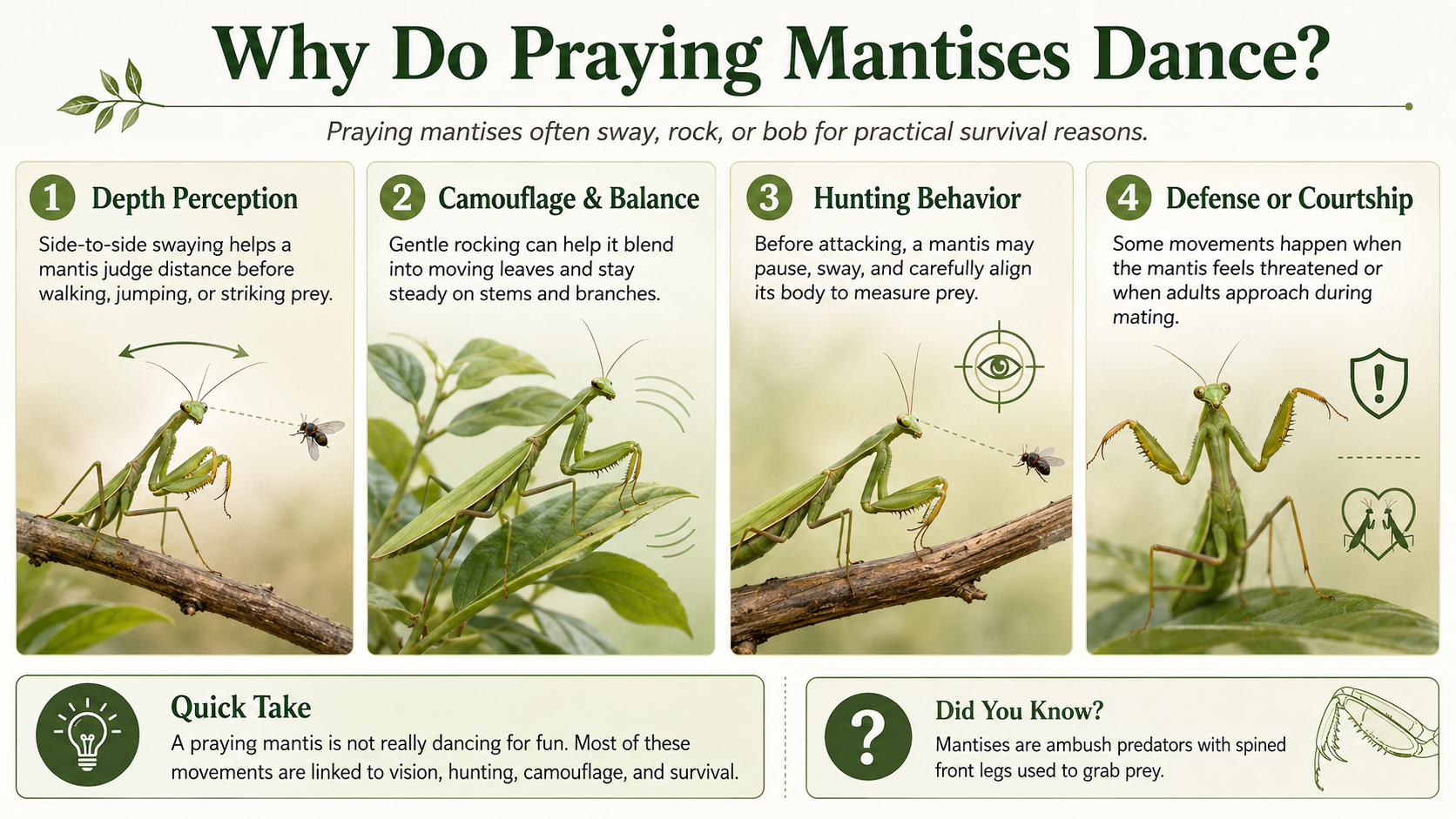
The most important explanation is visual. Mantises rely heavily on sight. When a mantis sways or bobs, it may be helping itself judge distance and depth before moving, jumping, flying, or striking at prey. UC Agriculture and Natural Resources notes that the “peering” movement of mantises is a behavioral adaptation for gaining depth perception, rather than simply a leaf-mimic dance.
That said, mantis movement can look surprisingly expressive. A mantis may rock gently like a leaf in the breeze, freeze with its forelegs folded, raise its body when disturbed, or make tiny adjustments before it strikes. To a beginner, it may look like the insect is dancing. To the mantis, these movements are part of staying alive.
This guide explains why praying mantises dance, what different movements may mean, how to observe them responsibly, and how mantis behavior fits into a garden ecosystem.
About This Guide
This guide is written for beginners, homeowners, gardeners, students, teachers, and nature enthusiasts who want a clear explanation of praying mantis behavior.
Although this website focuses mainly on beetle identification and beetle facts, mantises are often seen in the same gardens, yards, shrubs, and outdoor spaces where people observe beetles. Understanding mantises can help readers compare different insects more carefully.
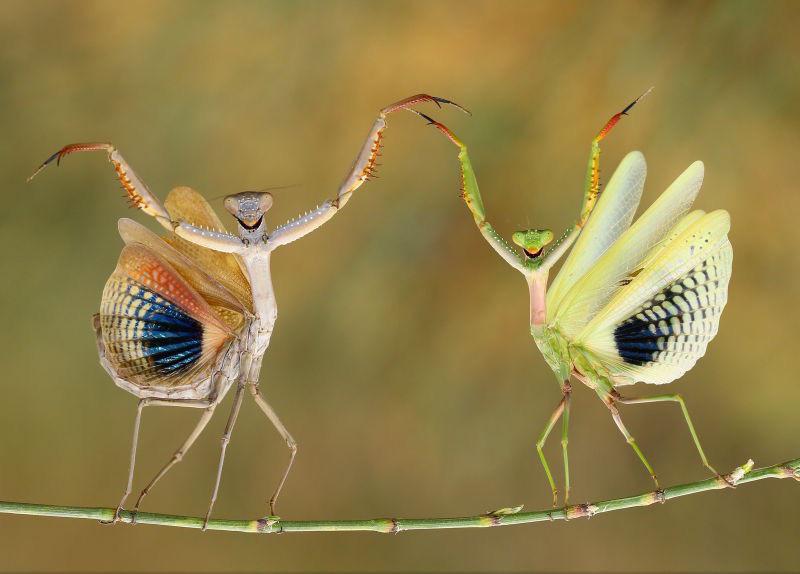
A responsible insect guide should avoid overclaiming. Identification and behavior interpretation can vary by region, life stage, season, species, and photo quality. A small mantis nymph, a large adult Chinese mantis, a Carolina mantis, and a European mantis may not behave or look exactly the same.
When observing any insect, including mantises and beetles, use multiple clues:
- Size
- Color
- Body shape
- Antennae
- Wing covers or wings
- Leg structure
- Habitat
- Behavior
- Season
- Geographic location
- Quality of the photo or video
This article is educational and should not be treated as guaranteed species identification. For formal identification, consult university extension resources, museum collections, natural history references, government agriculture resources, or professional entomology references.
What Does “Praying Mantis Dancing” Mean?
When people say a praying mantis is dancing, they usually mean one of these behaviors:
- The mantis is swaying from side to side.
- The mantis is rocking back and forth.
- The mantis is bobbing its head or body.
- The mantis is stepping slowly with a rhythmic motion.
- The mantis is raising its forelegs or spreading its wings.
- The mantis is shifting its body before striking.
- The mantis is moving strangely after being handled or disturbed.
These movements can look playful, but they are not entertainment. A praying mantis is a predator with excellent visual attention, spined grasping forelegs, and a body built for ambush hunting. Britannica describes mantises as carnivorous insects in the order Mantodea, characterized by enlarged, spined front legs used to seize prey.
The “dance” is usually a survival behavior.
Why Do Praying Mantises Dance?
Praying mantises “dance” for several possible reasons:
- To judge distance and depth
- To move carefully through vegetation
- To prepare for a jump, flight, or strike
- To remain visually confusing to prey or predators
- To react defensively when threatened
- To communicate or approach during mating
- To clean or adjust the body
- To regain balance after climbing
The same movement can have different meanings depending on context. A mantis swaying gently on a plant stem is not necessarily doing the same thing as a mantis raising its wings after being touched.
The Main Reason: Swaying Helps a Mantis Judge Distance
The most scientifically useful explanation for mantis swaying is depth perception.
Humans have two forward-facing eyes and a large brain that combines two slightly different images into a sense of depth. Mantises also have large compound eyes and strong visual hunting ability, but their visual system is different from ours. When a mantis moves its head or body side to side, the changing view may help it judge how far away an object is.
This is sometimes called peering behavior. The mantis appears to rock or sway while it visually measures its surroundings. UC Agriculture and Natural Resources specifically describes this swaying movement as a way mantises gain depth perception before moving, jumping, or taking flight.
A practical example:
A mantis sits on a tomato plant. A fly lands a few inches away. Before striking, the mantis may slowly shift its body, adjust its head, and lean forward. It is not dancing for fun. It is likely judging distance, angle, and timing.
This is one reason mantises can appear thoughtful or even curious. They often pause, turn their heads, and study nearby movement.
Is the Swaying Motion for Camouflage?
Many people say mantises sway to imitate leaves moving in the wind. This explanation is popular because it looks convincing. A green or brown mantis rocking on a plant stem can resemble a leaf, twig, or dry piece of vegetation.
However, the explanation should be handled carefully. Some sources and observers interpret mantis swaying as leaf mimicry, while UC Agriculture and Natural Resources cautions that the peering movement is better understood as a visual depth-perception behavior, not simply vegetation mimicry.
A balanced way to explain it is this:
A mantis may benefit from moving slowly and blending into plant surroundings, but not every swaying motion is camouflage. In many cases, swaying helps the mantis see and measure its environment.
Mantises are already well adapted for camouflage because many species have body colors and shapes that match leaves, stems, bark, or flowers. Their stillness is often more important than their movement. A mantis that freezes on a matching plant surface can be extremely hard to notice.
Do Praying Mantises Dance Before Attacking?
Sometimes, yes. A mantis may seem to dance before it strikes because it is preparing for a precise attack.
Praying mantises are ambush predators. They often wait motionless until prey comes within reach. Then they use their spined front legs to grab the prey quickly. Wisconsin Horticulture notes that praying mantids are predaceous and feed on prey such as flies, beetles, crickets, moths, and grasshoppers.
Before striking, a mantis may:
- Turn its head toward the prey
- Shift its body weight
- Sway slightly
- Raise or angle its forelegs
- Freeze for a moment
- Lean forward
- Strike suddenly
This can look like a slow, careful dance. In reality, the mantis is calculating distance and timing.
Example: A Mantis Watching a Fly
If a fly lands on a nearby leaf, the mantis may not rush immediately. It may sway, pause, and adjust its body. Once the fly is close enough, the mantis strikes with its raptorial forelegs.
The movement is part of hunting, not random motion.
Do Praying Mantises Dance When They Are Scared?
A disturbed mantis may move in a way that looks like a warning dance. This can happen when a person, bird, lizard, dog, cat, or larger insect gets too close.
A threatened mantis may:
- Freeze
- Raise its body
- Lift its forelegs
- Spread its wings
- Show colored wing patches, if present
- Rock or jerk its body
- Move away quickly
- Drop from a plant
- Fly or jump
Some mantis species use startle or defensive displays. In behavioral biology, sudden threat displays are often called deimatic behaviors. A broad review of deimatic behavior describes these as startle behaviors used against predators and rivals.
Not every mantis will perform a dramatic display. Some simply freeze. Others walk away. Younger mantises may drop from leaves and disappear into vegetation.
How to Tell If a Mantis Is Defensive
A mantis is more likely reacting defensively if:
- It raises its front legs high.
- It spreads its wings.
- It turns directly toward you.
- It rocks more sharply rather than gently.
- It opens its mouthparts or appears to “face off.”
- It backs away when approached.
If this happens, the best response is simple: give it space.
Is Dancing Related to Mating?
Sometimes mantis movement can be related to mating, but not every swaying mantis is looking for a mate.
Adult mantises may show courtship and mating-related behaviors. Male mantises often approach females carefully, partly because mantises are predators and cannibalism can occur in some situations. Research on mantis mating shows that sexual cannibalism is real but variable, not a simple rule that always happens. A PLOS ONE paper notes that sexual cannibalism varies among mantis species and mating contexts.
Courtship-related movement may include cautious approach, pauses, body orientation, and careful timing. To an observer, this may look like slow dancing. But it is risky, practical behavior.
Important Note About Mantis Mating Myths
Many people believe female mantises always eat males after mating. This is not accurate. Sexual cannibalism occurs in some mantises and under some circumstances, but it is not universal. The frequency depends on species, hunger, environment, and mating conditions.
For a beginner-friendly article, it is better to say:
“Some mantises may show cannibalism during mating, but it does not happen every time and should not be treated as a guaranteed behavior.”
Do Baby Praying Mantises Dance?
Young mantises, called nymphs, can also sway or rock. They look like tiny versions of adults, although they lack fully developed wings.
Baby mantises may “dance” when they are:
- Exploring vegetation
- Judging distance
- Avoiding danger
- Hunting very small prey
- Moving through leaves
- Responding to wind or touch
Mantises undergo incomplete metamorphosis, meaning they hatch as nymphs and gradually grow into adults through molts rather than passing through a caterpillar-like larval stage. Utah State University Extension describes mantid life cycle information and notes that mantids hatch from egg cases called oothecae.
A tiny mantis swaying on a leaf is not unusual. It is learning and surviving in a world full of predators.
How to Read Praying Mantis Body Language
A mantis cannot tell you what it is doing, but context helps.
Gentle Swaying While Walking
Likely meaning:
- Judging distance
- Moving carefully
- Navigating plant stems
- Preparing to jump or climb
This is usually normal.
Swaying While Watching Prey
Likely meaning:
- Estimating distance
- Preparing to strike
- Aligning the body
- Waiting for the prey to move closer
This is hunting behavior.
Freezing Completely
Likely meaning:
- Camouflage
- Avoiding detection
- Waiting in ambush
- Responding to a possible threat
Stillness is one of the mantis’s most important survival tools.
Raising the Forelegs
Likely meaning:
- Defensive posture
- Hunting readiness
- Balance adjustment
- Threat response
If the mantis raises its body and faces you, it may feel threatened.
Wing Spreading
Likely meaning:
- Defense
- Startle display
- Adult movement or flight preparation
- Species-specific display
Wing spreading is more common in adults than nymphs.
Rapid Jerky Movement
Likely meaning:
- Escape response
- Disturbance
- Defensive reaction
- Attempt to regain balance
Give the mantis space and avoid handling it.
Praying Mantis Identification Clues
Praying mantises are not beetles, but they are often seen in the same gardens where beetles are found. For a site about beetles, it is useful to help readers tell them apart.
Most mantises have:
- A triangular head
- Large, prominent eyes
- A long prothorax, sometimes described as a “neck-like” front body section
- Spined front legs folded in a “praying” position
- A long body
- Green, brown, tan, or bark-like coloration
- Slow, deliberate movement
- Predatory behavior
Missouri Botanical Garden’s insect order guide describes mantids as having long slender bodies, triangular heads that can turn from side to side, prominent eyes, and enlarged spiny front legs for catching prey.
Important Identification Reminder
Mantis identification varies by:
- Region
- Season
- Life stage
- Sex
- Wing development
- Color form
- Photo angle
- Lighting
- Whether the insect is a nymph or adult
Do not rely on color alone. Green mantises and brown mantises are not automatically different species.
Praying Mantis vs Beetle: Key Differences
Because typesofbeetles.com focuses on beetles, readers may wonder whether a praying mantis is a type of beetle. It is not.
Praying mantises belong to the order Mantodea. Beetles belong to the order Coleoptera.
Main Differences
| Feature | Praying Mantis | Beetle |
|---|---|---|
| Insect order | Mantodea | Coleoptera |
| Front legs | Enlarged, spined, used for grabbing prey | Usually walking, digging, swimming, or climbing legs |
| Head shape | Often triangular with large eyes | Highly variable, usually not triangular like a mantis |
| Wing structure | Wings may be present in adults, but not hardened into beetle-like covers | Forewings are hardened wing covers called elytra |
| Feeding style | Mostly predatory | Highly variable: plant-feeding, predatory, scavenging, fungus-feeding, wood-boring, and more |
| Movement | Slow stalking, swaying, ambush posture | Varies widely by beetle species |
| Common posture | “Praying” folded forelegs | No praying posture |
A quick rule: if the insect has hard shell-like wing covers meeting in a straight line down the back, it may be a beetle. If it has a triangular head and folded spiny grasping legs, it may be a mantis.
Habitat and Behavior: Where Do Praying Mantises Dance?
Praying mantises are usually found where prey insects are available.
Common places include:
- Gardens
- Flower beds
- Tall grasses
- Shrubs
- Vegetable patches
- Meadow edges
- Forest edges
- Porch lights where insects gather
- Outdoor walls near vegetation
- Hedges and vines
Mantises often wait in areas where other insects visit. Flowers can attract flies, bees, butterflies, moths, and other insects, which may also attract mantises. UC Agriculture and Natural Resources notes that mantids are wholly predaceous and may wait at flowers where they capture nectar- and pollen-feeding insects.
A mantis “dancing” on a plant is usually doing normal mantis work: watching, waiting, balancing, and measuring the world around it.
What Do Praying Mantises Eat?
Praying mantises eat live prey. They are predators, not plant feeders.
Common prey may include:
- Flies
- Moths
- Beetles
- Crickets
- Grasshoppers
- Caterpillars
- Bees
- Wasps
- Leafhoppers
- Other mantises
- Spiders and other small arthropods
Wisconsin Horticulture lists flies, beetles, crickets, moths, and grasshoppers among mantid prey. University extension sources also emphasize that mantises are not selective pest-control agents; they may eat pests, pollinators, and beneficial insects.
This matters for gardeners. A mantis may eat a pest caterpillar one day and a pollinating bee the next.
Praying Mantis Life Cycle
The praying mantis life cycle has three main stages:
- Egg
- Nymph
- Adult
Mantises lay eggs in a protective case called an ootheca. The young hatch as nymphs, which resemble small adults. As they grow, they molt several times. Adults may develop wings, depending on species and sex.
Utah State University Extension discusses mantid egg cases and life cycle information, including the ootheca stage.
When Are Mantises Most Active?
This depends on climate and species, but many temperate-region mantises are most visible during warm months. Adults are often noticed in late summer and fall, when they are larger and easier to see.
Nymphs may be harder to notice because they are small, delicate, and well hidden among leaves.
Are Praying Mantises Good for Gardens?
Praying mantises can be fascinating garden predators, but they should not be described as perfect pest-control helpers.
They do eat many insects, including some that gardeners consider pests. However, they also eat beneficial insects and pollinators. University of New Hampshire Extension states that mantids are not entirely beneficial because they are just as likely to eat butterflies or bumblebees as nuisance caterpillars. Utah State University Extension similarly notes that mantids are not host-specific and may eat pests, pollinators, and other beneficial insects.
Practical Garden Advice
If you find a mantis naturally in your garden:
- Leave it alone if it is not causing a problem.
- Avoid unnecessary pesticide use.
- Do not expect it to solve pest outbreaks.
- Do not move it onto hummingbird feeders or pollinator-heavy flowers.
- Observe it as part of the garden ecosystem.
Should You Buy Praying Mantis Egg Cases?
For most home gardens, buying mantis egg cases is not the most reliable pest-management strategy. Mantises disperse, eat both pest and beneficial insects, and may cannibalize each other. Extension sources generally caution that mantises have limited value as targeted biological control agents.
Common Mistakes When Interpreting Mantis “Dancing”
Mistake 1: Assuming Every Sway Means Leaf Mimicry
Some swaying may help a mantis blend into plant movement, but peering for depth perception is a strong explanation for many side-to-side movements.
Mistake 2: Thinking the Mantis Is Playing
Mantises are not dancing for amusement. Their movements usually serve hunting, balance, vision, defense, or mating.
Mistake 3: Calling a Mantis a Beetle
Mantises and beetles are both insects, but they belong to different insect orders. Beetles have hardened forewings called elytra; mantises have raptorial forelegs and a distinctive ambush posture.
Mistake 4: Assuming Mantises Only Eat Bad Bugs
Mantises are generalist predators. They may eat pest insects, but they may also eat bees, butterflies, and other beneficial insects.
Mistake 5: Handling a Defensive Mantis Too Closely
A mantis that raises its body, spreads its wings, or strikes defensively should be left alone. It is not trying to be aggressive in a human sense; it is trying to protect itself.
When to Seek Professional Help
A praying mantis in a garden, on a wall, or near a porch light usually does not require professional help.
Consider seeking expert advice if:
- You need a formal species identification.
- You are documenting an unusual regional record.
- You find many unfamiliar egg cases on ornamental plants.
- You are managing a greenhouse or nursery.
- You suspect an invasive species issue in your region.
- You need pest management advice for crops or gardens.
Good places to ask include:
- Local university extension offices
- Natural history museums
- Entomology departments
- Government agriculture agencies
- Regional insect identification groups
- Certified pest management professionals, when a household pest problem is involved
For general observation, a clear photo from above, the side, and the front can help experts identify the insect more accurately.
FAQ: Why Do Praying Mantises Dance?
Why do praying mantises dance?
Praying mantises appear to dance because they sway, rock, or bob while judging distance, stalking prey, moving through plants, reacting to threats, or preparing to strike. The behavior is usually normal and practical.
Why do praying mantises sway side to side?
Praying mantises often sway side to side to help judge depth and distance. This peering movement can help them measure nearby objects before walking, jumping, flying, or striking prey.
Are praying mantises dancing for fun?
No. A mantis is not dancing for fun in the human sense. Its movements are usually connected to survival, including hunting, balance, vision, camouflage, defense, or mating.
Do praying mantises sway to look like leaves?
Sometimes people interpret mantis swaying as leaf mimicry, but many swaying movements are better explained as peering behavior for depth perception. A mantis may still benefit from blending into vegetation, especially when it moves slowly among leaves.
Why does a praying mantis rock before attacking?
A mantis may rock or shift before attacking because it is judging the distance to its prey and aligning its body for a fast strike. Mantises use spined front legs to seize prey such as flies, moths, beetles, crickets, and grasshoppers.
Why does a praying mantis raise its arms?
A praying mantis may raise its forelegs when hunting, balancing, or defending itself. If it raises its body, spreads its wings, or faces you directly, it may feel threatened.
Do baby praying mantises dance too?
Yes. Young mantises, called nymphs, may sway or rock as they explore, hunt, avoid danger, or judge distance. Nymphs look like small adults but do not yet have fully developed wings.
Is a dancing praying mantis sick?
Not usually. Gentle swaying, rocking, and careful stepping are normal mantis behaviors. However, if a mantis cannot climb, falls repeatedly, appears injured, or has deformed limbs or wings, it may be old, injured, molting unsuccessfully, or affected by environmental stress.
Do praying mantises dance during mating?
Some mantis movement can be related to courtship or mating, especially cautious approach behavior. However, not every swaying mantis is mating. Many mantises sway while hunting or navigating their surroundings.
Are praying mantises good for gardens?
Praying mantises can eat garden pests, but they also eat pollinators and other beneficial insects. They are interesting predators, but they are not precise or reliable pest-control tools.
Is a praying mantis a beetle?
No. A praying mantis is not a beetle. Mantises belong to the order Mantodea, while beetles belong to the order Coleoptera. Beetles usually have hardened wing covers, while mantises have spined grasping forelegs and a distinctive ambush posture.
Should I move a praying mantis from my garden?
Usually, no. If the mantis is in a safe outdoor place, leave it alone. If it is on a door, walkway, vehicle, or hummingbird feeder, you can gently relocate it to nearby vegetation using a leaf, stick, or container.
Conclusion: Why Do Praying Mantises Dance?
Praying mantises dance because their slow, swaying movements help them survive. What looks like a strange little performance is usually a mix of vision, balance, hunting, camouflage, and defense.
The most important reason is that swaying can help a mantis judge distance and depth. A mantis may also rock while stalking prey, freeze to avoid detection, raise its forelegs when threatened, or move cautiously during mating.
For gardeners and nature observers, this behavior is a reminder that insects are not simple background creatures. A mantis on a leaf is reading its surroundings with care. It is watching, measuring, waiting, and reacting.
So the next time you see a praying mantis “dancing,” pause before disturbing it. You may be watching one of the garden’s most patient predators at work.