
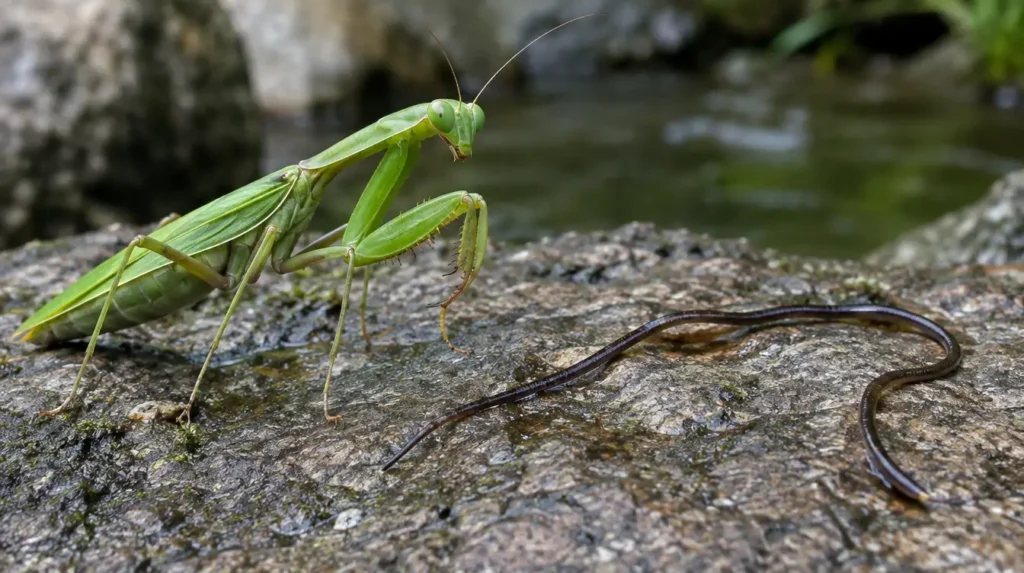
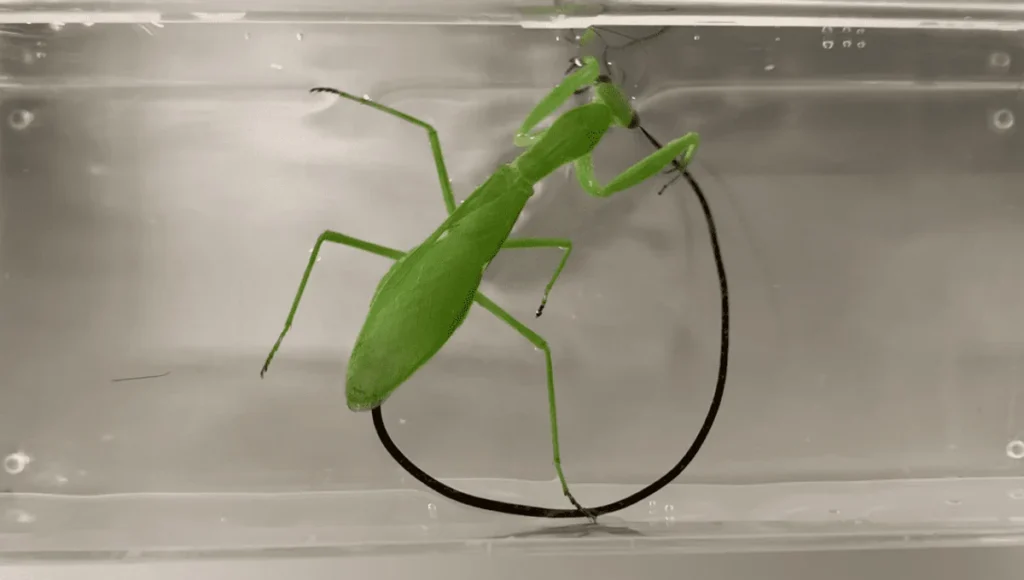
A long, dark worm suddenly emerges from a praying mantis and begins twisting through the water. The worm may be several times longer than the insect itself. It looks almost impossible that something so large could have been living inside such a small animal.
Yet this is a real biological phenomenon.
The creature is a horsehair worm, a parasite that develops inside certain insects, including praying mantises. Some species can even alter an infected mantis’s behavior, increasing the likelihood that it enters water.
For the mantis, the encounter can be fatal. For the worm, reaching water is an essential part of reproduction.
Quick Answer: What Is the Horsehair Worm Parasite in a Praying Mantis?
Horsehair worms are long, threadlike parasites belonging to the phylum Nematomorpha. Certain species develop inside praying mantises, absorbing nutrients and growing within the insect’s body cavity.
When the worm matures, it must reach water to reproduce. Research has shown that some horsehair worms can alter their hosts’ responses to environmental cues, making infected mantises more likely to enter water.
Once the host reaches water, the mature worm may emerge and continue its life cycle as a free-living adult.
Although the process looks disturbing, horsehair worms are not capable of establishing infections in humans or other vertebrates.
What Is a Horsehair Worm?
Horsehair worms are also called Gordian worms. Their name comes from their extraordinary appearance: extremely long, narrow bodies that resemble strands of horsehair.
They are not ordinary earthworms, and they are not the same organisms as parasitic roundworms.
Horsehair worms belong to their own animal phylum, Nematomorpha.
Most freshwater species have two very different life stages:
- Juvenile stage: The worm develops as a parasite inside an invertebrate host.
- Adult stage: The mature worm lives freely in water, where it can mate and reproduce.
Adult freshwater horsehair worms are often brown, dark gray, black, or pale in color, depending on the species.
Some reach lengths of 20–30 centimeters (8–12 inches), although size varies considerably. Their bodies remain remarkably thin, often around a millimeter or less in diameter.
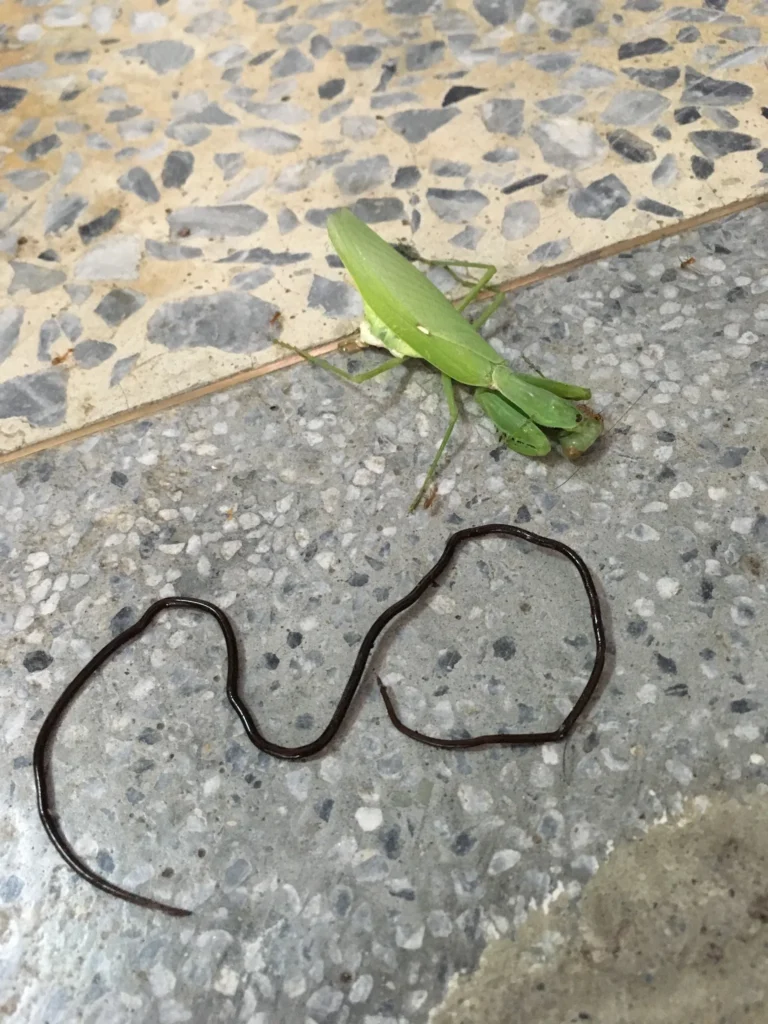
A fully grown worm can therefore be much longer than the insect carrying it.
The genus Chordodes is particularly important in the relationship between horsehair worms and praying mantises. Different Chordodes species infect different mantis species, and their host preferences are not identical.
This means that not every horsehair worm infects mantises, and not every mantis species is equally susceptible.
How Does a Horsehair Worm Get Inside a Praying Mantis?
A praying mantis generally becomes infected by eating prey that carries an immature stage of a horsehair worm.
This happens because the parasite’s life cycle connects aquatic environments with terrestrial predators.
Step 1: Horsehair worms reproduce in water
Adult horsehair worms mate in freshwater environments such as streams, ponds, and other suitable bodies of water.
Females lay eggs, often in elongated, gelatinous strings.
The eggs eventually hatch into tiny larvae.
At this stage, the young worms must find a way into suitable invertebrate hosts to continue developing.
Step 2: Larvae enter aquatic invertebrates
Depending on the species, horsehair worm larvae can infect aquatic insects or other small invertebrates.
Some form resistant cysts within these animals.
These intermediate or transport hosts help move the parasite from an aquatic environment into the terrestrial food web.
Step 3: A praying mantis eats infected prey
Praying mantises are opportunistic predators.
They capture insects and other small animals using their specialized front legs.
If a mantis eats an insect carrying a viable horsehair worm stage, the parasite may establish itself inside the mantis.
For a closer look at the types of prey mantises normally capture, see our guide to what praying mantises eat.
Importantly, eating an infected insect does not guarantee that infection will occur. The parasite and mantis must be biologically compatible.
Step 4: The parasite grows inside the mantis
Once established, the juvenile horsehair worm develops within the mantis’s body cavity.
It can obtain nutrients from its host while growing dramatically in size.
The worm’s long, flexible body allows it to remain folded or coiled inside the insect.
As it matures, the parasite may occupy a substantial proportion of the available body cavity.
Its final challenge is reaching water, because the mature worm must leave its terrestrial host to reproduce.
How Does a Horsehair Worm Control a Praying Mantis?
This is the most remarkable part of the relationship.
Praying mantises are primarily terrestrial insects. Although they may encounter rain, wet vegetation, or water surfaces, entering deep water is not normal behavior for most species.
However, certain infected mantises show an increased tendency to enter water.
Researchers describe this phenomenon as parasite-induced behavioral manipulation.
The parasite benefits because water is the environment in which the adult worm can emerge, find a mate, and reproduce.
The 2021 discovery: A parasite changes the mantis’s response to light
A study published in Current Biology in 2021 investigated praying mantises infected by Chordodes horsehair worms.
The researchers examined Hierodula patellifera, a mantis species found in East Asia.
Their experiments revealed an important difference between infected and uninfected insects.
Infected mantises were attracted to horizontally polarized light, while uninfected mantises did not show the same attraction.
Why does that matter?
Water surfaces often reflect horizontally polarized light. For some animals, this visual property provides a cue associated with water.
By changing how a mantis responds to that cue, the parasite may increase the chance that its host approaches and enters water.
The researchers also conducted field experiments comparing pools with different light-polarization properties.
Infected mantises were more likely to enter the pool producing stronger horizontal polarization, despite another pool having brighter but less strongly polarized reflections.
These findings provided experimental evidence for a mechanism connecting horsehair worm infection, visual behavior, and water entry.
However, this does not establish that every horsehair worm species manipulates every insect host through exactly the same sensory pathway.
The 2023 discovery: Genes may help explain the manipulation
In 2023, researchers published another major study in Current Biology.
They examined gene activity in horsehair worms and infected praying mantises during behavioral manipulation.
The results suggested that some horsehair worm genes resemble genes that originated in mantis ancestors.
The researchers proposed that these similarities could reflect horizontal gene transfer.
Horizontal gene transfer occurs when genetic material moves between organisms through processes other than normal parent-to-offspring inheritance.
The study identified numerous candidate genes that may have entered the parasite’s evolutionary lineage through this process.
Some of these genes showed increased expression during host manipulation.
This raises an intriguing possibility: over evolutionary time, horsehair worms may have acquired genetic tools that help them interfere with their hosts’ biological systems.
But an important distinction remains.
The study did not demonstrate that every candidate gene directly controls a mantis’s behavior. Nor does it mean that a worm steals new genes from each individual mantis it infects.
The exact molecular pathways connecting parasite-produced molecules to the mantis’s nervous system are still being investigated.
Does the Horsehair Worm Live in the Mantis’s Brain?
No. Horsehair worms generally develop within the host’s body cavity rather than growing inside its brain.
This is an important distinction because online descriptions sometimes portray the parasite as a worm physically occupying the brain and operating the insect like a puppet.
The reality is more complicated.
The worm appears capable of influencing behavior without needing to inhabit the brain itself.
Scientists are investigating how changes in parasite gene expression, possible molecular signals, and host sensory responses contribute to this process.
The observed behavioral changes are real, but the full mechanism has not yet been established.
Why Does the Horsehair Worm Come Out When the Mantis Touches Water?
The worm needs an aquatic environment for the next stage of its life cycle.
Inside the mantis, the juvenile parasite can grow and obtain nutrients. Once mature, it must emerge as a free-living adult.
Water provides the environment where freshwater horsehair worms can survive, mate, and deposit eggs.
When an infected host enters suitable water, a mature worm may emerge through an opening in the host’s body.
The process can look astonishing because an extraordinarily long parasite may emerge from an insect only a fraction of its length.
However, water does not create the worm, and simply immersing a healthy mantis cannot produce a parasite.
The worm must already be present and sufficiently developed.
Never deliberately submerge a mantis to test whether it is infected. Doing so can drown or seriously stress the insect.
What Are the Signs of a Horsehair Worm Infection in a Praying Mantis?
Identifying an infected mantis before the worm emerges is difficult.
The parasite develops internally, and its body is usually hidden by the mantis’s exoskeleton.
Some infected insects may appear relatively normal until late in the parasite’s development.
Potential observations include:
- Unusual movement toward water
- Unexpected entry into a pond, stream, or pool
- A long, thin worm emerging from the abdomen
- Noticeable weakness during or after parasite emergence
These signs are not equally diagnostic.
A mantis moving near water is not proof of infection. Likewise, weakness, reduced feeding, or an unusual abdomen can have many possible explanations.
There is no dependable visual checklist that allows a casual observer to diagnose an internal horsehair worm infection.
Normal mantis movements are especially easy to misinterpret. Swaying, rocking, and changes in posture often have ordinary behavioral explanations, as discussed in our article on why praying mantises dance.
A clearly visible horsehair worm emerging from a mantis provides much stronger evidence than changes in behavior alone.
Does a Horsehair Worm Kill the Praying Mantis?
Horsehair worm infection can be fatal to a praying mantis, especially when the manipulated insect enters deep water and drowns.
The developing parasite may also impose substantial physiological costs on its host.
However, it is important to distinguish between three different events:
Damage from the developing parasite: A growing worm consumes resources and occupies space inside the insect.
Danger from entering water: A terrestrial mantis may drown after entering water.
Damage associated with emergence: The worm’s exit may cause additional injury or stress.
These events can overlap, making it difficult to identify a single cause of death.
Can a praying mantis survive after the worm comes out?
Survival is possible in some horsehair worm host systems.
For example, researchers have documented crickets surviving after their parasites emerged, with some showing recovery from altered behavior.
But evidence from crickets should not be treated as direct proof that praying mantises have the same survival rates.
For mantises, the outcome can depend on the host species, infection severity, physical condition, and whether the insect survives entering water.
There is no reliable general survival percentage that applies to all infected praying mantises.
Can More Than One Horsehair Worm Live Inside a Mantis?
Yes.
Although a single visible worm may be the most familiar example, some mantises carry multiple horsehair worms.
A 2011 study describing Chordodes formosanus examined 30 infected mantises containing 40 worms in total.
Most mantises carried one worm, but several contained two, three, or even four.
The study demonstrates that multiple infections can occur, although it does not establish how commonly this happens across all mantis populations.
It is also possible for closely related horsehair worm species to share certain mantis hosts.
Research published in 2024 found differences in the host ranges of Chordodes japonensis and Chordodes formosanus, illustrating how specific some parasite-host relationships can be.
Are All Praying Mantises Infected With Horsehair Worms?
No.
Horsehair worms are natural parasites of certain insects, but infection should not be assumed in every mantis.
The frequency of infection varies with the parasite species, host species, geographic region, and ecological conditions.
Exposure also depends on local food webs.
For example, a mantis may encounter infected prey in an environment where the parasite’s aquatic and terrestrial life stages can connect.
Another mantis living in a different habitat may have little exposure to the same parasite.
A global infection percentage for praying mantises cannot be inferred from dramatic videos or localized scientific surveys.
Can Horsehair Worms Infect Humans or Pets?
No. Horsehair worms do not establish parasitic infections in humans, dogs, cats, or other vertebrates.
Their parasitic development occurs in suitable invertebrates.
University extension entomologists consistently describe freshwater horsehair worms as harmless to people, pets, livestock, and plants.
Finding one in a pond, birdbath, swimming pool, or water container does not mean it came from a human or pet.
It may have emerged from an infected insect nearby.
Although these worms can look alarming, they are not a reason to use insecticides or parasite treatments around a garden.
Normal hygiene is still sensible when handling animals or water from outdoor containers.
What Should You Do if You Find an Infected Praying Mantis?
If you encounter a mantis with a visible horsehair worm, the safest general approach is to avoid interfering with the animals.
Do not pull the worm from the mantis, cut the insect open, or force it into water.
Those actions can cause serious injury and are not established treatments.
For a wild mantis, observe from a distance whenever possible.
If you keep a pet mantis and suspect a parasite, separate it from other captive insects, review the source of its feeder insects, and consult a qualified veterinarian or invertebrate specialist if one is available.
There is no well-established, safe home deworming treatment for horsehair worms in mantises.
For routine captive care, using appropriately sourced feeder insects is more sensible than attempting to treat a suspected infection yourself.
Wild-caught prey may carry parasites or pesticide residues, although commercially raised feeders cannot be assumed to be completely risk-free.
Why Are Horsehair Worms Important in Nature?
Horsehair worms are more than unusual parasites.
They connect terrestrial insects, aquatic invertebrates, predators, and freshwater ecosystems through a complicated life cycle.
Their influence can extend beyond individual infected hosts.
When parasites cause terrestrial insects to enter streams, those insects can become food for aquatic predators.
Scientists have studied how these events move nutrients and energy between land and water.
Horsehair worms also offer an extraordinary example of how one organism’s evolutionary adaptations can influence another organism’s behavior.
The relationship is biologically remarkable precisely because the mantis is normally such an effective predator.
Its specialized vision, camouflage, and rapid hunting movements help it capture prey. You can learn more about these adaptations in our guide to how praying mantises hunt.
Yet under certain conditions, one of the animals it eats may carry a parasite capable of altering its future behavior.
Frequently Asked Questions
Do praying mantises really have worms inside them?
Yes. Some praying mantises become infected with horsehair worms, particularly species in the genus Chordodes. The parasites develop internally and may become much longer than their hosts.
Does every praying mantis have a horsehair worm?
No. Infection depends on exposure to suitable parasite stages, host compatibility, and local environmental conditions.
Do horsehair worms control the mantis’s brain?
Certain horsehair worms can manipulate host behavior, but they do not need to live inside the mantis’s brain. The complete molecular mechanism remains under investigation.
Why do infected praying mantises jump into water?
Research suggests that infection can change how mantises respond to environmental cues. A 2021 study showed that infected mantises were attracted to horizontally polarized light, a visual cue associated with water surfaces.
Can a praying mantis survive a horsehair worm infection?
The outcome varies. Horsehair worm emergence is not necessarily fatal in every insect host, but infected mantises can die from drowning, physiological damage, or complications associated with parasite emergence. Reliable survival rates for mantises are not established.
How long can a horsehair worm grow?
Many freshwater horsehair worms grow to several inches or more. Some commonly reach around 20–30 centimeters (8–12 inches), although length varies by species.
Can you remove a horsehair worm from a living mantis?
Attempting to remove one manually is not recommended. Pulling or extracting the worm can injure the host, and there is no established safe home treatment for an infected mantis.
Can humans get horsehair worms from praying mantises?
No. Horsehair worms cannot complete their parasitic development in humans.
Final Thoughts
The praying mantis horsehair worm parasite is one of the most striking examples of behavioral manipulation in the natural world.
A tiny parasitic stage can enter a mantis through its prey, grow into a worm far longer than the host, and eventually influence behavior associated with entering water.
Research has demonstrated important parts of this relationship, including changes in polarized-light responses and possible evolutionary contributions from horizontally transferred genes.
Other questions, especially the precise molecular mechanism and survival outcomes across mantis species, still need further study.
Understanding the difference between established findings and unanswered questions makes this natural phenomenon more interesting—not less.
Scientific References
The following research was used to check the main biological claims in this article.
Schmidt-Rhaesa, A., & Ehrmann, R. (2001). Horsehair Worms (Nematomorpha) as Parasites of Praying Mantids with a Discussion of their Life Cycle. Zoologischer Anzeiger, 240, 167–179. DOI: 10.1078/0044-5231-00014.
Sato, T., et al. (2021). Enhanced polarotaxis can explain water-entry behaviour of mantids infected with nematomorph parasites. Current Biology. DOI: 10.1016/j.cub.2021.05.001.
Mishina, T., et al. (2023). Massive horizontal gene transfer and the evolution of nematomorph-driven behavioral manipulation of mantids. Current Biology, 33, 4988–4994.e5. DOI: 10.1016/j.cub.2023.09.052.
Chiu, M.-C., et al. (2011). A new horsehair worm, Chordodes formosanus sp. n. (Nematomorpha, Gordiida) from Hierodula mantids of Taiwan and Japan. ZooKeys, 160, 1–22. DOI: 10.3897/zookeys.160.2290.
Additional reference: University of Minnesota Extension, Horsehair Worms (reviewed 2024).
How This Article Was Researched
This guide was prepared using peer-reviewed research on horsehair worms and their mantis hosts, along with university extension resources covering parasite identification, life cycles, and human safety.
Findings from cricket studies were distinguished from direct observations of praying mantises. Proposed molecular mechanisms were described as research hypotheses rather than established facts.
The article is intended for general nature education and does not claim to present original laboratory research or firsthand field observations.