
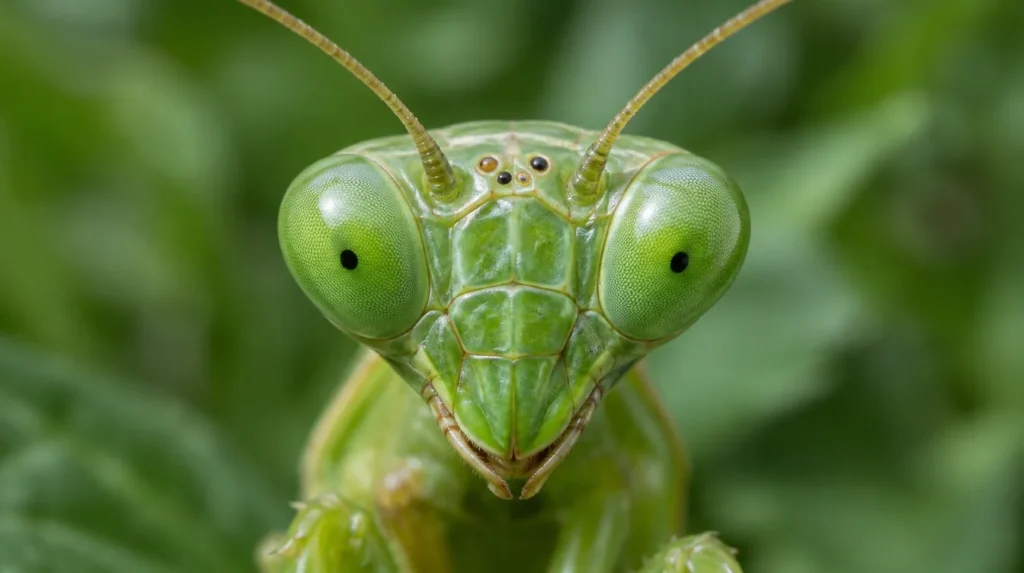
If you have looked a praying mantis in the face, you have probably noticed a small black dot in each eye that seems to stare straight back at you. Move to the left and the dot moves with you. Move to the right and it follows again. It looks a lot like a pupil.
It isn’t one. The black dot is called a pseudopupil, which means “false pupil.” It is not a hole, a lens, or a painted-on mark. It is an optical effect created by the way a mantis’s compound eye is built. Where the dot appears depends on where you are standing, not on where the mantis is looking.
The short answer
A mantis eye is made of thousands of tiny, tube-like units, each pointing in a slightly different direction. The units aimed directly at you absorb the light coming from your direction, so that small patch of the eye looks dark. The units angled away from you reflect and scatter light, so they show the eye’s usual green, tan, or brown color. The dark patch always marks the units lined up with your line of sight. That is why it shifts across the eye when you move, and why it looks like the mantis is tracking you.
How a compound eye makes a “false pupil”
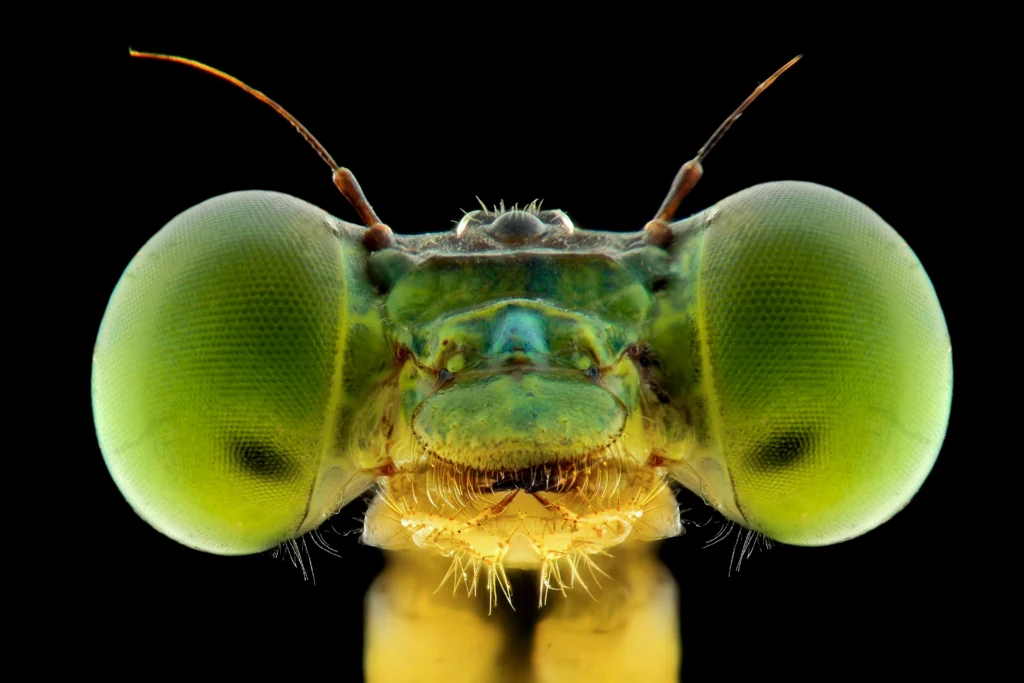
Like most insects, a praying mantis has two large compound eyes. Each one is a dome made of many repeating units called ommatidia (singular: ommatidium). Every ommatidium has its own small lens at the surface and a long, narrow light-sensing core underneath. Pigment around each unit keeps light from leaking between neighbors.
Each ommatidium faces a slightly different direction, so together they cover a wide view of the world. Light that travels straight down the axis of a unit goes deep into it and is absorbed. Very little bounces back out to your eye, so those units look dark. Units pointing elsewhere catch your line of sight at an angle. Light reflects off their surfaces and surrounding pigment, so they look the color of the rest of the eye.
You are always looking straight down a small cluster of units, and that cluster becomes the dark spot. Pseudopupils are not unique to mantises. They occur in the compound eyes of many insects and crustaceans. They are just unusually easy to see on a mantis, whose large eyes often face you when it turns its head your way.
Why the black dot seems to follow you
The dot seems to follow you because it is literally defined by your position. When you step sideways, a different set of ommatidia lines up with your view, and the dark patch appears over those units instead. The mantis does not need to move at all for this to happen.
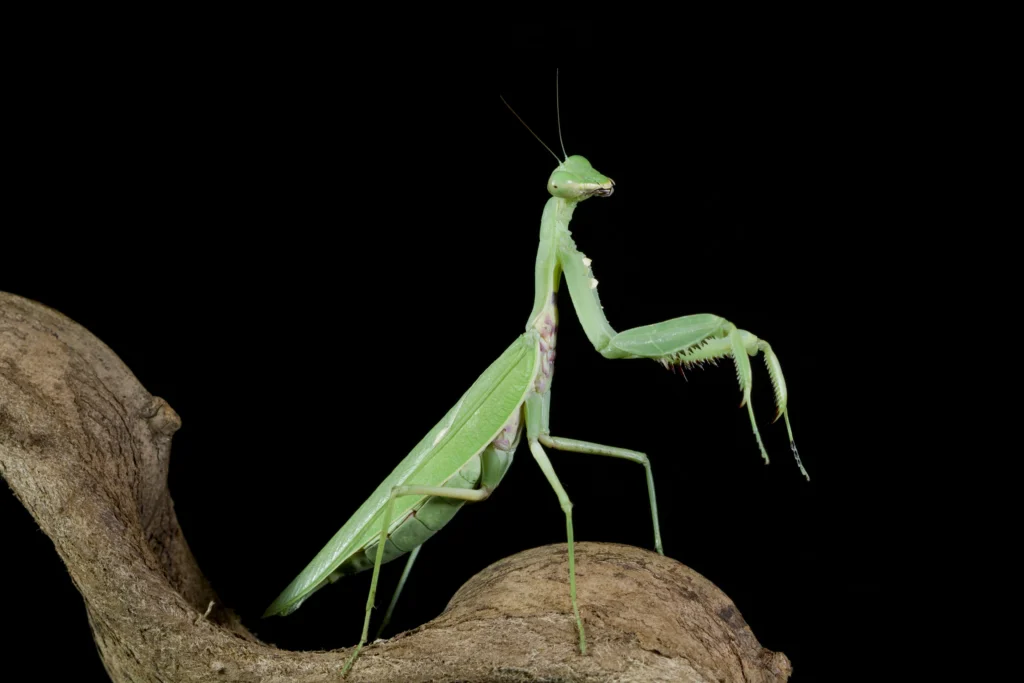
That said, it is not always an illusion that the mantis is watching you. Mantises have a triangular, highly mobile head that can turn from side to side. They often swivel to face movement, including a person leaning in for a closer look. So sometimes the mantis really is looking at you. The black dot alone just can’t tell you whether it is.
If you want to know more about how this mobile head and forward-facing vision fit into catching prey, see how praying mantises hunt.
Why the dot looks bigger at the front of the eye
When a mantis faces you head-on, the black dot often looks larger and more obvious than when you view the eye from the side. This is not random. It reflects how the eye is built.
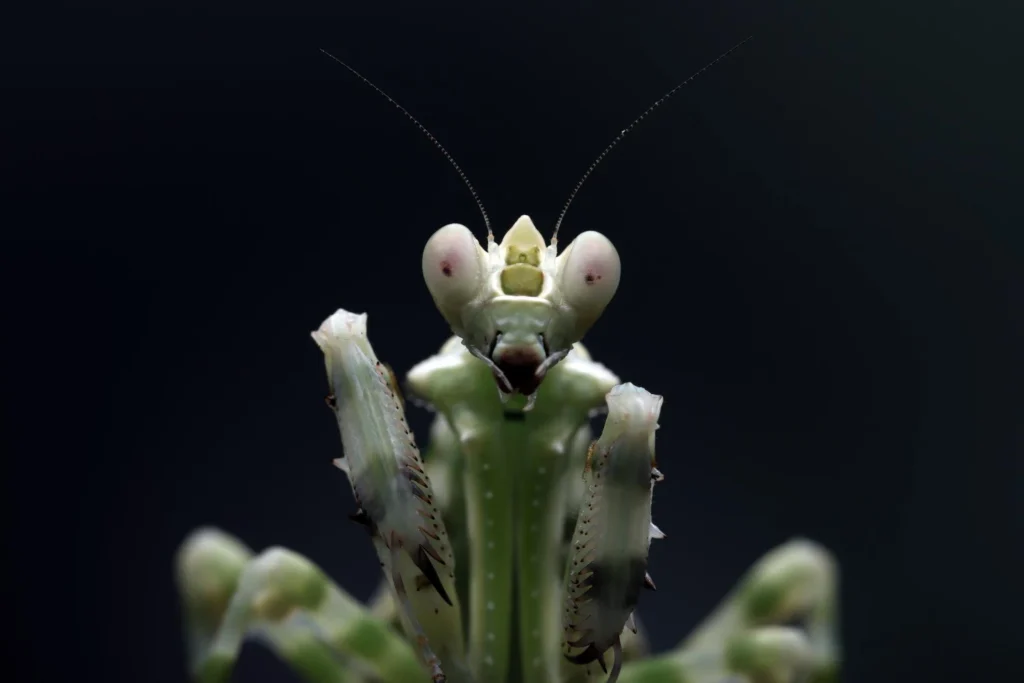
The size and shape of a pseudopupil depend on how many ommatidia point into a given patch of space. In regions where the units are packed more densely, with only tiny angles between neighbors, more of them line up with your view at once, so the dark patch looks bigger. Vision researchers use this effect to map how compound eyes sample the world.
In a mantis, the front of each eye is the sharpest part. A detailed study of the mantis Tenodera australasiae described a forward-facing high-resolution zone, sometimes called a fovea. There, neighboring ommatidia were only about 0.6° apart, compared with about 2.5° near the edges of the eye. The same study found that the two eyes’ fields of view overlap at the front, so both eyes can see the same area ahead of the mantis.
That overlap matters. Experiments with Sphodromantis lineola, in which mantises wore tiny colored 3D glasses and watched virtual prey, showed that mantises use stereo vision to judge distance. A large, dark pseudopupil at the front of the eye is a visible sign of the region the mantis relies on most when it lines up a strike.
Why mantis eyes turn dark at night
Many people notice a second, more dramatic change after dark: a mantis’s normally pale eyes can turn much darker, sometimes almost black. This is a different effect from the small black dot, although the two are related.
In a laboratory study of the mantis Hierodula patellifera, the eyes darkened noticeably when the lights went off. They were darkest about two and a half hours later, then gradually lightened through the rest of the night, returning to their daytime color shortly before the lights came back on. The researchers linked this to the movement of screening pigment inside the eye. They suggested the pigment’s daily cycle is tied to the mantis’s internal circadian clock and kept in step by light. Earlier work had already noted that mantis eyes darken at night and that the pseudopupil enlarges at the same time. That work interpreted both changes as the eye adjusting its sensitivity for low light.
Two points of caution apply. The exact mechanism has not been fully worked out in mantises, and only a few species have been studied in detail. And because eye color can shift between day and night, eye color by itself is not a reliable identification clue. A mantis with dark eyes in the evening is not a different species from the same mantis with pale eyes at noon.
Is the black dot a sign of a problem?
No. The pseudopupil is a normal feature of a healthy compound eye. It is a by-product of how the eye collects light, not a disease, an injury, or a parasite.
A simple test can help you tell the pseudopupil apart from something else. Slowly move your head to one side while watching the eye. A true pseudopupil will slide across the eye’s surface as your angle changes. A dark mark that stays in exactly the same place no matter where you stand is not the pseudopupil. It could be a natural marking, a scuff, or damage to the eye’s surface. For a pet mantis, ask a keeper or specialist familiar with that particular species, because what counts as normal varies from species to species.
Other “dots” on a mantis head
If you look closely between the bases of a mantis’s antennae, you may also see three tiny, shiny bumps arranged in a small triangle. These are ocelli, simple eyes that are separate from the two large compound eyes. They don’t move the way the pseudopupil does and are not what people usually mean by “the black dot.”
Seeing it for yourself
You don’t need to pick up a mantis to watch the pseudopupil in action. If you find one on a plant or a fence, stay a comfortable distance away and slowly lean from side to side. Watch how the dark spot glides across each eye. Then compare a view from the front with a view from the side. Observing quietly like this lets you see a real piece of insect optics without stressing the animal.
For more beginner-friendly background on mantis anatomy and senses, the Praying Mantis Facts guide is a good next stop. If you are just getting started, What Is a Praying Mantis? covers the basics.
References
- Rossel, S. (1979). Regional differences in photoreceptor performance in the eye of the praying mantis. Journal of Comparative Physiology, 131, 95–112. doi:10.1007/BF00619070
- Land, M. F. (1989). Variations in the structure and design of compound eyes. In D. G. Stavenga & R. C. Hardie (Eds.), Facets of Vision (pp. 90–111). Springer.
- Schirmer, A. E., Prete, F. R., Mantes, E. S., Urdiales, A. F., & Bogue, W. (2014). Circadian rhythms affect electroretinogram, compound eye color, striking behavior and locomotion of the praying mantis Hierodula patellifera. Journal of Experimental Biology, 217, 3853–3861. doi:10.1242/jeb.102947
- Nityananda, V., Tarawneh, G., Rosner, R., Nicolas, J., Crichton, S., & Read, J. (2016). Insect stereopsis demonstrated using a 3D insect cinema. Scientific Reports, 6, 18718. doi:10.1038/srep18718
- The University of Queensland. Insect Science, “25 Orders of Insects: Mantodea.”