
Subheadings below are set one level down to fit this document; use them as H2 in WordPress. The three internal links are already in place.
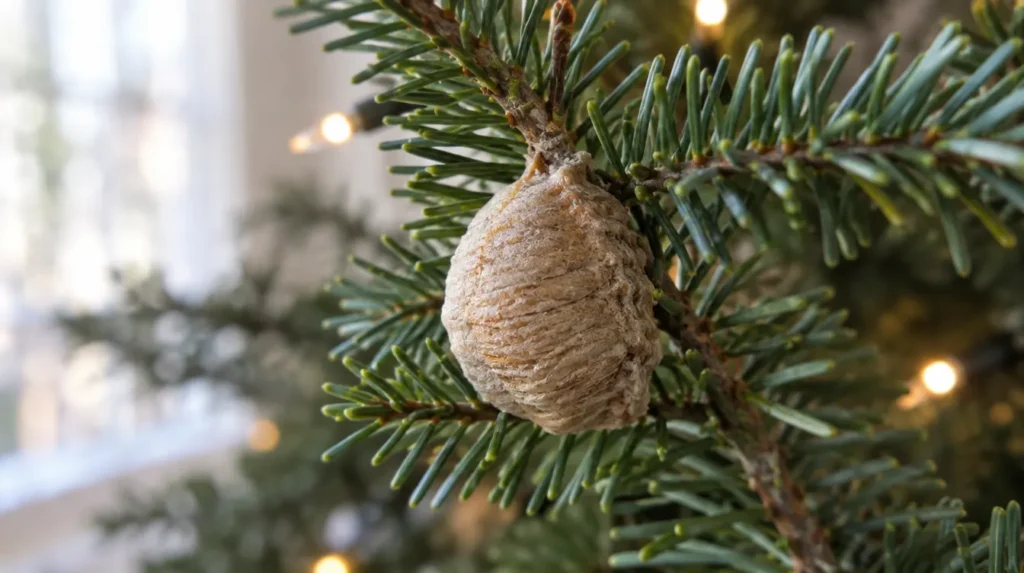
A tan or brown lump that looks like hardened foam, glued to a branch of a real Christmas tree, may be a praying mantis egg case. Entomologists call it an ootheca. It is harmless to people, pets, and the house. The simplest response is to clip the twig it sits on and put it outdoors in a shrub or evergreen, where the eggs can stay cold and hatch in spring.
Why a mantis egg case ends up on a Christmas tree
Christmas trees grow outdoors for years, and they are part of the same habitat as any other shrub or young tree. In temperate North America, female mantises lay their eggs in late summer and fall. The eggs are laid in a frothy mass that hardens into a protective case around a twig or stem. The adults die as cold weather arrives, and the eggs pass the winter inside the case.
Conifer twigs and branches are among the places mantises attach their egg cases, so a cut tree occasionally carries one home. It is not common. Penn State Extension notes that most real Christmas trees are free of insects and other arthropods, and University of Illinois Extension describes hitchhikers of any kind as rare on cut trees.
What the egg case looks like
A mantis egg case on a Christmas tree usually has these features:
- Color: tan, straw, or light brown, sometimes grayish.
- Texture: dry and lightweight, like hardened foam or spray insulation, often with fine ridges.
- Attachment: firmly glued to a twig or wrapped partly around it, often tucked among the needles rather than on the trunk.
- Size: frequently compared to a walnut, though size and shape vary with the species.
Shape gives a rough clue to the species. The egg case of the native Carolina mantis is slender and elongated, with a pale stripe along the middle. The egg case of the introduced Chinese mantis is rounder and bulkier. Color alone is not a reliable guide. For more detail on shapes and what is inside, see our guide to the praying mantis egg case.
Look-alikes worth ruling out
A few other things on a Christmas tree can be mistaken for a mantis egg case.
| What it is | How it differs |
|---|---|
| Spotted lanternfly egg mass | Flat and gray, like a smear of dried mud, usually on the trunk or bark. Eggs sit in rows under a waxy coating. |
| Spongy moth egg mass | Oval, tan to brown, and fuzzy, like a patch of felt. |
| Small cone or dried sap | Hard, woody, or sticky rather than foam-like. |
Spotted lanternfly egg masses are unlikely on Christmas trees, according to Penn State Extension, but the insect is an invasive pest in parts of the United States. If you think you have found one, scrape it off, destroy it, and follow your state agricultural agency’s reporting guidance. If you cannot tell what you have, a clear photo sent to a local extension office is a reasonable next step.
What to do if you find one
- Leave the case on its twig. Cut the twig a few inches on either side with pruners. Prying the case off can damage it.
- Move it outside soon. The longer the case sits in a warm room, the more likely the eggs are to resume development.
- Place it in a shrub or evergreen. Wedge or tie the twig among the branches, off the ground and out of standing water, where a damp case could rot.
- Leave it alone until spring. The nymphs emerge when outdoor conditions suit them and small prey is available.
Do not spray the tree. Extension specialists warn that aerosol insecticides are often flammable and should not be used on a Christmas tree.
The best time to look is before the tree comes indoors. Check along the inner branches at the lot or farm, or on the porch at home. Shaking a tree can dislodge loose insects, but it will not remove a glued-on egg case.
What happens if the egg case stays on the tree
Indoor warmth works like a false spring. Penn State Extension notes that mantis egg cases brought indoors hatch after several weeks. The number of nymphs depends on the species and the size of the case, from a few dozen to a couple of hundred.
The nymphs are tiny, pale, and wingless, and they spread quickly across the tree, walls, and windows. They do not damage the house or its contents. The problem is theirs, not yours. A heated home in winter has almost nothing for them to eat, so they starve or eat one another. In a cold climate, they would not survive being put outdoors in midwinter either. That is why moving the unhatched case outside early is the kinder choice.
If the eggs have already hatched
There is no perfect option once nymphs are loose in December or January. Raising them is difficult. Newly hatched mantises need a steady supply of very small live prey, such as fruit flies, and they will eat each other when crowded. Penn State Extension adds that mantises kept alive through the winter would be out of step with wild prey and wild mantises when released in spring.
The common belief that mantises are legally protected is a misconception, according to the same source, so there is no obligation to rescue every nymph. Stray nymphs on walls and windows can be removed with a vacuum cleaner. If you would like to try saving some, our guide on what to do with baby praying mantises indoors covers the practical steps.
A note on native and introduced mantises
A Christmas tree may have been grown far from where it is sold, so the egg case may come from another region. In eastern North America, the mantises that lay on conifers include the native Carolina mantis and three introduced species: the Chinese, narrow-winged, and European mantises.
Standard extension advice is still to place the egg case outdoors. Some gardeners prefer not to add introduced mantises to their yards, and that is a reasonable position too. If the question matters to you, a local extension office can help identify the case. Our article on whether you can move a praying mantis egg case looks at relocation in more depth.
Whichever you choose, do not count on the egg case for pest control. Mantises are generalist predators. They eat what they can catch, including pollinators and other beneficial insects.
References
- Skvarla, M. J. “Insects on Real Christmas Trees.” Penn State Extension. https://extension.psu.edu/insects-on-real-christmas-trees
- Enroth, C. “Christmas Tree Hitchhikers.” University of Illinois Extension.
- Barnes, E. “5 Bugs That Might Hitchhike on Holiday Decorations.” Purdue Landscape Report, Purdue University.
- Missouri Department of Conservation. “Mantids (Mantises).” Field Guide.
- NC State Extension. “Chinese Mantids.” Growing Small Farms.