
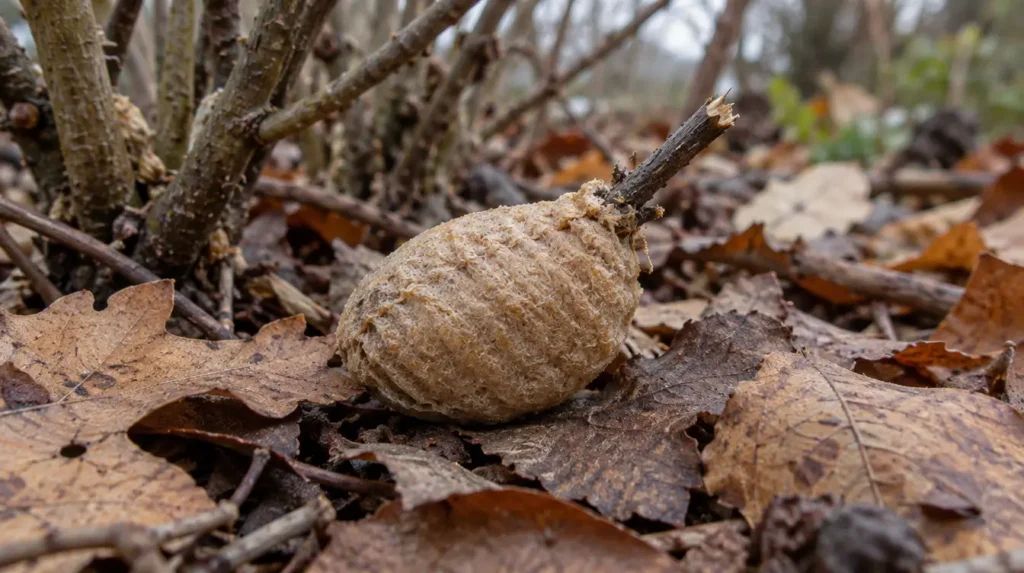
A praying mantis egg case that has come loose from a branch, wall, or fence post is not automatically lost. The eggs sit inside a hardened, foam-like shell called an ootheca, and that shell does not stop protecting them just because it is no longer stuck to something.
What matters is what happens next. A case left on damp soil, carried into a warm house, or sealed in a jar faces more risk than one that is simply put back outdoors in a sensible place.
Quick Answer
If the egg case looks intact, pick it up gently, keep it outdoors, and fix it to a sheltered shrub or other firm support close to where it fell. Place it off the ground, in roughly the position it had before, with its outer face left uncovered so the young mantises can get out.
Do not bring it into a heated room, and do not leave it lying on the soil. No method can promise that the eggs will hatch, but these steps avoid the most common ways a fallen case is lost.
Why Egg Cases Come Loose
Mantises attach their egg cases to many surfaces, including branches, plant stems, walls, fences, posts, and the sides of houses. Some of those surfaces do not last the winter.
Common causes include:
- Pruning or autumn garden cleanup
- Annual stems that dry out and collapse
- Flaking paint or loose bark under the case
- Doors, gates, and garden furniture that get knocked or moved
- Strong wind, heavy snow, or animals brushing past
In most of these situations the case itself is undamaged. It has lost its anchor, not its contents.
First, Check What You Have
Spend a minute looking before you decide anything.
Is it a mantis egg case? Shape and size differ by species. In much of the central and eastern United States, a Carolina mantis case is small, narrow, and elongated with a pale band down the middle, while a Chinese mantis case is larger, light brown, and rounded like a half dome. Other regions have other species, so compare the object with local photographs. This guide to the praying mantis egg case explains the structure in more detail.
Has it already hatched? Look at the seam that runs down the outer face of the case, on the side that faced away from the stem or wall. On an unhatched case that seam is generally intact. On an old, empty case it is usually broken by slits or holes. An empty case can be left where it is; nothing inside needs help.
Are there small round holes scattered over the surface? These can be the exit holes of tiny parasitic wasps that develop inside mantis eggs. A case with many such holes may hatch few mantises or none.
Is it crushed or split open? A case that was stepped on or cut through is unlikely to recover. A case with a scuffed surface or a chipped edge may still be fine.
Is it soft? A freshly laid case starts out soft and hardens afterward. Handle a soft one as little as possible.
You cannot confirm from the outside that the eggs are alive, or even that they were fertilized. Do not shake the case, hold it over a hot lamp, or cut it open to find out.
Can a Fallen Egg Case Still Hatch?
Often, yes. In temperate regions mantises pass the winter as eggs inside the case, and the case is built to cope with cold, wind, and rain. A short fall onto grass or leaf litter is a small event by comparison.
The larger risks come afterward:
- The ground. University of Illinois Extension advises never putting an egg case on the ground because ants will eat the eggs. Damp soil and wet mulch can also cause a case to rot.
- Indoor warmth. Warm rooms restart development and bring on hatching months early.
- Rough handling. Squeezing, piercing the centre, or coating the case can damage it in ways that do not show.
It is also worth knowing that some egg cases never hatch even when nobody touches them. If yours stays closed in spring, the fall may not be the reason.
What to Do, Step by Step
1. Pick it up carefully
Hold the case by its edges, or by any twig, bark, or paint flake still attached to it. Keep that attached material. It gives you something to tie later without touching the case.
2. Work out how it was sitting
Look for clues. The back of the case is usually flatter or grooved where it gripped the stem or wall, and a mark is often left on the surface it came from. Keep the back toward the new support and the seamed outer face pointing outward.
Extension advice on orientation is not fully consistent. One specialist warns that changing it can interfere with hatching, while another notes that females themselves lay cases at different angles. Matching the original position as closely as you can is the cautious choice. If you truly cannot tell, the priority is that the outer face stays open and unobstructed.
3. Choose a spot close by
Stay on the same property and as near the original site as is practical. A good position is:
- Off the ground, in a shrub, hedge, or sturdy plant
- Sheltered from constant foot traffic and garden tools
- Not due for pruning, pressure washing, painting, or pesticide treatment before late spring
- Exposed to normal outdoor temperatures
Evergreen shrubs are often suggested because they give cover through winter.
4. Fix it in place
If the case still has a piece of twig or stem: tie that piece to a branch with soft garden twine or a plant tie. Nothing should press on the case itself.
If the case is completely bare: there is no perfect method, and published advice is thin. An extension entomologist answering this exact problem suggested two options: a pin passed carefully through the outer edge of the foam, well away from the centre where the eggs are, or a small piece of double-sided tape between the flat back of the case and the new surface.
Whichever you use, keep it minimal. Adhesive or tape should touch only the back, never wrap around the case, and never cover the seam on the outer face.
5. Leave it alone
Once the case is secure, resist the urge to check it every week. Normal winter weather is part of its cycle. If the case was still on its original plant and you are deciding whether to shift it somewhere safer, the fuller guide to moving a praying mantis egg case covers that decision.
If You Cannot Put It Back Right Away
Sometimes the case turns up in the middle of a job, or after dark, or in weather that makes outdoor work impractical.
For a short delay, keep it somewhere that stays at outdoor winter temperatures. Iowa State University Extension recommends a box or jar in an unheated garage or porch rather than inside the home. Make sure the container has air holes and is kept dry, out of direct sun, and away from fumes and chemicals.
Treat this as a holding step. The longer a case sits in a container, the greater the chance that it is forgotten until dozens of nymphs appear at once.
What Not to Do
- Do not keep it in a heated room. Kansas State University Extension notes that at around 70°F (21°C) nymphs can emerge in four to six weeks. Iowa State warns that a case kept indoors may hatch in January or February, when the young cannot be released.
- Do not leave it on the ground, in mulch, or anywhere that stays wet.
- Do not seal it in an airtight container.
- Do not coat it with glue, paint, or varnish, or wrap tape around it.
- Do not open it to see what is inside.
- Do not carry it to another town or region. Some mantises found in gardens are native and others were introduced, and their status differs from place to place. Keeping the case where you found it avoids moving a species somewhere it does not already live.
If It Hatches Indoors
A case that spent time in a warm building may hatch before you expect it. A single case can release fifty to two hundred nymphs, and they will begin eating one another if they are confined without food.
What you should do depends on the season and the outdoor temperature at the time. The steps are set out in what to do with baby praying mantises indoors.
When to Ask for Local Help
A county or university extension office can identify an egg case from clear photographs and advise on local conditions. It is worth contacting one if:
- You cannot tell what species the case belongs to
- The case is damaged, soaked, or was exposed to paint or chemicals
- It came from a purchased plant, firewood, or a Christmas tree from another region
- You are unsure whether it should be returned to the garden at all
Photograph the whole case, its side profile, and its back, with a ruler or coin for scale.
Frequently Asked Questions
Will a praying mantis egg case hatch if it falls off?
It may. An intact case can remain viable after it detaches, as long as it is kept outdoors, off the ground, and at normal seasonal temperatures. There is no guarantee, and some cases fail to hatch for reasons unrelated to the fall, such as unfertilized eggs or parasitic wasps.
Can I glue a mantis egg case back on?
Coating a case in glue is not a good idea, and nothing should cover its outer face. If the case has no twig attached, one extension specialist suggests a small piece of double-sided tape on the flat back, or a pin through the outer foam edge. Tying on any attached twig is gentler when that is possible.
Can I leave a fallen egg case on the ground?
No. Extension sources advise against it because ants can reach the eggs and damp conditions can rot the case. Lift it into a shrub or onto another firm support above ground level.
Does it matter which way up the egg case goes?
Keep it the way it was if you can tell. Published guidance differs on how much orientation matters, so matching the original position is the cautious option. At a minimum, the back should sit against the support and the seamed outer face should be clear.
Summary
A fallen praying mantis egg case is usually a small problem with a simple answer. Check that it is intact and unhatched, get it off the ground, fix it to a sheltered outdoor spot near where it fell, and keep it out of the house. Then let winter and spring do the rest.
References
- Cloyd, R. A. (2021). Praying Mantids (MF3593). Kansas State University Agricultural Experiment Station and Cooperative Extension Service.
- Iowa State University Extension and Outreach, Yard and Garden. Praying Mantis.
- Allsup, K. (2020). Fall finds: praying mantis egg cases. University of Illinois Extension, Flowers, Fruits, and Frass.
- Ask Extension knowledgebase, expert responses on mantis oothecae: relocation from a door frame (Michigan, 2020); identifying old versus unhatched egg cases (University of Maryland Extension).
- Gibb, T., quoted in I Found Something Strange in My Garden (2021). Purdue Extension, Whitley County.