
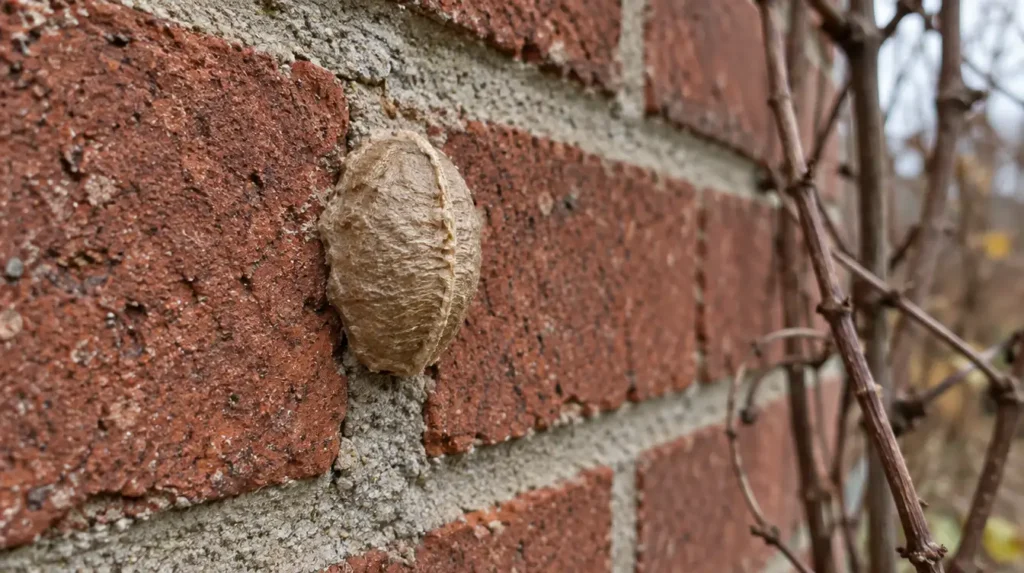
A tan or light brown, foam-like lump stuck to a house wall in fall or winter is often a praying mantis egg case. It does not damage the wall, it is not a sign of an infestation, and in most cases the simplest and safest choice is to leave it where it is until the young mantises hatch in spring.
The rest of this guide explains why mantises use walls, how to check that the object really is a mantis egg case, and what to do if it sits somewhere inconvenient.
Why a mantis would lay eggs on a wall
A mantis egg case is called an ootheca (plural: oothecae). The female lays her eggs inside a frothy secretion that hardens within a short time into a tough, lightweight casing. The foam insulates the eggs, which is how they survive winter in colder regions.
We tend to picture egg cases on twigs and plant stems, and many are laid there. But a female mantis is not looking for a plant in particular. She needs a firm surface that will hold her weight while she works, and an upright one suits her well. University extension sources in the United States list walls, fences, posts, eaves, and the sides of houses alongside branches and stems as normal places to find oothecae. Brick, siding, stucco, window frames, sheds, and garage walls all meet the same basic need.
In temperate North America, the cases are laid in late summer and fall. The adults die as cold weather arrives, and the eggs overwinter inside the case. That is why most people notice an egg case on a wall between late fall and early spring, when leaves are down and the wall is bare.
How to tell it is a mantis egg case
Look at shape, texture, and how the object is attached.
- Texture: firm and dry, like hardened spray foam or a toasted marshmallow. It is not silky, fuzzy, or muddy.
- Color: tan, beige, light brown, or gray-brown.
- Attachment: glued flat against the surface along one side. It does not hang from a thread.
- Structure: a visible seam or band usually runs down the middle of the outer face.
Shape differs by species, and it can offer a clue about which mantis laid it. Using two species that are common in much of the eastern and central United States as examples:
| Species | Typical egg case |
|---|---|
| Carolina mantis (Stagmomantis carolina) | Slender and elongated, about 1/2 to 3/4 inch long, fairly flat against the surface, with a pale band down the center. Often found on flat vertical surfaces. |
| Chinese mantis (Tenodera sinensis) | Larger and bulkier, about 1 to 1 1/4 inches long, rounded or half-domed, uniformly tan to light brown. |
Treat this as a clue, not a firm identification. Other species occur in many regions, their egg cases can look similar, and a case that has weathered on a wall for months may have lost some of its original shape. Your location matters as much as the shape. For a fuller description of oothecae, see our guide to the praying mantis egg case.
A few other things turn up on walls and can cause confusion. Spider egg sacs are made of silk and look woven or papery. Mud dauber and potter wasp nests are made of dried mud. Some moth egg masses are tan but have a fuzzy, felt-like surface. None of these has the dry, rigid foam texture of a mantis ootheca.
Is it harmful to the wall or the house?
No. An ootheca is hardened foam stuck to the surface. Nothing inside it feeds on or tunnels into wood, brick, paint, or mortar. Mantises are predators at every active life stage and have no interest in building materials.
It is also not the start of an indoor problem. When the eggs hatch, the nymphs are tiny, about a centimeter long, and they leave the case quickly. Young mantises will eat one another if they stay crowded, so they spread out into nearby vegetation within a short time. They do not nest, they do not return to the case, and they do not try to move into a house.
Is the egg case still alive?
It is hard to be certain from the outside, but two signs help:
- Check the seam. According to University of Maryland Extension, the seam down the outer face is intact on an unhatched case. On an old, empty case it is broken by slits or small openings where the nymphs came out.
- Look for scattered round holes. Small round holes in many places across the surface usually mean tiny parasitic wasps developed inside. Those eggs will not hatch into mantises.
Old cases can stay glued to a wall for a long time. An empty one can be left alone or removed, as you prefer.
When will it hatch?
In regions with cold winters, nymphs usually emerge in spring to late spring, once temperatures have warmed. The exact timing depends on local weather and on the species, so there is no single date to expect.
A single case can release anywhere from a few dozen to a couple of hundred nymphs. Most will not survive to adulthood. They are eaten by birds, spiders, other insects, and each other, which is a normal part of the mantis life cycle.
Should you leave it or move it?
On an outdoor wall, leaving it is usually best. The female chose a spot that was stable and reasonably sheltered, and a case glued to a flat surface is harder to detach in one piece than one on a twig you can simply clip.
Moving it is reasonable when the wall is about to be painted, pressure-washed, or repaired, or when the case is at a height where it will be knocked or scraped. If you do move it:
- Work a thin, flat tool gently under the base. Do not squeeze or pull on the case itself.
- Keep it outdoors, in a sheltered place off the ground, such as a shrub or a protected corner of a fence. University of Illinois Extension warns against putting an egg case on the ground, where ants can get at the eggs.
- Place it at a similar height and exposure to where you found it.
Our separate guide covers timing, distance, and reattachment in more detail: Can You Move a Praying Mantis Egg Case?
On a wall inside a heated space, do move it. Warmth is the cue for hatching. Kansas State University Extension notes that an egg case kept indoors at around 70°F (21°C) or warmer can release nymphs in roughly four to six weeks. Indoors in midwinter, those nymphs have nothing to eat and cannot be released into freezing weather. An unheated garage or shed that stays close to outdoor temperature is a different situation and is usually fine. If hatching has already happened inside, see what to do with baby praying mantises indoors.
A note on native and non-native mantises
Some readers ask whether an egg case should be kept at all. In parts of North America, several of the mantises people encounter, including the Chinese mantis, were introduced from elsewhere, while others, such as the Carolina mantis, are native. All mantises are generalist predators that eat pollinators and other beneficial insects as well as pests.
For that reason, some extension staff and gardeners in the eastern United States choose to remove the egg cases of non-native species and leave native ones. Others leave every case alone. Which species are native, and how local experts view the introduced ones, varies by region. If this matters to you, a local extension office, natural history museum, or native plant society can tell you what applies where you live.
Quick answers
Will the egg case stain or mark the wall? The case itself does no structural harm. Once the nymphs have left, an empty case can be eased off.
Can I spray it off with a hose? Only if you are sure it is empty. A strong jet can break up a live case or knock it to the ground.
Do I need to protect it over winter? No. The foam casing is the protection. Covering or wrapping it is unnecessary and can trap moisture.
Will the mother come back? No. In regions with cold winters, the adult female dies in fall, usually not long after laying.
References:
- Cloyd, R. A. (2021). Praying Mantids (MF3593). Kansas State University Agricultural Experiment Station and Cooperative Extension Service.
- Allsup, K. (2020). “Fall finds: praying mantis egg cases.” Flowers, Fruits, and Frass, University of Illinois Extension.
- Roos, D. (updated 2026). “Challenging the Conventional Wisdom About Praying Mantids.” Growing Small Farms, NC State Extension.
- University of Maryland Extension, Home and Garden Information Center (2024). Ask Extension response #857726 on mantis egg cases.