
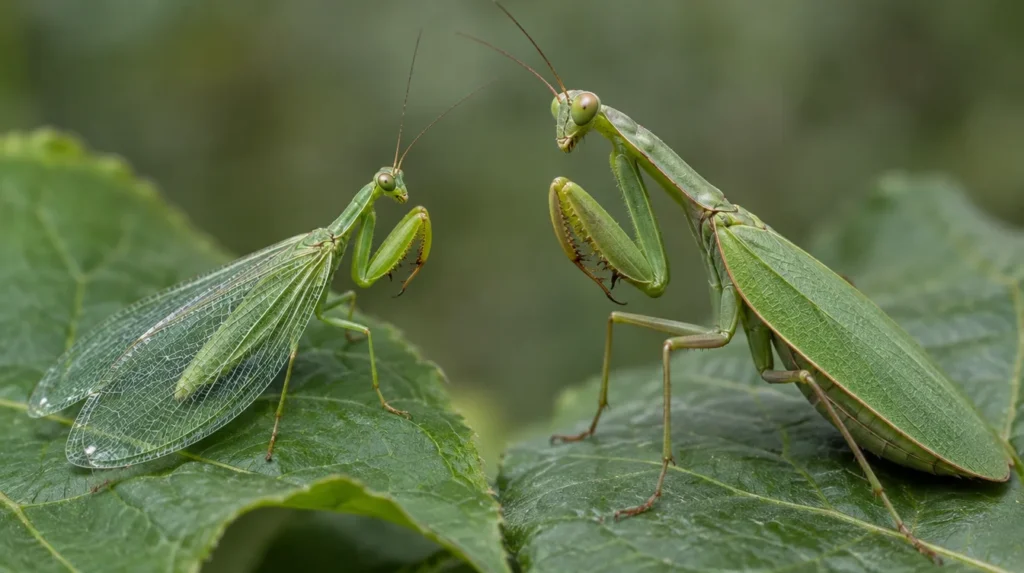
If you have found a small insect with folded, mantis-like front legs and clear, lacy wings, you may be looking at a mantisfly rather than a praying mantis. The two share a similar hunting tool at the front of the body, but they are not closely related. They belong to different insect orders, grow up in very different ways, and can usually be told apart with one good look at the wings.
The Short Answer
A mantisfly (also spelled mantidfly, or called a mantispid) is not a small or young praying mantis. Mantisflies belong to the family Mantispidae in the order Neuroptera, the same broad group as lacewings and antlions. Praying mantises belong to a separate order, Mantodea, whose closest living relatives are cockroaches and termites.
The resemblance is mostly in the front half of the body. Both have a triangular head with large eyes, a long, neck-like front section of the thorax (the prothorax), and raptorial front legs: spiny forelegs that fold shut to grip prey. Behind that, they are built quite differently.
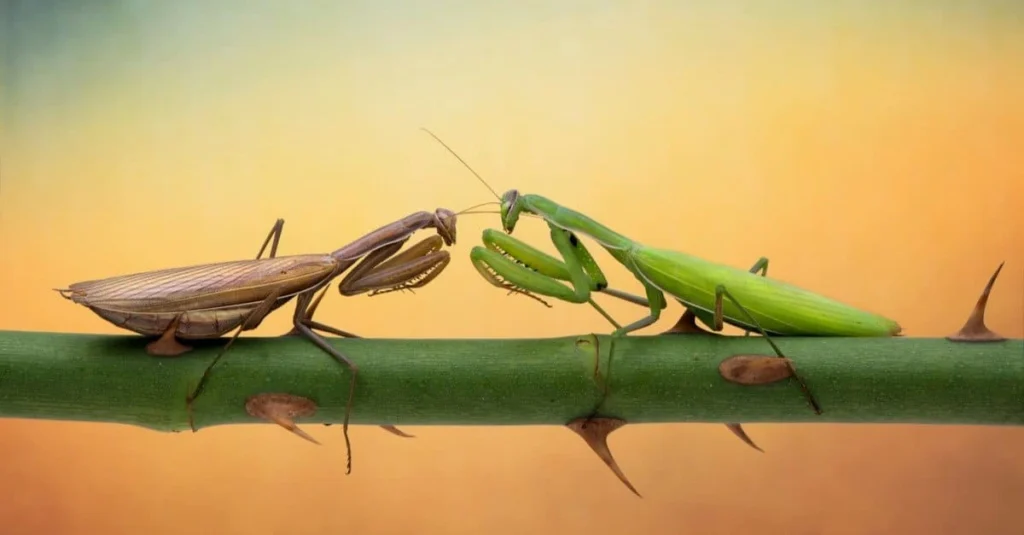
If you only check one thing, check the wings. An adult mantisfly has four clear, finely net-veined wings that look like a lacewing’s. An adult praying mantis usually has tougher, often leathery forewings that cover its hind wings.
Why They Look So Alike
Grasping front legs have evolved more than once in insects. Besides mantises and mantisflies, they also appear in assassin bugs and some flies. Researchers who study the leg structure point out that the spines on a mantisfly’s forelegs are built differently from a mantis’s spines. The long prothorax of mantisflies is also considered convergent with mantises: the same solution reached independently, not evidence of close kinship.
You won’t see those spine details without magnification. They are worth knowing because they explain why two unrelated insects can look so similar from a distance.
Mantisfly vs Praying Mantis at a Glance
| Feature | Mantisfly | Praying mantis |
|---|---|---|
| Classification | Order Neuroptera, family Mantispidae | Order Mantodea (many families) |
| Closer relatives | Lacewings and antlions | Cockroaches and termites |
| Adult wings | Four clear or lightly tinted wings with a fine network of veins; front and hind wings look similar | Forewings usually tougher and often leathery, covering folded hind wings; wing length varies by species and sex |
| Young stages | Larvae that look nothing like the adult, usually hidden inside spider egg sacs or other hosts | Nymphs that look like small, wingless versions of the adult and hunt in the open |
| Development | Complete metamorphosis: egg, larva, pupa, adult | Incomplete metamorphosis: egg, nymph, adult |
| Eggs | Many tiny eggs, each on a thin stalk, usually in clusters | Eggs laid inside a foamy egg case (ootheca) |
| Typical adult length | Roughly 3/4 to 1 1/4 inches (about 20–35 mm) | Varies widely by species; many common garden species are considerably larger as adults |
| Adult food | Small insects and other small arthropods; some adults have been reported taking plant fluids | Generalist predators of insects and other arthropods |
Clue 1: Look at the Wings First
Wings are the most reliable field clue for adults.
A mantisfly’s four wings are thin, mostly transparent, and covered in a fine, net-like pattern of veins, much like a green lacewing’s. The front and hind wings are similar in shape and texture. At rest they fold back over the body.
In many praying mantis species, the forewings are thicker and more leathery and are often colored to match the body. They lie over the larger, thinner hind wings, which open like a fan in flight or during a defensive display. Mantis wings vary a lot, though. Some species have short wings in adults, and wing length can differ between males and females.
Life stage matters most here. Adult mantisflies have fully developed wings, and young mantisflies look nothing like a mantis. So a mantis-shaped insect with no wings, or only small wing pads, is almost always a praying mantis nymph or a short-winged adult mantis, not a mantisfly.
Clue 2: Size and Life Stage
Mantisflies are small. Most adults are about an inch long or a little less. Many of the praying mantises people notice in late summer are noticeably larger as adults.
Size alone can mislead you, because young mantises are small too. A tiny mantis-shaped insect seen in spring or early summer is often a mantis nymph. Combine size with wings: small, wingless or with wing pads usually points to a mantis nymph; small with full, clear, veined wings usually points to a mantisfly. For more on young mantises, see our guide to small praying mantis identification.
Clue 3: Color and Wasp Mimics
Color is not a reliable way to separate the two. Both groups include green and brown individuals. Most mantisflies are green, brown, tan, gray, or yellowish.
Some mantisflies look strikingly like paper wasps, which adds another layer of confusion. In North America, the brown wasp mantidfly (Climaciella brunnea) is banded in shades of yellow, brown, rust, or black and has wasp-like wings. If you see what looks like a wasp with mantis arms, it is very likely a mantisfly. As with any identification, use several clues together rather than color alone; our simple field guide to identifying a praying mantis explains how to combine body shape, wings, location, and season.
Clue 4: Where and When You See It
Mantisflies are generally less often noticed than praying mantises. Many are attracted to lights at night, especially ultraviolet “black lights,” so finding one on a porch screen or window after dark is not unusual.
Timing and diversity depend on region. In Missouri, for example, the state conservation department reports adult mantisflies from late April through June, with some lasting until heavy frosts in October. Species counts also depend on the area covered: Missouri’s field guide lists about 11 species in North America north of Mexico, while a University of Florida source counts about 15 in the United States, mostly in the South. Worldwide, roughly 400 living mantisfly species have been described.
Their Life Cycles Are Completely Different
The two insects differ most clearly in how they grow up.
Praying mantises develop through incomplete metamorphosis. A female lays her eggs in a frothy mass that hardens into a protective egg case called an ootheca. The young that hatch are nymphs: small, wingless mantises that already hunt and gradually grow through a series of molts until they reach adulthood. If you have seen a tan, foam-like case on a twig or fence, that is the mantis stage you are most likely to find; our guide to the praying mantis egg case explains what it looks like.
Mantisflies develop through complete metamorphosis, with an unusual twist. A female lays many tiny eggs (one University of Florida source gives a range of roughly 200 to 2,000), each perched on its own slender stalk. The newly hatched larva is slender and active. In many species it searches for a spider egg sac, or climbs onto a spider and rides along until she produces one, then slips inside. Larvae that ride spiders tend to use hunting spiders rather than web-builders, and some even transfer from a male spider to a female during mating.
Once inside the egg sac, the larva changes into a plumper, grub-like form and feeds on the spider eggs. When fully grown, it spins a cocoon, pupates, and later emerges as a winged adult. This change in larval body form partway through development is called hypermetamorphosis.
Not all mantisflies use spiders. Depending on the group, larvae may develop on the young of bees or wasps in their nests, and a few species have been recorded feeding on beetle grubs or caterpillars.
Are Mantisflies Helpful in the Garden?
Adult mantisflies catch small insects and other small arthropods, and their larvae consume spider eggs. That makes them part of the natural web of predators in a garden, but not a pest-control solution. Missouri’s conservation department notes that they are probably not abundant enough to have a major effect by themselves.
The same caution applies to praying mantises. Both are generalist predators. They eat whatever suitable prey they can catch, including beneficial insects, and do not specifically target the insects gardeners consider pests.
What to Do If You Find One
You don’t need to do anything with a mantisfly or a praying mantis you find. If you want to confirm which one you saw:
- Photograph it from the side and from above so the wings and front legs are both visible.
- Note your location, the date, and whether you found it near a light at night.
- If one has come indoors, gently guide it into a cup and release it outside near vegetation, rather than handling it directly.
Frequently Asked Questions
Is a mantisfly a baby praying mantis?
No. Mantisflies are a separate family in the lacewing order, Neuroptera. Young mantises are wingless nymphs, while adult mantisflies are fully winged.
Can a mantisfly turn into a praying mantis?
No. Mantisflies grow from larvae through a pupal stage into adult mantisflies. Praying mantises hatch from an egg case as nymphs and become adult mantises. Neither changes into the other.
Is a mantisfly a cross between a mantis and a wasp?
No. Some mantisflies look like wasps, which is generally interpreted as mimicry, but they are neither mantises nor wasps.
References
- Missouri Department of Conservation. Mantidflies (Mantis Flies). Missouri Field Guide.
- University of Florida, Department of Entomology and Nematology. Mantidflies and Mantids. Beneficial Arthropods: Predators image gallery.
- North Carolina State University, General Entomology. Family Mantispidae. Insect Identification resources.
- Pérez-de la Fuente, R., & Peñalver, E. (2019). A mantidfly in Cretaceous Spanish amber provides insights into the evolution of integumentary specialisations on the raptorial foreleg. Scientific Reports. https://doi.org/10.1038/s41598-019-49398-1
- Ardila-Camacho, A., Winterton, S. L., & Contreras-Ramos, A. (2023). The genus Climaciella Enderlein, 1910 (Neuroptera, Mantispidae) in French Guiana. ZooKeys, 1153.