
Can Praying Mantises Fly?
Yes, many praying mantises can fly, but not all of them, and not at every stage of life. Only adult mantises have working wings. Young mantises (nymphs) cannot fly at all. Among adults, males of many common species are the ones you are most likely to see in the air. Females are often heavier and fly poorly, rarely, or not at all, especially once they are carrying eggs. A few species have short or nonfunctional wings in one or both sexes.
So whether a particular mantis can fly depends on three things: its life stage, its sex, and its species.
Only Adult Mantises Have Working Wings
Mantises grow by incomplete metamorphosis. A nymph hatches looking like a small, wingless version of the adult and grows through a series of molts. In the last nymphal stages, small wing pads become visible on the back. These pads are developing wings, not flight wings. Fully formed wings appear only after the final molt to adulthood.
That gives a simple rule. If a small mantis has no wings, or only short pads on its back, it cannot fly. If you are trying to work out whether a small mantis is a nymph, our guide to small praying mantis identification walks through the clues. The full sequence from egg case to adult is covered in our praying mantis life cycle guide.
How Mantis Wings Work
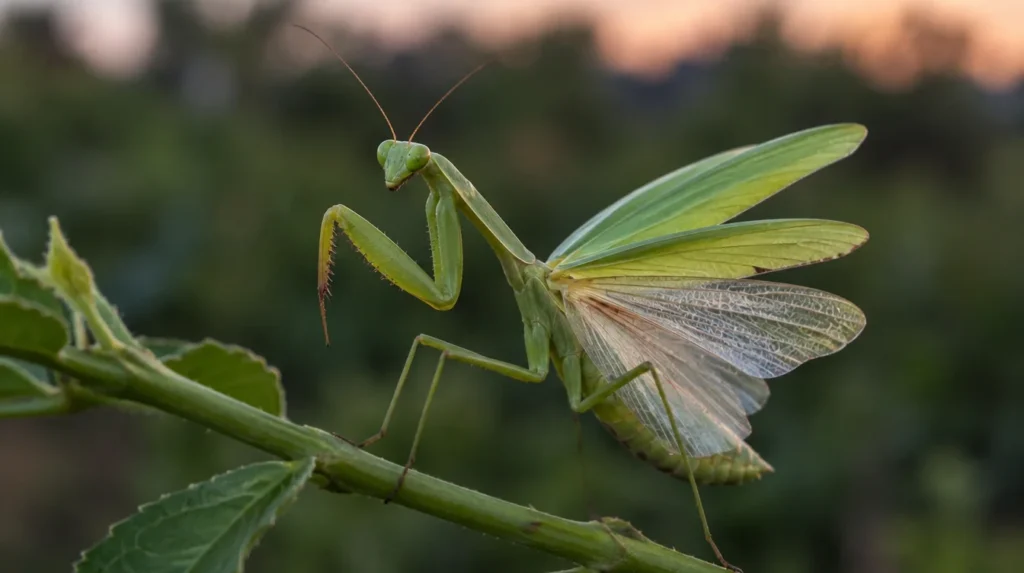
Most winged adult mantises have two pairs of wings, and the pairs do different jobs.
- Forewings (tegmina): narrow, somewhat leathery wings that lie over the back like covers. They protect the delicate wings underneath.
- Hindwings: large, thin, membranous wings that fold like a fan beneath the forewings. These do most of the work in flight.
When a mantis is resting or hunting, both pairs stay folded flat over the abdomen. They open when the mantis is about to take off, or when it is alarmed. Wings are not only for flying. Many mantises spread their wings in a defensive threat display, which makes them look larger to a would-be predator. One extension entomologist notes that adults use their wings more often for this display than for flight.
Males and Females Fly Very Differently
In many familiar species, including the Chinese mantis and the European mantis, the difference between the sexes is striking.
- Males are usually smaller and slimmer, and they are the active fliers. In the Carolina mantis, males are the sex most likely to be seen in flight, especially in late afternoon and around dusk.
- Females are larger and heavier. Several university extension sources describe adult females of common species as too heavy to fly, or as flying only very rarely, if ever. Colorado State University notes that females cannot fly once they begin to swell with eggs.
Sources do not all draw the line in exactly the same place. Some describe females of a given species as simply flightless. Others say females are capable of limited flight that becomes difficult as the abdomen fills with eggs. The safest summary is that a large female, particularly late in the season, is very unlikely to fly any meaningful distance.

Some Mantises Have Short or Nonfunctional Wings
Wing length varies between species and sometimes between the sexes of one species.
- Carolina, California, and bordered mantises (Stagmomantis species): females have shorter wing covers that do not reach the tip of the abdomen. Males have longer wings.
- Ground mantis (Litaneutria minor): females have only short wings that do not work for flight. Males may be winged or wingless.
- Grasshopper mantis (Yersiniops species): wingless or with very short, nonfunctional wings. These small mantises run and jump instead.
Short wings on an adult are therefore not always a sign of damage or a failed molt. If you have found a mantis whose wings stop well short of the abdomen, our guide to the praying mantis with short wings explains how to tell a short-winged adult from a nymph.
When Do Mantises Fly?
Mantises spend most of their lives sitting still and waiting for prey, so flight is an occasional activity rather than a daily habit. Typical observations include:
- Dusk and night flights by males. Male mantises are often seen flying around dusk, and many species fly at night.
- Flights to lights. In a long-term light-trapping study of mantises in Ghana, most of the mantises that came to the lights were males. This matches the general pattern that males are the more mobile, flying sex.
Because adult males do most of the flying and females of many species barely fly, male flight is commonly interpreted as part of finding mates. This is a reasonable interpretation of the pattern rather than a rule that explains every flight.
Authoritative sources rarely give figures for how far a mantis can fly. Treat any precise distance you see online with caution unless it names the species and the study.
How Flying Mantises Avoid Bats
Many mantises have an unusual hearing organ: a single ear on the underside of the body, between the hind legs. Researchers studying it called it a “cyclopean” ear because there is only one. In most mantises that have been tested, this ear is most sensitive to ultrasound in roughly the range many insect-hunting bats use.
The ear matters most in flight. In experiments on one African mantis, Parasphendale agrionina, flying males that heard bat-like ultrasound made sudden evasive maneuvers. These included turns, diving turns, and steep spiral dives toward the ground, with the sharpest dives made when the sound was closest. Males that were standing on a surface did not react to the same sounds. In other words, the escape response is linked to flight. Not every mantis hears this way: the response and sensitivity vary between species, and some groups hear poorly.
How to Tell Whether the Mantis You Found Can Fly
Use several clues together:
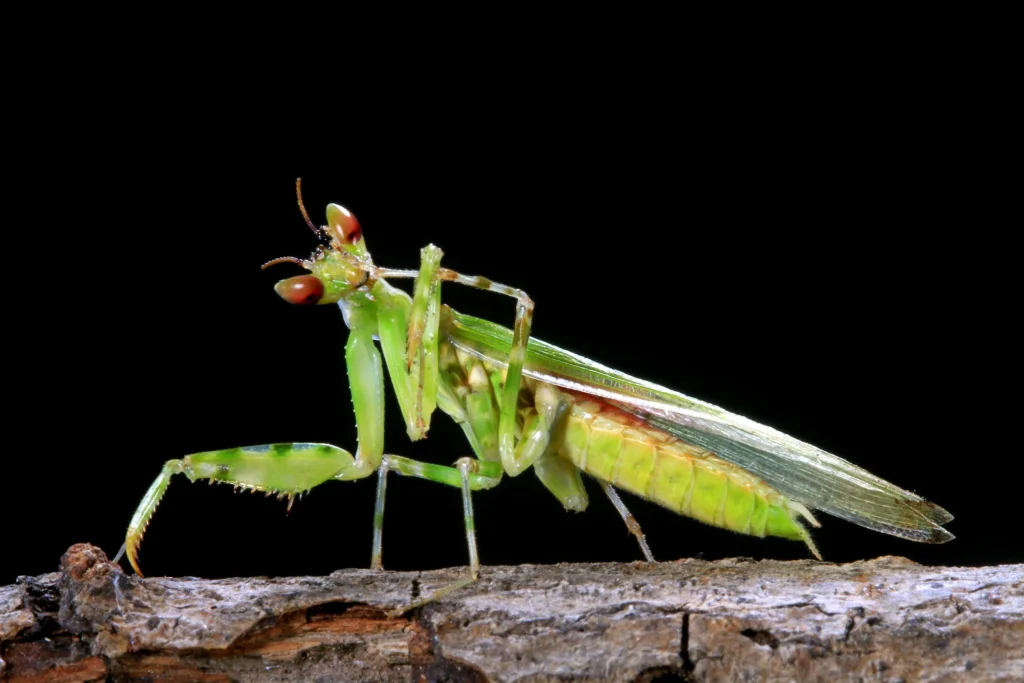
- Check for full wings. No wings, or only small pads on the back, means a nymph, and nymphs cannot fly.
- Look at wing length. Wings that reach about to the end of the abdomen suggest a fully winged adult. Wings that clearly stop short may belong to a short-winged species or a female of a species with reduced wings.
- Consider the sex. A slim, lighter-bodied adult is more likely to be a male and more likely to fly. A heavy-bodied female, especially one with a swollen abdomen in late summer or fall, probably will not.
- Think about the species and region. Which mantises live where you are makes a big difference, because wing development varies between species.
There is no need to test a mantis by tossing it into the air. A heavy female or a short-winged mantis can be injured by a fall. If you want to see one fly, the best approach is to watch quietly, especially around dusk.
Frequently Asked Questions
Can baby praying mantises fly?
No. Nymphs have no functional wings. Wing pads appear in the later nymphal stages, but working wings appear only after the final molt.
Can female praying mantises fly?
It depends on the species and the female’s condition. In many common species, adult females fly rarely or not at all, and several sources describe them as too heavy to fly, especially when carrying eggs. In some species, females have short or nonfunctional wings.
Why did a praying mantis fly to my porch light?
Flying mantises, mostly males, are known to come to lights at night. Lights also attract the small insects that mantises eat.
Do praying mantises fly well?
Adult males of many species fly competently and can even dive to escape bats. Mantises are still mainly sit-and-wait predators, though, and flight is something they do occasionally rather than constantly.
References
- Colorado State University Extension. Mantids of Colorado, Fact Sheet 5.510 (W.S. Cranshaw). https://extension.colostate.edu/resource/mantids-of-colorado
- Colorado State University. Colorado Insect of Interest: European Mantid.
- UC Davis Bohart Museum of Entomology. Praying Mantises, Information Note No. 26.
- Baker, J. Chinese Praying Mantid. NC State Extension, 2019.
- Layton, B. Carolina Mantis. Bug’s Eye View, Mississippi State University Extension, 2022.
- Dugas, K. Mantids (Order Mantodea, Family Mantidae). The Connecticut Agricultural Experiment Station.
- Edmunds, M. (1986). The phenology and diversity of praying mantids in Ghana. Journal of Tropical Ecology.
- Yager, D. D., May, M. L., & Fenton, M. B. (1990). Ultrasound-triggered, flight-gated evasive maneuvers in the praying mantis Parasphendale agrionina. I. Free flight. Journal of Experimental Biology, 152, 17–39.
- Triblehorn, J. D., & Yager, D. D. (2001). Broad versus narrow auditory tuning and corresponding bat-evasive flight behaviour in praying mantids. Journal of Zoology, 254(1), 27–40.