
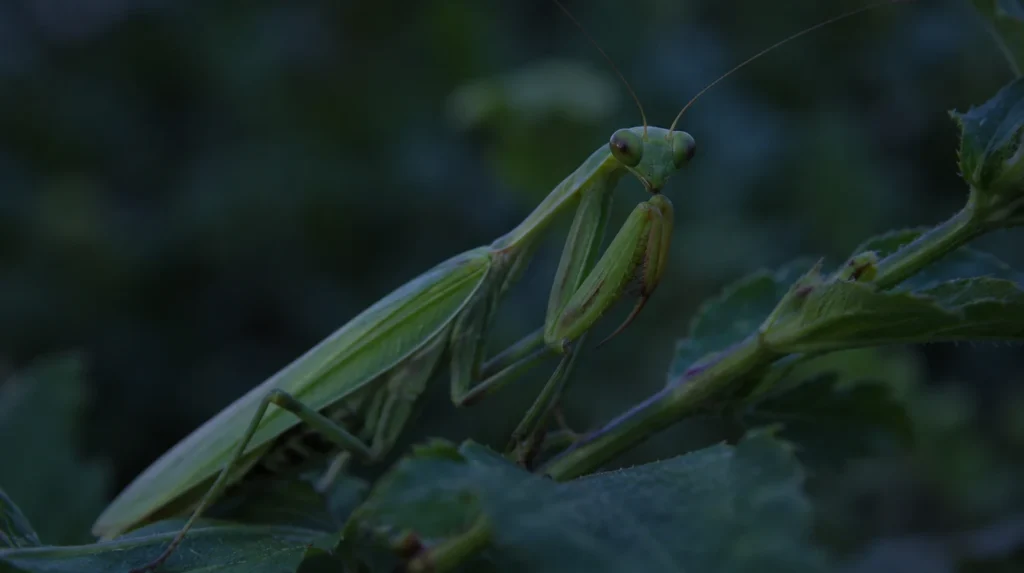
Praying mantises do rest, and they follow clear daily rhythms. Whether that rest counts as true sleep is a different question, and researchers have not yet tested it directly in mantises. Sleep-like states have been well documented in other insects, so something similar in mantises is plausible. Even so, a motionless mantis is not necessarily asleep. Stillness is also how a mantis hunts, how it prepares to molt, and how it copes with cool weather.
What “sleep” means for an insect
Insects have no eyelids, so a mantis cannot close its eyes. Scientists therefore cannot rely on the visual signs we use for mammals. Instead, they look at behavior.
In insects, sleep is generally recognized as a period of inactivity during which the animal responds less to its surroundings. A second sign is that the animal makes up for lost rest after being kept awake, which is often called rebound sleep. The fruit fly is by far the best-studied example. In fruit flies, sleep is shaped by two forces: a built-in “sleep pressure” that grows while the animal is awake, and an internal daily clock. Sleep-like states have also been described in other insects, including honeybees and cockroaches.
These tests take careful laboratory work: measuring how strong a disturbance it takes to rouse the animal, and whether lost rest is recovered later. No such study has been carried out on mantises. The honest answer is that mantises clearly rest, but scientists have not confirmed that this rest meets the full definition of sleep.
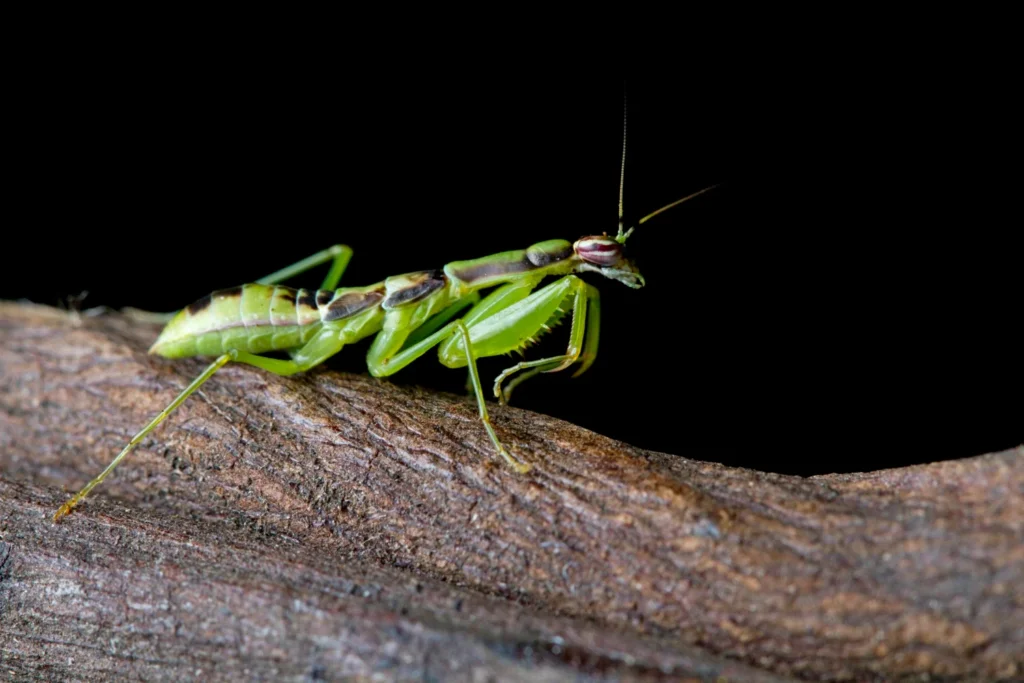
What research shows about mantis daily rhythms
What we do know comes from a laboratory study of Hierodula patellifera, an Asian mantis species, kept on a regular cycle of light and darkness.
Its daily activity was not spread evenly. Movement increased toward the end of the light period and peaked just after the lights went off. That burst lasted about an hour. For the rest of the dark period, the mantises moved very little. The pattern fits the idea of a settled, low-activity phase at night.
That quiet phase was not the same as being “switched off,” however. Under constant light, the mantises’ eyes became more sensitive during the hours that would normally have been night. They also struck at prey-like targets more often at night than during the day. Because these differences appeared even when the lighting did not change, the researchers concluded that an internal clock was driving them.
This is one species, studied with small numbers of animals in captivity, so it should not be treated as a rule for all mantises. It does show that mantis behavior runs on a daily cycle, and that low movement at night can coexist with a nervous system that stays ready to respond.
Why a mantis’s eyes look darker at night
Many people notice that a mantis’s eyes turn dark brown or nearly black at night. This can look like a sign of sleep, but it has a different explanation.
In the same Hierodula patellifera study, the eyes darkened when the lights went off and were darkest about two and a half hours later. They then gradually lightened again and returned to their daytime color shortly before the lights came back on. The researchers linked this to the movement of pigment inside the compound eye, timed partly by the mantis’s internal clock. It helps the eye work in dim light. It is a change in how the eye handles light, not a closing of the eyes.
Are praying mantises nocturnal?
Mantises are mainly visual hunters, and in gardens they are most often noticed in daylight. Night is not simply downtime for every mantis, though, and behavior differs by species, sex, and life stage.
- Adult females can be active at night in other ways. In a study of two European species, the European mantis (Mantis religiosa) and Empusa pennata, adult females bent their abdomens into a “calling” posture through the dark period. This is thought to release a scent that attracts males. Males stayed still when there was no calling female, but walked when they could smell one.
- In some species, adult males fly at night. Mantises collected at lights after dark are mostly males. Research on the African species Parasphendale agrionina found that flying males respond to bat-like ultrasound with sudden turns and dives that help them escape. This only makes sense for an insect that is regularly flying in the dark.
A single word like “diurnal” or “nocturnal” does not fit all mantises. Many spend much of the night quietly, while some adults use darkness for mate finding.
Why a mantis may stay still for a long time
If you see a mantis that has not moved for hours, sleep is only one possible explanation. Several ordinary reasons are more common:
It is hunting. Most mantises are ambush predators. They wait without moving until prey comes within reach. A mantis that looks idle may be fully alert. You can read more about this in our guide to how praying mantises hunt.
It is getting ready to molt. Nymphs grow by shedding their skin. Before a molt, a nymph often stops eating and becomes very still, and it usually hangs upside down to shed. Molting is a vulnerable time, so a mantis in this state is best left undisturbed. Our praying mantis life cycle guide explains how nymphs develop into adults.
It is cold. Like other insects, mantises depend on outside temperatures for warmth. On a cool morning or evening, a mantis may move slowly or barely at all until it warms up.
It is late in the season. In regions with cold winters, mantises survive the winter as eggs inside their egg cases, and there is typically one generation per year. A sluggish adult in late autumn is nearing the end of its season, not preparing for a long winter sleep.
Is a still mantis something to worry about?
In the wild, usually not. A mantis holding its normal posture on a plant is most likely resting, waiting for prey, warming up, or preparing to molt. The kindest approach is to observe it without picking it up or moving it.
For captive mantises, normal resting and genuine health problems can look similar to an inexperienced eye, and needs vary widely between species. Care guidance specific to the species you keep will be more reliable than any general rule.
Frequently asked questions
Do praying mantises close their eyes when they sleep?
No. Mantises have no eyelids, so their eyes stay open. Darker-looking eyes at night come from changes inside the eye that help it work in dim light.
Do praying mantises sleep at night or during the day?
In the one species studied closely in the lab, activity dropped off for most of the dark period after a short burst at dusk. Night is not inactive for every mantis, though, since adult females of some species signal to males at night and adult males of some species fly after dark.
Do praying mantises hibernate?
Not as adults in cold-winter regions. The winter is passed in the egg stage, inside the egg case.
To explore other everyday mantis behaviors, visit our Mantis Behavior hub.
References
- Helfrich-Förster, C. (2018). Sleep in insects. Annual Review of Entomology, 63, 69–86. doi:10.1146/annurev-ento-020117-043201
- Schirmer, A. E., Prete, F. R., Mantes, E. S., Urdiales, A. F., & Bogue, W. (2014). Circadian rhythms affect electroretinogram, compound eye color, striking behavior and locomotion of the praying mantis Hierodula patellifera. Journal of Experimental Biology, 217(21), 3853–3861. doi:10.1242/jeb.102947
- Gemeno, C., Claramunt, J., & Dasca, J. (2005). Nocturnal calling behavior in mantids. Journal of Insect Behavior, 18(3), 389–403. doi:10.1007/s10905-005-3698-y
- Yager, D. D., May, M. L., & Fenton, M. B. (1990). Ultrasound-triggered, flight-gated evasive maneuvers in the praying mantis Parasphendale agrionina. I. Free flight. Journal of Experimental Biology, 152, 17–39.
- Cloyd, R. A. (2021). Praying Mantids (MF3593). Kansas State University Agricultural Experiment Station and Cooperative Extension Service.