
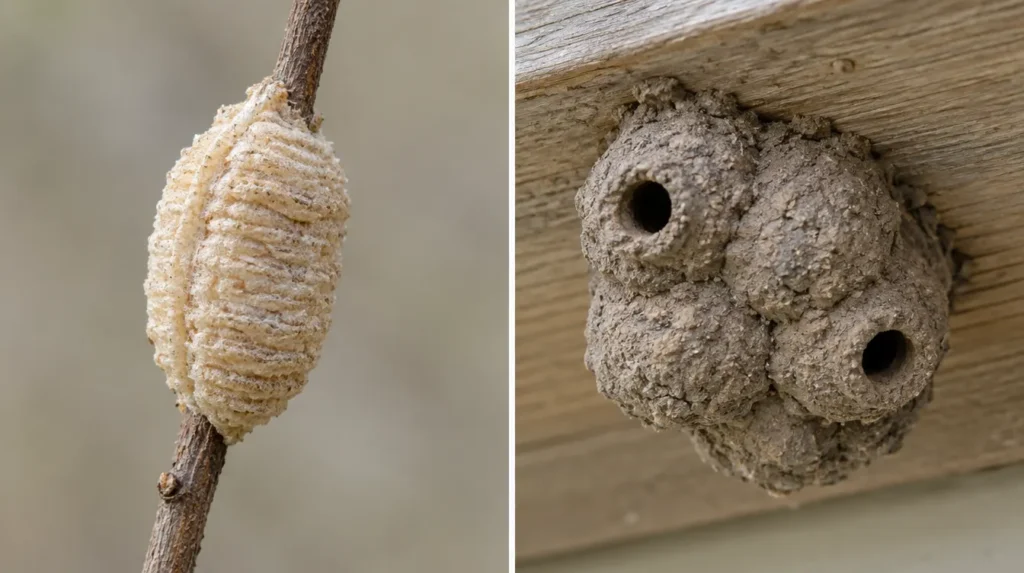
A praying mantis egg case and a mud dauber nest can both look like a small brown lump stuck to a wall. They are made of completely different materials, though, and that is usually the fastest way to tell them apart.
A mantis egg case (an ootheca) is a single capsule made of hardened foam. It feels light and slightly spongy-firm, a bit like packing foam or foam insulation. A mud dauber nest is built from dried mud. It looks earthy and gritty, and it is made of several cells or tubes, often with round holes where adult wasps have chewed their way out.
If you remember only one clue, make it this one: foam means mantis, mud means wasp.
Quick comparison
| Clue | Praying mantis egg case | Mud dauber nest |
|---|---|---|
| Material | Hardened foam, Styrofoam-like | Dried mud |
| Color | Usually light brown to tan | The color of local soil: gray, brown, or reddish |
| Structure | One compact capsule | Several cells clustered together, or long tubes side by side |
| Size | Roughly ½ to 1½ inches, depending on species | From lemon- or fist-sized lumps to tubes several inches long |
| Holes | Usually none; tiny pinholes can mean parasitic wasps | Round exit holes large enough for an adult wasp |
| Inside | Mantis eggs embedded in foam | Cells with paralyzed spiders, wasp larvae, or cocoons |
These are general patterns from North American species. Shapes and sizes vary by species and region, so use several clues together rather than relying on one.
Why the two get confused
Both structures turn up in the same kinds of places. Kansas State University lists branches, plant stems, walls, fences, posts, house siding, and eaves as common sites for mantis egg cases. Mud daubers also favor sheltered spots such as eaves, garages, barns, and covered areas on buildings.
Season doesn’t separate them either. Mantis egg cases are often noticed in fall and winter, because mantises overwinter as eggs inside the case. Many mud daubers also spend the winter as immature wasps sealed inside their nest cells. Finding a brown lump in winter doesn’t tell you which one you have.
What a praying mantis egg case looks like
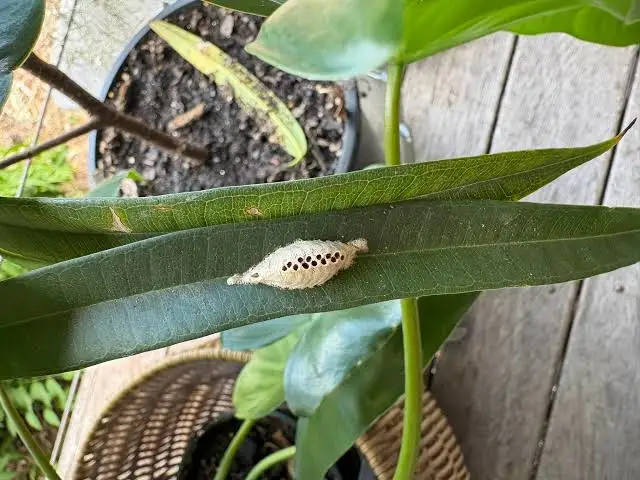
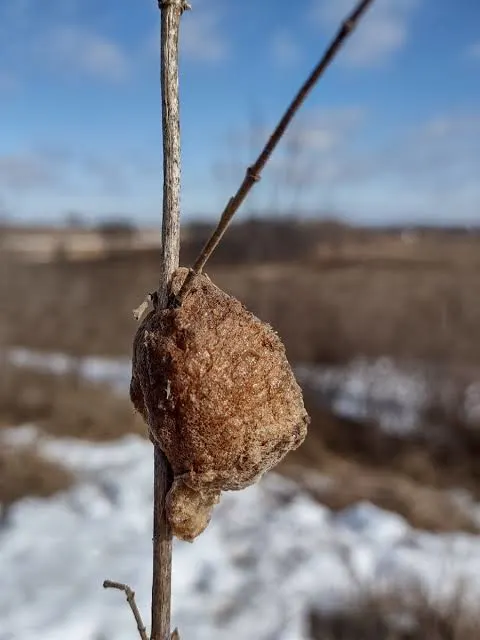
A female mantis covers her eggs in a frothy material that hardens into a protective, foam-like case. Extension writers often compare the result to expanding foam insulation. The surface is fairly uniform and has a slightly layered look. It does not look like crumbly soil.
Shapes depend on the species. In North America, two common examples are:
- Chinese mantis (Tenodera sinensis): a light brown case about an inch or more long, half-domed, with one end tapered. Females attach these to twigs, stems, fences, and building sides.
- Carolina mantis (Stagmomantis carolina): a smaller case, usually under an inch, that is elongated and rounded at both ends with a pale white-to-gray band down the middle. These are often found on flat vertical surfaces.
One case can produce dozens to a couple of hundred nymphs in spring. For more on how cases form, hatch, and survive winter, see our praying mantis egg case guide.
What a mud dauber nest looks like
Mud daubers are solitary wasps. Females carry balls of mud to a sheltered surface and build cells. Each cell is stocked with paralyzed spiders, given a single egg, and then sealed. In North America you are most likely to see three nest styles:
- Black-and-yellow mud dauber (Sceliphron caementarium): a clustered lump of side-by-side or stacked cells, often about the size of a lemon or a fist. A nest may hold up to about 25 cells.
- Organ pipe mud dauber (Trypoxylon politum): long vertical tubes laid side by side, like the pipes of an organ. The tubes can reach six inches or more and are usually built on smooth vertical surfaces.
- Blue mud dauber (Chalybion californicum): this wasp often reworks old nests built by other mud daubers. The result looks irregular and patchy, with old exit holes plastered over.
Because the nest is built from whatever mud is nearby, its color matches the local soil. Up close, the surface looks grainy and slightly uneven, sometimes with visible ridges where each mud load was added.
Five clues that settle most cases
1. Material and texture. This is the strongest clue. Mud looks and feels like dried earth and can crumble at the edges. A mantis case looks like solid foam and has a more uniform surface. You can usually judge this by eye; there is no need to press hard or break anything.
2. One unit or many. A mantis egg case is one compact capsule. A mud dauber nest is a set of cells or tubes joined together. If you can make out separate chambers or parallel tubes, you are almost certainly looking at a wasp nest.
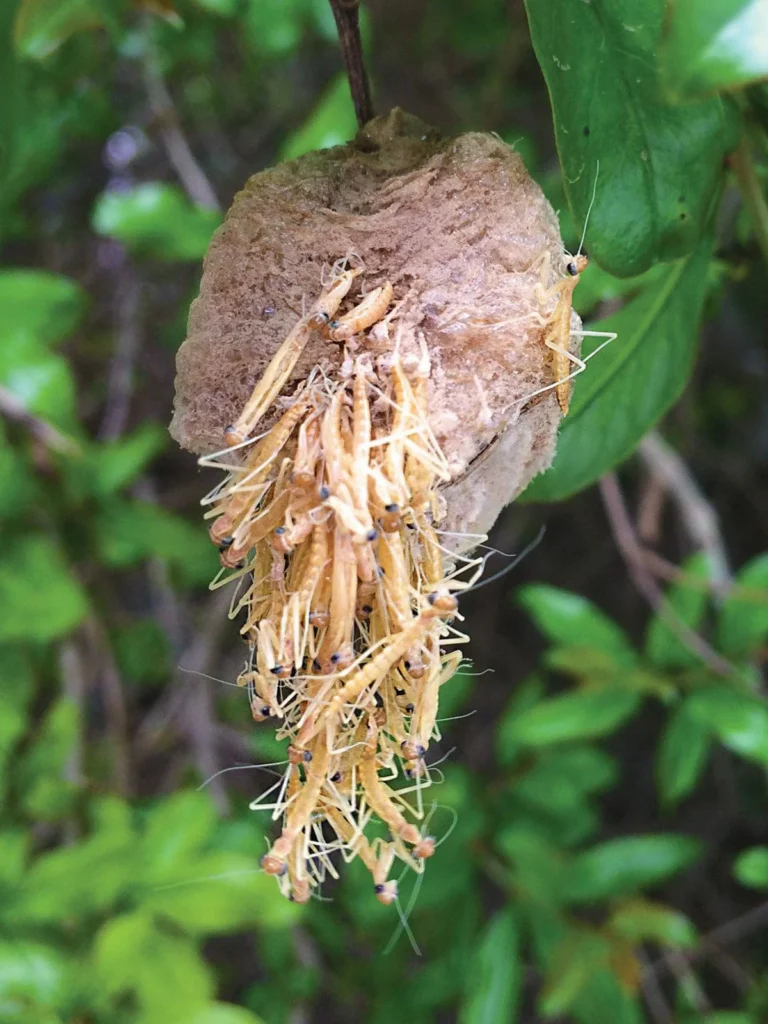
3. Holes. When a mud dauber finishes developing, it chews a hole through the wall of its cell to get out. Old nests often show several round holes, each large enough for an adult wasp. A mantis case usually has no large round holes. If you see very small, scattered pinholes on a foam case, tiny parasitic wasps have probably developed inside some of the mantis eggs.
4. Exact placement. Both can appear on walls and under eaves. Mantis cases, however, are also very common on twigs, plant stems, and shrub branches. Mud dauber nests are usually built where they stay dry, such as under overhangs, inside sheds and garages, or on the undersides of ledges. A brown lump wrapped around a garden stem leans toward mantis. A lump tucked high under a roof overhang could be either, so check the material.
5. What’s inside, if it is already broken. Don’t break open an intact structure to check. If a piece has already broken off, though, the contents are a clear giveaway. Mud dauber cells contain paralyzed spiders, wasp larvae, or thin reddish-brown cocoons. A mantis case holds small eggs set in foam.
Other mud structures you might find
Not every small mud structure is a mud dauber’s tube or lump. Some wasps build small vase- or jug-shaped mud nests on plant stems, and some simply plaster mud into existing cracks. These are wasp nests too, not mantis egg cases. The material test still applies: if it is mud, it isn’t a mantis case.
What to do with the one you found
If it’s a mantis egg case, the best option is usually to leave it where it is. The case is built to protect the eggs through winter, and the nymphs disperse on their own in spring. If it truly has to come off a door, gate, or something you need to use, read whether you can move a praying mantis egg case before relocating it. Avoid bringing a case indoors. Warm temperatures can trigger hatching weeks early, when there is nothing for the nymphs to eat.
If it’s a mud dauber nest, there is usually no cause for alarm. Mud daubers are solitary and do not defend their nests the way paper wasps or yellowjackets do. Females can sting but rarely do unless they are handled or pressed against skin, and males have no stinger. Extension services generally treat mud daubers as a nuisance rather than a pest. Many people leave the nests alone. If a nest is somewhere it causes real problems, your local extension office can advise on removal.
If you still aren’t sure
Take a clear, close photo with a coin or ruler beside the structure for scale. Note where you found it (a plant stem, a wall, or under an overhang) and roughly where you live. Your local extension office can usually identify it from that information. You can also compare it with other mantis features in our mantis identification guides.
References
- Cloyd, R. A. Praying Mantids (MF3593). Kansas State University Research and Extension, 2021.
- Allsup, K. “Fall finds: praying mantis egg cases.” University of Illinois Extension, Flowers, Fruits, and Frass, 2020.
- Clemson Cooperative Extension, Home & Garden Information Center. “Mud Daubers.”
- Missouri Department of Conservation. “Mud Daubers.” Field Guide.
- Layton, B. “Organ Pipe Mud Dauber.” Mississippi State University Extension, Bug’s Eye View, Vol. 6, No. 20.
- Powell, E., and Taylor, L. “Black and Yellow Mud Dauber, Sceliphron caementarium.” UF/IFAS Featured Creatures, EENY-654.